This one-to-one physics lecture focuses on collision in one dimension (1D) and explains how to calculate final velocities after collision using clear, step-by-step methods. This video is specially designed for intermediate (FSc), college, and university-level students, who want to understand collision mechanics through numerical problem solving and concept-based learning.
In this lecture, we start with the basics of collision, including elastic collision, inelastic collision, and perfectly inelastic collision. You will learn the difference between these types of collisions, their real-life examples, and how to identify them in numerical problems. The session explains the core physics concept of conservation of momentum and its application in one-dimensional collisions. You will learn how momentum is conserved in an isolated system and how to use the conservation laws correctly to solve problems.
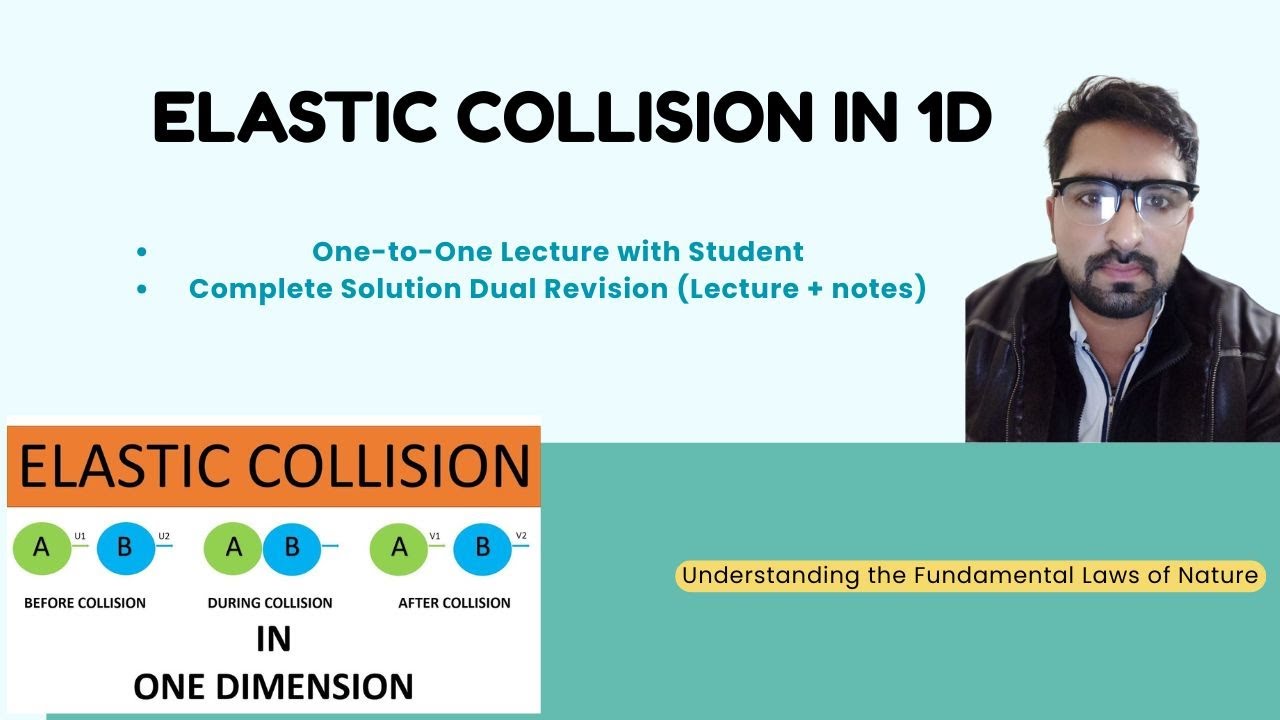
The main focus of the lecture is on calculating final velocities after collision in one dimension. We cover the general formulas for elastic collision, where both momentum and kinetic energy are conserved. You will learn how to derive the equations for final velocities of two colliding bodies and apply them to solve multiple numerical examples. For inelastic collisions, the lecture shows how to calculate the final velocity of the combined mass using momentum conservation only. The concept of the coefficient of restitution is also introduced and used in problems involving partially elastic collisions.
This one-to-one session includes multiple solved numerical problems based on real exam patterns and board exam questions. Students will be guided step-by-step to understand how to set up equations, choose the correct variables, apply the conservation laws, and calculate final velocities accurately. The lecture also highlights common mistakes students make in collision problems, such as wrong sign conventions, incorrect momentum calculations, and misuse of energy conservation.
The teaching approach is interactive and personalized, making it ideal for students who need concept clarity and exam-oriented problem-solving skills. Whether you are preparing for board exams, entry tests, engineering admission tests, or university physics, this lecture will help you master collision in one dimension and build confidence in solving complex problems.
📌 Topics Covered in This Video:
• Collision in one dimension (1D)
• Conservation of momentum
• Elastic collision
• Inelastic collision
• Perfectly inelastic collision
• Coefficient of restitution
• Final velocities after collision
• Numerical problems and examples
• Exam tips and common mistakes
🎯 Who Should Watch This Video?
• FSc / Intermediate students
• College and university physics students
• Students preparing for entry tests and engineering exams
• Students looking for one-to-one physics tutoring
• Self-learners who want strong conceptual understanding
🔍 SEO Keywords Included:
collision in one dimension, 1D collision physics, final velocity after collision, elastic collision formula, inelastic collision, conservation of momentum, coefficient of restitution, one-dimensional collision problems, physics numericals, physics tutoring, online physics tutor, inter level physics, FSc physics lecture, engineering physics, collision and momentum, one-to-one physics class

Информация по комментариям в разработке