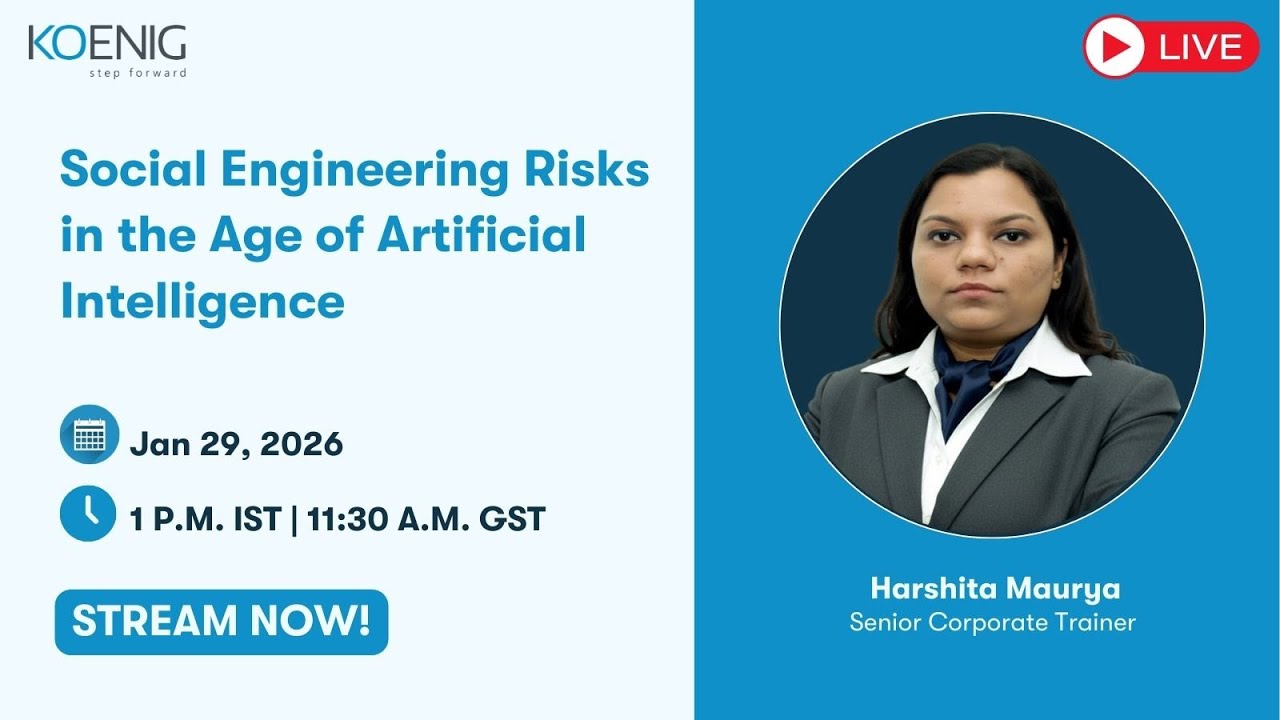
🔴 Social Engineering Risks in the Age of Artificial Intelligence
(How AI Supercharges Deception — and How to Defend Against It)
📅 January 29 · 1 PM IST – Set Reminder ▶️
As AI becomes more powerful, scalable, and accessible, cyber attackers are evolving at a frightening pace. What once took time and technical skill can now be automated, personalized, and executed with machine-level precision. From deepfake identities to AI-written phishing messages that mirror real communication styles, social engineering has entered a new era — one where traditional awareness is no longer enough.
This session provides a clear, practical breakdown of how AI is transforming social engineering attacks, revealing the techniques, psychological triggers, and real-world deception campaigns that today’s threat actors are deploying. Participants will learn not only how these attacks work, but why people fall for them — and what organizations must do differently to stay secure.
Led by Harshita Maurya, Senior Corporate Trainer, this session is designed for both technical and non-technical participants who want to strengthen human-centric defenses in an AI-driven threat landscape.
🔍 What you’ll learn:
1. How AI Is Transforming Social Engineering
Deepfake videos and AI-generated identities used for impersonation.
Voice cloning for fraudulent calls and verification bypass.
Mass personalization of phishing and scams at unprecedented scale.
2. Understanding Modern AI-Driven Attack Techniques
Real-world examples of AI-powered deception campaigns.
How attackers gather data, mimic behavior, and craft believable messages.
Automation tools that enable social engineering at speed.
3. Psychological Triggers Exploited by AI Systems
Authority, urgency, familiarity — and how AI amplifies them.
Why personalized AI-generated messages drastically increase success.
Human cognitive biases that attackers repeatedly target.
4. Why Traditional Awareness Isn’t Enough Anymore
Limitations of outdated training and static warning checklists.
How AI bypasses filters, monitoring tools, and employee intuition.
The shift from reactive security to continuous human risk management.
5. Practical Defense Strategies
Recognizing subtle red flags in AI-assisted deception.
Improving verification processes for calls, emails, payments, and identity checks.
Strengthening organizational resilience through layered human-centric controls.
6. Building a Modern Social Engineering Awareness Framework
Training teams to detect AI-generated cues and behavioral anomalies.
Policies and playbooks for incident response involving deepfakes or voice clones.
Tools and best practices that empower employees — not overwhelm them.
7. Real-World Scenarios & Lessons Learned
Deepfake CEO scams, fraudulent approvals, and spear-phishing case studies.
How organizations were breached — and how they recovered.
Key takeaways that apply across sectors.
8. Live Q&A and Applied Guidance
Addressing participant questions on AI risks, user behavior, and security controls.
Tailored advice for cybersecurity, IT, leadership, and awareness teams.
🎯 Who should attend?
Cybersecurity professionals
IT and security operations teams
Risk managers and compliance leaders
Business leaders responsible for approvals and decision-making
Anyone involved in security awareness, training, or fraud prevention
Speaker:
Harshita Maurya
Senior Corporate Trainer | Koenig Solutions Pvt. Ltd.
📢 Follow & Learn More:
🔗 Koenig Solutions: https://www.koenig-solutions.com
🔗 LinkedIn: / koenig-solutions
🔗 Facebook: / koenigsolutions
🔗 Instagram: / koenigsolutions
🔗 Twitter (X): https://x.com/KoenigSolutions
🔗 Upcoming Webinars: https://www.koenig-solutions.com/upco...
🧠 In a world where AI can imitate anyone and anything, awareness must evolve. This session will prepare you — and your organization — to stay alert and defend smarter.
👍 Like | 💬 Comment | 🔔 Subscribe for more expert-led cybersecurity and AI risk sessions.
#KoenigWebinars #KoenigSolutions #StepForward #AIThreats #SocialEngineering #CyberSecurityAwareness #AITechRisks #Deepfakes #PhishingDefense

Информация по комментариям в разработке