GREEK THEATER OF SIRACUSA
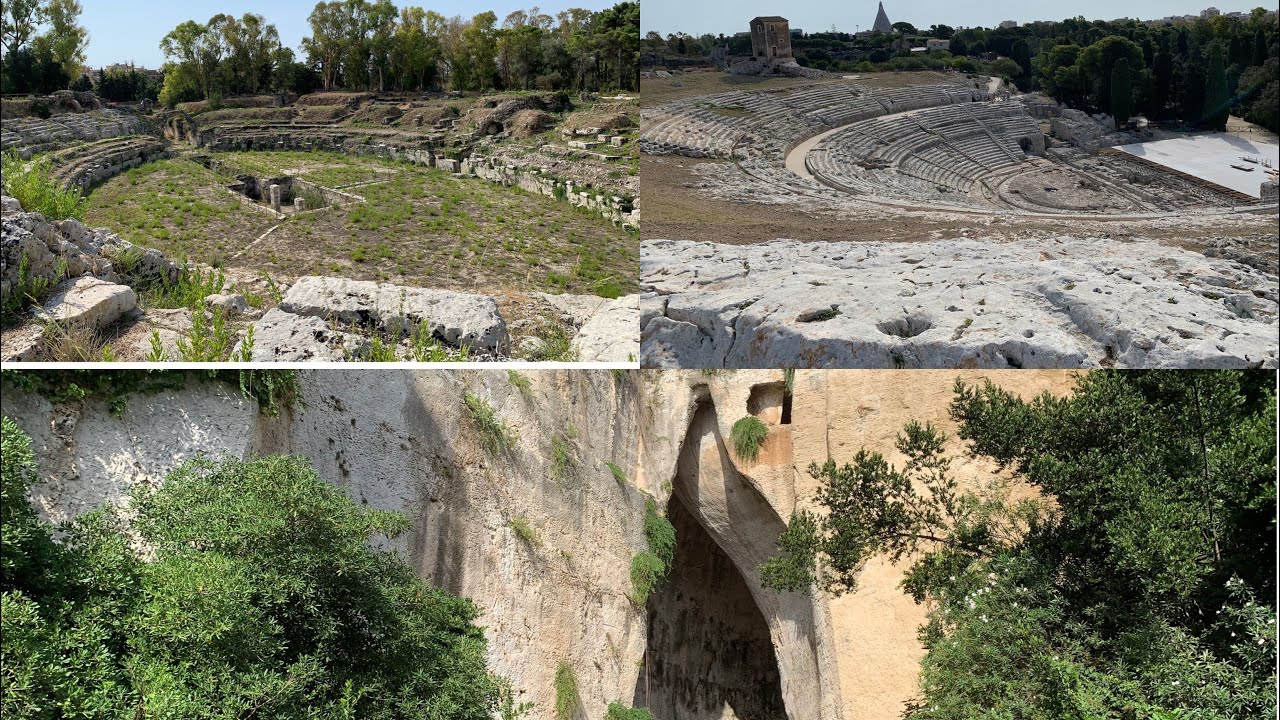
The Greek Theater of Syracuse is today the most famous monument in the city, but even in ancient times it had great international fame and prestige, being the most important building for performances in the Greek-Western world, a very high example of civil architecture. It was also a place of worship and of great popular assemblies, seat of public trials and, in Roman times, it was also adapted to circus and variety performances.
Almost forgotten in the Middle Ages, in the following centuries the theater was subjected to transformations, plundering, damage and removals that today only leave visible its gigantic footprint carved into the rock that fascinated travelers and artists from the 1700s to the mid 1800s. year hundreds of thousands of visitors who want to admire its majesty or who want to attend the classic theatrical performances that take place there between spring and summer.
Archaeologists have been studying it since the 1800s, but the theater continues to be a fertile place for research and studies for archaeological science. Its history begins in the Archaic period: the base of a temple discovered on the terrace overlooking the theater from the north dates back to the end of the 6th century BC. C .. In the third century BC the theater adapts to the architectural principles of the Greek-oriental world, wisely exploiting the conformation of the Temenite hill where it is located and perfectly combining architectural values with those of the landscape. Giuseppe Voza, one of the great contemporary archaeologists who dedicated so much of his activity to the theater, claims that it demonstrates how it was Syracuse that transmitted the principles of Hellenistic architecture to the Roman world.
The Ear of Dionysus
It is certainly the most unique for both its name and its shape.
In fact, it is 23 meters high and up to 11 meters wide, while its depth extends for almost 65 meters, drawing an S-shape that tightens inwards. The name was given to it by Caravaggio, who visiting it in 1586 and certainly inspired by the clear shape of the ear canal of the human ear, gave it the name of "ear" associating it with the tyrant of Syracuse Dionysius.
Legend has it that the tyrant of Syracuse used to imprison his enemies inside this cave. He overheard their discussions, thanks to the powerful resonance that occurs inside and to a small slot where Dionysius is presumed to rest his ear so that he could always be one step ahead of his enemies. Thanks to its strategic position and the strong echo it generates, some historians theorize that it could be used during the classical representations of the Greek theater by a choir that, singing inside with the voice coming out behind the audience, bewitched it because it was impossible. understand who and where was singing.
The Roman Amphitheater in Syracuse...
The amphitheater of Syracuse was constructed during the Roman period, most likely during the reign of Nero, but it took the form we see today only in the 3rd or 4rd century A.D. It is it he largest in Sicily, measuring 140 by 119 meters/ 460 by 390 feet, and one of the largest in Italy, being only slightly smaller than the Arena of Verona.
The structure was used for gladiatorial and animal fights, while the nearby theater was reserved for proper theatrical presentations.
Today, only the portion of the amphitheater carved into the rock remains, while all that was built of stone blocks was dismantled by the Spanish in the 16th century to build fortifications of the island of Ortigia. The centuries have also carved themselves into the rock, as it now shows veins running diagonally across the rows of seats. Because of the bad quality of its original stone, the amphitheater was entirely recovered with stone blocks, and these were also dismantled by the Spanish. At the center of the arena, a rectangular excavation (originally covered in ancient times) contained equipment used for performances.
Despite its ruinous state, the building retains an aura of majesty and grandeur by virtue of its size. Within the Roman Amphitheater of Syracuse, visitors can only walk along the top ring (with the exception of the stairs and the arena); in compensation, the route is facilitated by a convenient flat road, which runs from one end of the structure to the other.
Surrounding the amphitheater and on the access road one can see several ancient sarcophagi, transported here from the necropolis in the area, as well as some remains of houses dating from the Hellenistic period.
Reserve nature Cavagrande del Cassibile 👉 • Riserva naturale Cavagrande del Cassibile/...
#Italy #Sicily #Siracusa
Licence:
You’re free to use this song in any of your videos, but you must include the following in your video description (Copy & Paste):
Song: Fredji - Happy Life (Vlog No Copyright Music)
Music provided by Vlog No Copyright Music.
Video Link: • Fredji - Happy Life (Vlog No Copyright Music)
#NoCopyrightMusic #VlogMusic #VlogNoCopyrightMusic

Информация по комментариям в разработке