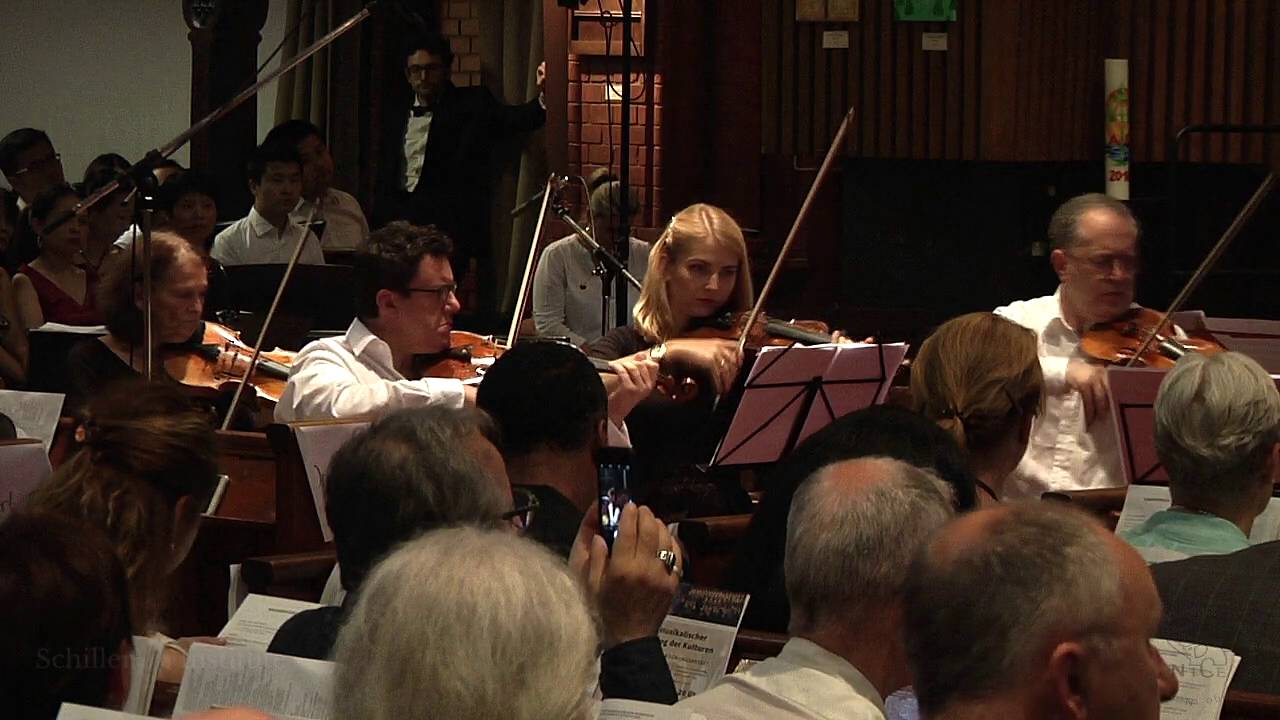
With this concert, we contribute to realizing Giuseppe Verdi’s wish to bring musical tuning back to where it was when the classical composers lived. The standard pitch gradually been raised to the point where it is practically one tone higher today than it was 200 years ago. Had Bach, Scarlatti, Mozart, Beethoven, Verdi and others wanted to have their works played one tone higher, they would have written them that way. In fact, the specific characteristics of the human singing voice and of the human body, as well as the proportions in nature and the universe suggest that there does exist a scientific tuning.
In the 1980s and 1990s, the Schiller Institute launched an international petition to lower the standard pitch from an arbitrary a = 440-450Hz to an a = 432Hz, as called for by Giuseppe Verdi. The petition gathered signatures from thousands of the top classical singers of the day, including Luciano Pavarotti, Joan Sutherland, Renata Tebaldi, Placido Domingo, Mirella Freni, Monserrat Caballé, Kurt Moll, Birgit Nilsson, Carlo Bergonzi and Piero Cappuccilli, just to name a few. Defense of the classical tradition of bel canto singing was at the center of the campaign. As Guiseppe Verdi himself wrote in February 1884, he favored “a single pitch for the entire musical world”, adding that the lower tuning gives the sonority “something more noble, more full and majestic than the shrieks a high pitch could ever give.”
The campaign for Verdi’s “scientific tuning” led to an international music symposium in Casa Verdi/Milan on April 9, 1988, during which the difference between usual tuning of today and the natural Verdi tuning was conclusively demonstrated. It made clear that the principles of music and science cannot be separated, and also that changing the register shifts (passagio) creates a problem not only for the singing voice, but also for musical instruments.
Thus, the optimal resonance of the famous Stradivari violin “Il Cremonese” lies at C = 256Hz (a = 432Hz), as analyzed by the International Institute for Violin making in Cremona. Norbert Brainin, the first violin of the legendary Amadeus String Quartett, who supported the Schiller Institute campaign, demonstrated the contrast between the different concert pitches, including at a concert in Munich’s Max-Joseph-Saal in 1988. Brainin also conducted several master classes with the Schiller Institute in the 1990s on the subject of thorough composition and tuning.
Just recently the Schiller Institute campaign again inspired a number of important initiatives in Italy. In Roncole, Verdi’s birthplace, a yearly festival in the Verdi tuning began last year (www.nuovoverdianeum.it). And the grand-niece of Verdi, Gaia Maschi Verdi, brought her grand-uncle’s piano from the Barezzo House/Bussetto to Teatro Argentina in Rome on June 6, to remain there on exhibition until Dec. 31. This piano (Carol Otto, Berlin) is tuned at a = 432Hz. For more on the subject, see www.teatrodiroma.net/doc/4331/verdi-e-I-italia.

Информация по комментариям в разработке