🔴 Our interactive news map: https://www.rfunews.com/map
🔴 Subscribe to unlock full access to the map + exclusive strategic insights: https://www.rfunews.com/pricing
Today, there is important news from the Russian Federation.
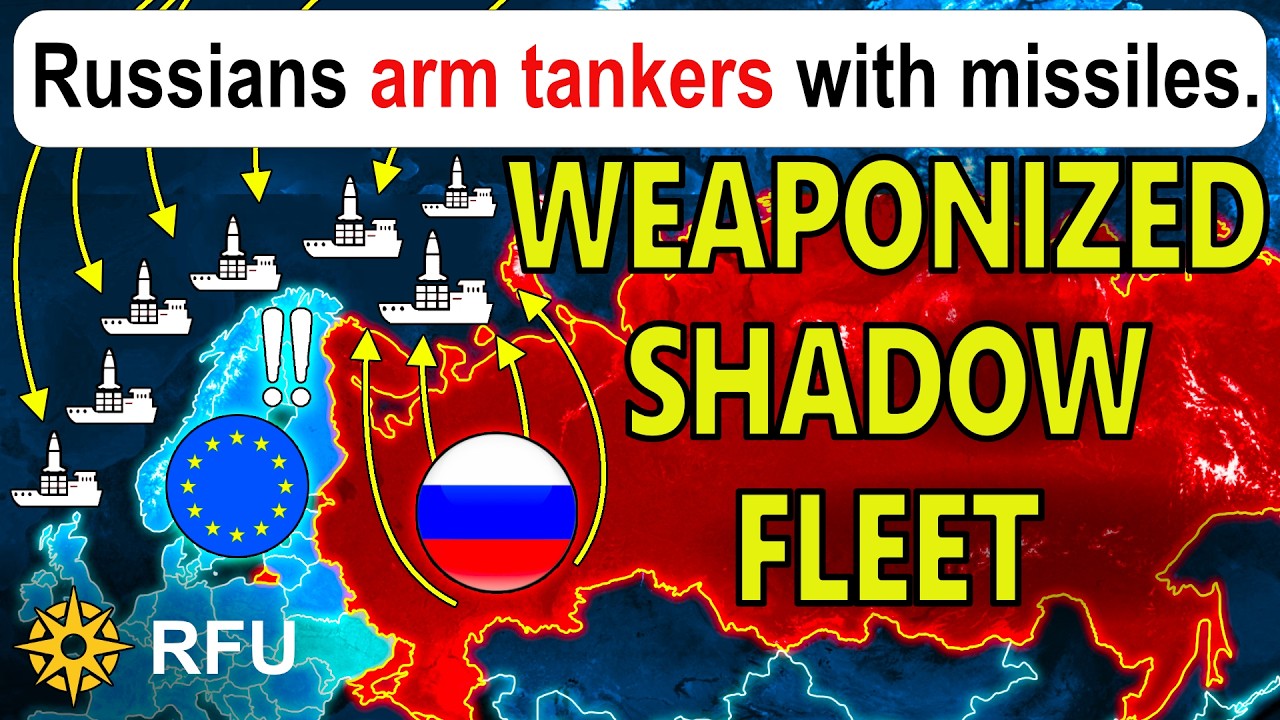
Here, a sharp shift in European enforcement behavior has exposed the fragility of Russia’s sanctions-evasion system. As a result, Russia is increasingly signaling that it will try to militarize its oil tankers with missiles and start deploying naval escorts in a desperate effort to stop the accelerating seizure of its shadow fleet.
Recently, Italy, Germany, and France have acted decisively against Russian-linked vessels, showing little hesitation or political restraint, with the 3 countries intercepting and seizing ships carrying steel and crude oil, on the suspicion of false-flag operations and sanctions evasion. Together, these actions signal a new European posture, with sanctions enforcement at sea no longer cautious or symbolic, but systematic and legally aggressive. For Russia, this means the informal tolerance that allowed its shadow fleet to operate in gray zones is rapidly disappearing.
The stakes are extremely high, as Russian military and economic analysts now openly acknowledge that the collapse of the shadow fleet would threaten economic failure. In 2025, Russia’s state budget relied heavily on oil revenues that moved through these unregulated tankers. Roughly 93 billion US dollars, or about 19 percent of total state revenues, came from oil exports, with the shadow fleet responsible for 40 percent, which equates to 37.2 billion US dollars. These ships allowed Moscow to bypass price caps and sanctions, cushioning the impact of falling global oil prices. If seizures continue, the result would be a sharp revenue shortfall, undermining both Russia’s war financing and its broader fiscal stability.
In response, Moscow has begun experimenting with limited naval escorts, but the effort reveals the Russian navy’s structural weakness. Satellite imagery confirms that the sanctioned vessel Mys Zhelaniya recently delivered military cargo to Libya under the escort of a Russian anti-submarine warship, departing from Kaliningrad and docking in Libya. While this shows Russia can protect individual voyages, it also demonstrates the limits of the approach. Russia lacks enough seaworthy surface combatants to escort tankers continuously. Chronic personnel shortages and uneven crew training reduce operational availability. Many ships are old, maintenance-intensive, and not optimized for long-duration convoy duty. Most importantly, the sheer scale of Russian oil exports, with 656 confirmed shadow fleet vessels under Ukrainian sanctions, far exceeds what any plausible escort force could cover. For comparison, Russia currently has fewer than 100 ships to use as an escort on paper, but in reality, many of them are older with limited range and readiness.
Geography makes the problem worse. Nearly all of Russia’s export capacity is tied to European Russia, not the Pacific. Pipeline networks, storage terminals, blending facilities, rail links, and river routes were historically built to serve Europe, concentrating flows toward Baltic and Black Sea ports. At the same time, Far Eastern ports lack comparable infrastructure and tanker throughput, and as a result, any disruptions in European waters rapidly choke export volumes. This geographic lock-in creates a strategic vulnerability that, even if possible, escorts alone cannot fix, especially when Russian shipping is under constant surveillance and pressure across the Baltic, Black Sea, Arctic, and Mediterranean.
Faced with this reality, Russian analysts increasingly concede that there is no clean counter to Western legal seizures if enforcement continues. As desperation grows, they have begun proposing extreme measures like arming the shadow fleet. Drawing on concepts of other countries like China, they suggest installing radar systems, anti-aircraft guns, and even medium-range surface-to-air missiles inside standard shipping containers. In theory, these combat container ships could be rapidly fitted onto civilian hulls, expanding defensive capacity without building new warships.
Yet even proponents of the idea admit the risks are enormous, as a weaponized tanker would still be no match for Nato naval forces and would blur the line between civilian and military shipping, inviting escalation. As with earlier Russian bluffs, such as deploying submarines that ultimately watched as tankers were boarded, this approach relies more on intimidation than credible force.
Overall, Russia’s interest in weaponizing tankers reflects desperation, not strength, as its maritime oil trade is increasingly exposed, and choking exports from European ports strikes at the core of the Russian state budget. With limited naval capacity, unfavorable geography, and determined Western enforcement, Moscow is running out of viable...

Информация по комментариям в разработке