No olvides suscribirte y comentar.
Not long ago we acquired for the house a plant of the anthurium family, whose flowering is a long rod terminated by an acorn that attracted green bees in large numbers, but at home they believed that it was those green flies that frequent matter in decomposition, so ... they cut the anthurium inflorescence to repel the supposed flies. Luckily they only took away what was attracting them, other people have become more radical and have sprayed the bees.
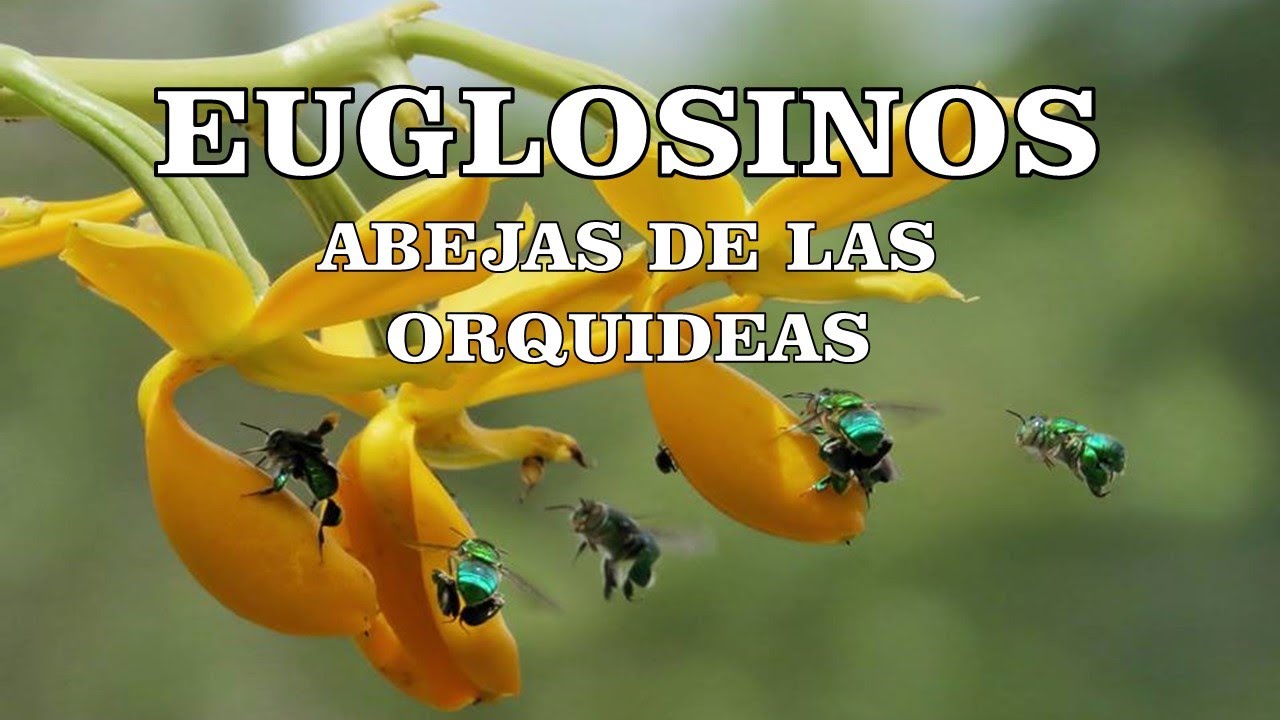
These little green bees are called Euglosinos or are better known as the orchid bees, grouped in a large family that includes more than 200 species.
These bees are distributed from northern Mexico to Argentina.
They are very attractive insects of a shiny metallic color, the green ones are the most common. But you can also see some blue, purple, gold, red and some are black with white and yellow hairs that look a lot like bumblebees.
They are robust bees that can measure from 8 to 30 millimeters, equipped with a very long tongue that sometimes exceeds its own body in extension and from there comes its name Euglossa or true tongue.
The orchid group of bees is made up of five well-defined genera, present only in the neotropical region. Euglosins are related to bumblebees, stingless bees, and honey bees.
Males usually collect aromatic essences from some species of orchids such as Catesetums and Stanhopeas, orchids that do not offer food to their pollinators, nor do they offer pollen, but a strong aroma liquid to which male bees are very attracted. The females for their part if they collect pollen and nectar from other plants.
With brushes that they have on their front legs, they sweep away the aromatic compounds that they then transfer to specially designed receptacles on their rear legs.
It is not very clear yet what males use these aromatic compounds for, but it is believed that these oils are essential for reproduction and are used for sexual attraction, that's right, just like humans. And this is how the plant has developed a special and exclusive bond with these bees.
Despite seeing them in good numbers collecting material from the flowers, these bees do not have a hive and do not form colonies like other types of bees, which is why they have been called solitary bees.
Although they can nest in groups, they never form swarms like honey bees.
Female Euglosinos nest alone and build cells for their young by themselves.
They nest in holes in wood, cavities in walls, bamboo stems, termite nests and sometimes in human constructions.
Recently it has become popular to help them by building shelters for solitary bees by drilling holes in pieces of wood and placing them in gardens.
The female coats the inside of the cells with wax and stores food for her offspring, usually made up of pollen.
So now you know, if you see some green insects flitting around the garden, take a good look, it could be orchid bees.
Don't forget that you can support me by subscribing to this channel and liking the video.
Thank you very much for watching and until next time.
Music provider:
• Essence - NO Copyright
www.audionautix.com
Essence









Информация по комментариям в разработке