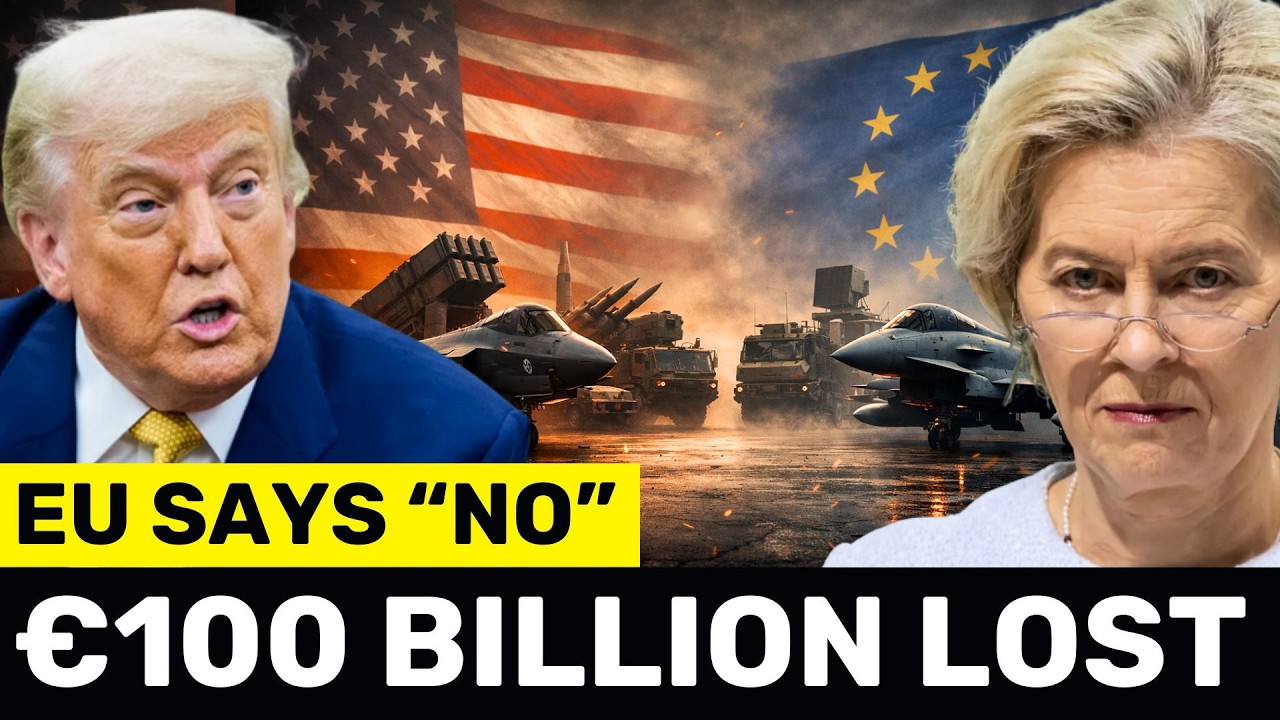
Washington is lobbying European governments to abandon a proposed “Prefer European” defense procurement rule that would prioritize EU-made jets, tanks and missiles over American systems. Publicly, US officials warn that such a policy could fragment NATO and reduce interoperability. Privately, the concern is much more direct: Europe’s defense boom represents one of the largest industrial opportunities in the world, and American firms risk losing their biggest foreign market.
Global defense spending reached $2.63 trillion in 2025, up from $2.48 trillion a year earlier. Europe now accounts for more than 21% of global military spending, compared with roughly 17% in 2022. Inside the EU, defense budgets climbed from about €200B in 2021 to roughly €320B in 2024. European NATO members already spend around 2.16% of GDP on defense and have pledged to move toward roughly 5% of GDP on combined defense and security by the mid-2030s, including about 3.5% for core military capabilities.
Russia’s 2025 defense bill is estimated at about $186B, or 7.3% of GDP, up from 6.7% a year earlier. Even when analysts inflate Russia’s nominal €137B budget using purchasing power parity, Europe now operates in the same weight class, backed by a far larger economic base. Meanwhile, Europe is expanding industrial output, targeting 1,000,000 artillery shells per year by 2025, up from roughly 300,000.
The US has been Europe’s dominant arms supplier. Between 2019 and 2023, the US provided roughly 50% of all major conventional weapons imported by European countries. Between 2022 and mid-2023, about 63% of European arms acquisitions went to US suppliers, though that share fell to roughly 44% in 2022–2024. Lockheed Martin reports that over 28% of its net sales, about $18B, come from international customers, with Europe a major component. Around 600 F-35s have already been ordered by European NATO members, worth more than $100B.
Germany has become the engine of Europe’s rearmament. After announcing a €100B special fund in 2022, its defense spending passed $100B, reaching about $107B in 2025, up from $86B in 2024. Berlin is also rolling out a broader €500B investment package and could push defense spending toward €109B to €119B, around 2.4% of GDP.
If “Prefer European” is implemented by late 2026, US contractors would gradually lose market share over the following 5 years. The shift would not happen overnight, but contract by contract, it would rebalance industrial power, supply chains and political leverage inside NATO.
#China #Europe #Trump
_______________________________________
Interesting videos:
U.S. Demands BRICS Cancel Non-Dollar Trade
• U.S. Demands BRICS Cancel Non-Dollar Trade...
U.S. Lied to China — Now China’s Getting Revenge by Dumping DOLLARS!
• U.S. Lied to China — Now China’s Getting R...
China Just Formed a New $25 Trillion Alliance Bigger than BRICS
• Trump in Shock: China Just Formed a New $2...
$40 Trillion Market GONE? China Cancels Trade in USD!
• $40 Trillion Market GONE? China Cancels Tr...
_______________________________________
Disclaimer: The information presented on this channel should not be interpreted or relied upon as professional advice for any specific fact or circumstance. This channel and its content are meant for entertainment and informational purposes only. The content provided offers a general overview of a topic and is not a replacement for professional services. Always seek the guidance of a finance or legal professional who can address your specific situation. The opinions expressed are solely my own, and only publicly available information has been used.
















Информация по комментариям в разработке