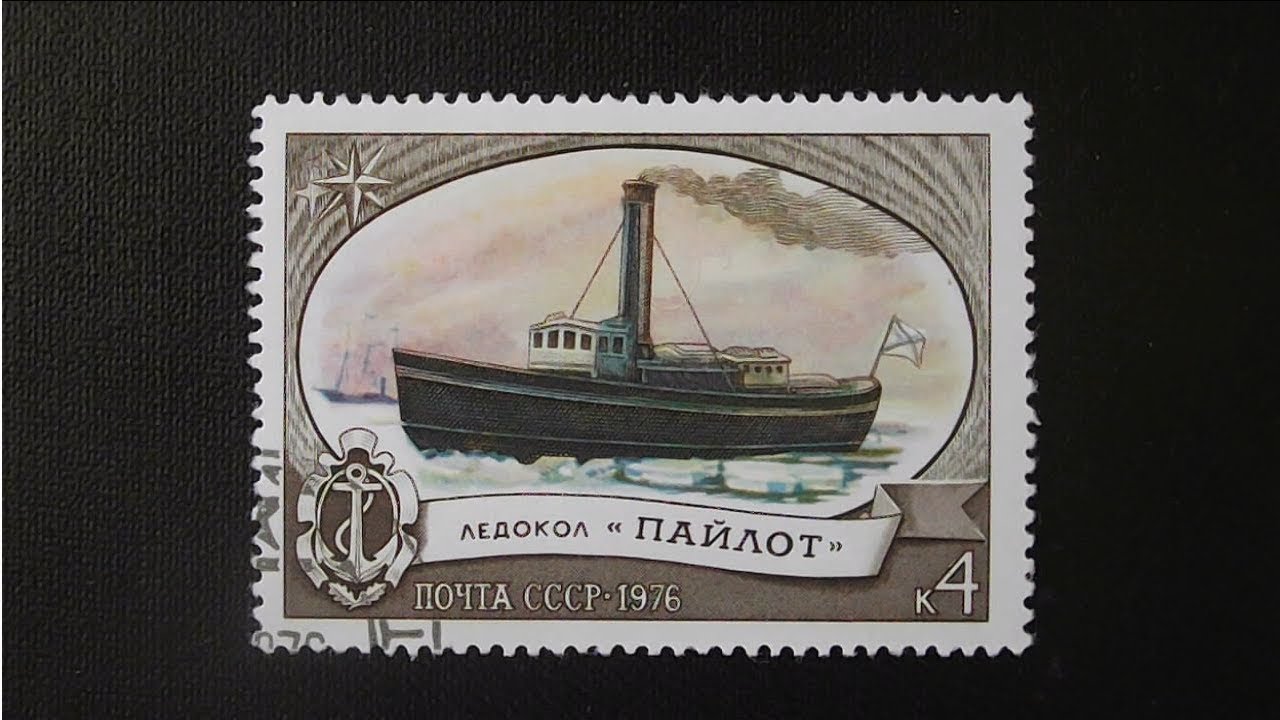
Russian philatelic series 1976-77 with icebreakers.
Beautiful stamps. An icebreaker is a special-purpose ship or boat designed to move and navigate through ice-covered waters, and provide safe waterways for other boats and ships. Although the term usually refers to ice-breaking ships, it may also refer to smaller vessels, such as the icebreaking boats that were once used on the canals of the United Kingdom.
For a ship to be considered an icebreaker, it requires three traits most normal ships lack: a strengthened hull, an ice-clearing shape, and the power to push through sea ice.[1]
Icebreakers clear paths by pushing straight into ice pockets. The bending strength of sea ice is so low that usually the ice breaks without noticeable change in the vessel's trim. In cases of very thick ice, an icebreaker can drive its bow onto the ice to break it under the weight of the ship. Because a buildup of broken ice in front of a ship can slow it down much more than the breaking of the ice itself, icebreakers have a specially designed hull to direct the broken ice around or under the vessel. The external components of the ship's propulsion system (propellers, propeller shafts, etc.) are at even greater risk of damage than the vessel's hull, so the ability of an icebreaker to propel itself onto the ice, break it, and clear the debris from its path successfully is essential for its safety. Even in the earliest days of polar exploration, ice-strengthened ships were used. These were originally wooden and based on existing designs, but reinforced, particularly around the waterline with double planking to the hull and strengthening cross members inside the ship. Bands of iron were wrapped around the outside. Sometimes metal sheeting was placed at the bows, stern and along the keel. Such strengthening was designed to help the ship push through ice and also to protect the ship in case it was "nipped" by the ice. Nipping occurs when ice floes around a ship are pushed against the ship, trapping it as if in a vise and causing damage. This vise-like action is caused by the force of winds and tides on ice formations. Although these wind and tidal forces may originate many miles away, the ice acts as a medium for this force.
The first boats to be used in the polar waters were those of the indigenous Arctic people. Their kayaks are small human-powered boats with a covered deck, and one or more cockpits, each seating one paddler who strokes a single or double-bladed paddle. Such boats, of course, have no icebreaking capabilities, but they are light and well fit to carry over the ice.
In the 9th and 10th centuries, the Viking expansion reached the North Atlantic, and eventually Greenland and Svalbard in the Arctic. Vikings, however, operated their ships in the waters that were ice-free for most of the year, in the conditions of the Medieval Warm Period. With its rounded shape and strong metal hull, the Russian Pilot of 1864 was an important predecessor of modern icebreakers with propeller. Built on the orders of merchant and shipbuilder Mikhail Britnev, it had the bow altered to achieve an ice-clearing capability (20° raise from keel line). This allowed Pilot to push herself on the top of the ice and consequently break it. Britnev fashioned the bow of his ship after the shape of old Pomor boats, which had been navigating icy waters of the White Sea and Barents Sea for centuries. Pilot was used between 1864-1890 for navigation in the Gulf of Finland between Kronstadt and Oranienbaum thus extending the summer navigation season by several weeks. Inspired by the success of the Pilot, Mikhail Britnev built a second similar vessel Boy ("Breakage" in Russian) in 1875 and a third Booy ("Buoy" in Russian) in 1889. Stamp beautiful.

Информация по комментариям в разработке