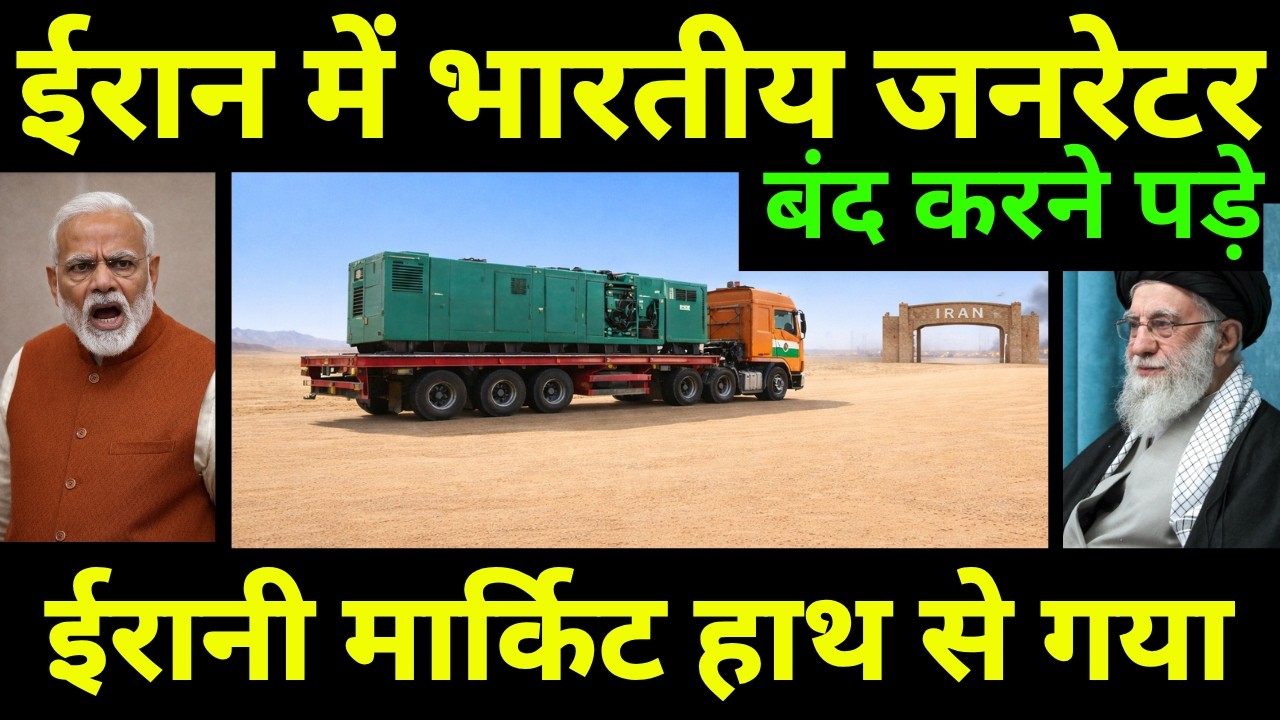
The ongoing geopolitical tensions involving Iran have begun to affect sectors connected with Iran India Trade relations, and the impact is gradually becoming visible on industries that rely on India Export to Iran. Disruptions in logistics and trade routes are influencing exporters who supply machinery and industrial equipment to Iran and nearby Central Asian markets. One sector that could feel this impact strongly is the diesel generator manufacturing industry in India, which has an established presence in the Iran India Export Import ecosystem.
The Iran generator market is estimated to be worth around $600–650 million, and a large portion of this demand is fulfilled through imports because local manufacturing in Iran cannot fully meet the country’s growing need for backup power equipment. Iran imports diesel generators and electrical machinery from several countries, including China, Turkey, and India. Although the share of Made in India export to Iran is still relatively small—generally below 10 percent—Indian brands such as Kirloskar, Ashok Leyland, and Mahindra Powerol have developed recognition among distributors and manufacturers of Iran involved in the power equipment sector.
Industry estimates suggest that India exports roughly 1,500 to 2,500 diesel generators each year to Iran. These machines usually fall within the 75 kVA to 750 kVA range and are widely used in factories, construction sites, telecom towers, hospitals, and commercial establishments. Demand for such equipment rises significantly during the summer season when electricity consumption increases across Iranian cities and industrial regions. This seasonal demand often leads to large orders related to export of machines from India to Iran, typically beginning early in the year.
India’s generator manufacturing sector itself is quite large. The country produces around 150,000 generators annually, and about 15,000–20,000 units are exported to more than 50 countries worldwide. Major buyers include markets in the Middle East and Africa. Countries such as the UAE and Saudi Arabia are among the largest importers of Indian generators, and historically some of the Iran import from Turkey or UAE channels have also included re-exports of Indian-made equipment.
At the same time, the Iranian generator market remains highly competitive. China currently dominates a major portion of Iran import markets for generators, supplying close to 70% of diesel gensets imported into the country. Chinese exporters benefit from strong regional connectivity through Central Asian land routes passing through Kazakhstan, Uzbekistan, and Turkmenistan. These corridors also link with regional supply chains connected to Iran Afghanistan trade, allowing goods to reach Iranian markets through road transportation.
Another major factor behind the growing demand for generators is Iran’s electricity situation. Global energy data shows that nearly 100% of Iran’s population has access to electricity, meaning most urban and rural areas are connected to the national grid. However, electricity shortages still occur frequently. Iran’s peak power demand is estimated to reach around 80,000 MW, while the country’s combined generation capacity from thermal and hydropower plants is closer to 62,000 MW.
During summer, hydropower generation declines while electricity consumption rises due to air-conditioning and industrial demand. Years of economic sanctions have also slowed modernization of the country’s energy infrastructure, which has reduced efficiency and caused occasional grid failures. Because petroleum fuel is relatively inexpensive in Iran, diesel generators are widely used as backup power solutions in homes, businesses, and factories. As a result, the Iranian generator market is expanding at an estimated 7% annual growth rate.
For Indian exporters, Iran represents a potential opportunity in West and Central Asia. Stronger Iran India Trade relations could allow Indian companies in Iran to expand in sectors such as electrical machinery, engineering equipment, and generators. With geographic proximity and competitive manufacturing costs, Indian suppliers could strengthen their presence in this market in the future.
At the same time, the evolving regional situation continues to influence Iran recent news, supply chains, and broader trade flows including Import in India from Iran. The Iranian market remains strategically important for exporters looking to expand Made in India export to Iran, especially in sectors related to machinery, generators, and industrial equipment. As regional trade stabilizes, opportunities for Indian manufacturers in Iran and stronger Iran India Export Import cooperation could grow further.
#indiairanrelations @TrainSome #iran









Информация по комментариям в разработке