Learn how to effectively use switch statements in C for user input of shapes, including creating a lookup table for string literals.
---
This video is based on the question https://stackoverflow.com/q/64629149/ asked by the user 'Tharusha Induwara' ( https://stackoverflow.com/u/12953881/ ) and on the answer https://stackoverflow.com/a/64629412/ provided by the user 'David C. Rankin' ( https://stackoverflow.com/u/3422102/ ) at 'Stack Overflow' website. Thanks to these great users and Stackexchange community for their contributions.
Visit these links for original content and any more details, such as alternate solutions, latest updates/developments on topic, comments, revision history etc. For example, the original title of the Question was: Input strings before switch statement & compare strings in c using switch statement
Also, Content (except music) licensed under CC BY-SA https://meta.stackexchange.com/help/l...
The original Question post is licensed under the 'CC BY-SA 4.0' ( https://creativecommons.org/licenses/... ) license, and the original Answer post is licensed under the 'CC BY-SA 4.0' ( https://creativecommons.org/licenses/... ) license.
If anything seems off to you, please feel free to write me at vlogize [AT] gmail [DOT] com.
---
Handling User Input for Shapes in C Using Switch Statements
When programming in C, it's common to encounter situations where you need to take user input and execute different code based on that input. However, using a standard switch statement with strings can be tricky, as C does not natively support this. In this guide, we'll explore how to effectively handle user input for shapes using a switch statement by creating a lookup table.
The Problem: Input Shapes and Using Switch
As a beginner in C, one of the challenges you might face is how to process string inputs with switch statements. For example, if a user is asked to enter a shape name, you want to evaluate the input and compute the area accordingly. However, a direct approach using strings in a switch will not work, as the switch statement only accepts integer expressions.
Example Scenario
Imagine you prompt the user to input a shape name like "circle", "square", "rectangle", or "triangle". Based on the input, you would then want to execute code that calculates the area of the shape. This is where many beginners run into issues.
The Solution: Using a Lookup Table with Switch
While directly switching on strings is not possible, you can work around this limitation by using a lookup table (an array of string literals) to validate user input, along with an integer index to perform the switch operation.
Step 1: Create a Lookup Table
First, you need an array containing all valid shape names:
[[See Video to Reveal this Text or Code Snippet]]
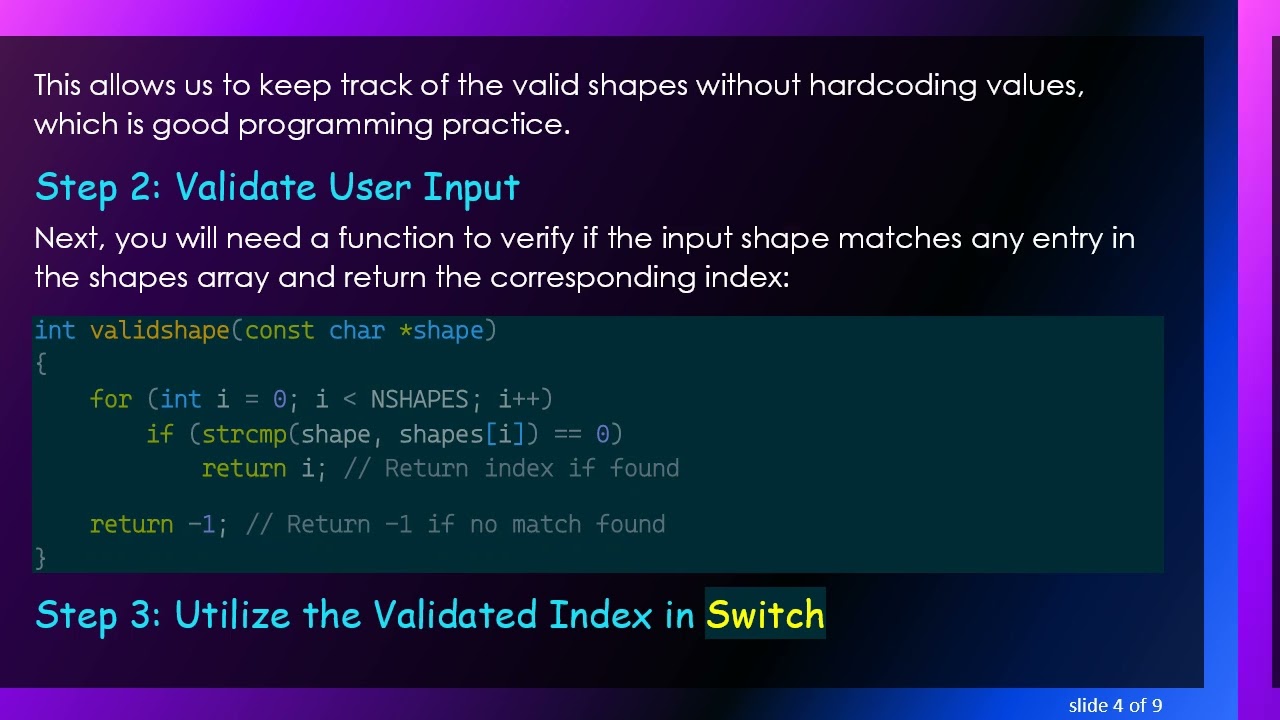
This allows us to keep track of the valid shapes without hardcoding values, which is good programming practice.
Step 2: Validate User Input
Next, you will need a function to verify if the input shape matches any entry in the shapes array and return the corresponding index:
[[See Video to Reveal this Text or Code Snippet]]
Step 3: Utilize the Validated Index in Switch
Now in your main() function, you can use the validated index to perform a switch operation:
[[See Video to Reveal this Text or Code Snippet]]
Step 4: Complete Example
Here is what the complete program might look like, demonstrating the functionality:
[[See Video to Reveal this Text or Code Snippet]]
Conclusion
By using a lookup table to validate user input strings and returning an integer index, you can efficiently handle shape calculations with a switch statement in C. This approach not only resolves the challenge of using strings in a switch statement but also promotes better coding practices by avoiding magic numbers. Happy coding!

Информация по комментариям в разработке