The video cuts out in the last 2 minutes. Here's the remainder of the video:
• Closing for Grade 6
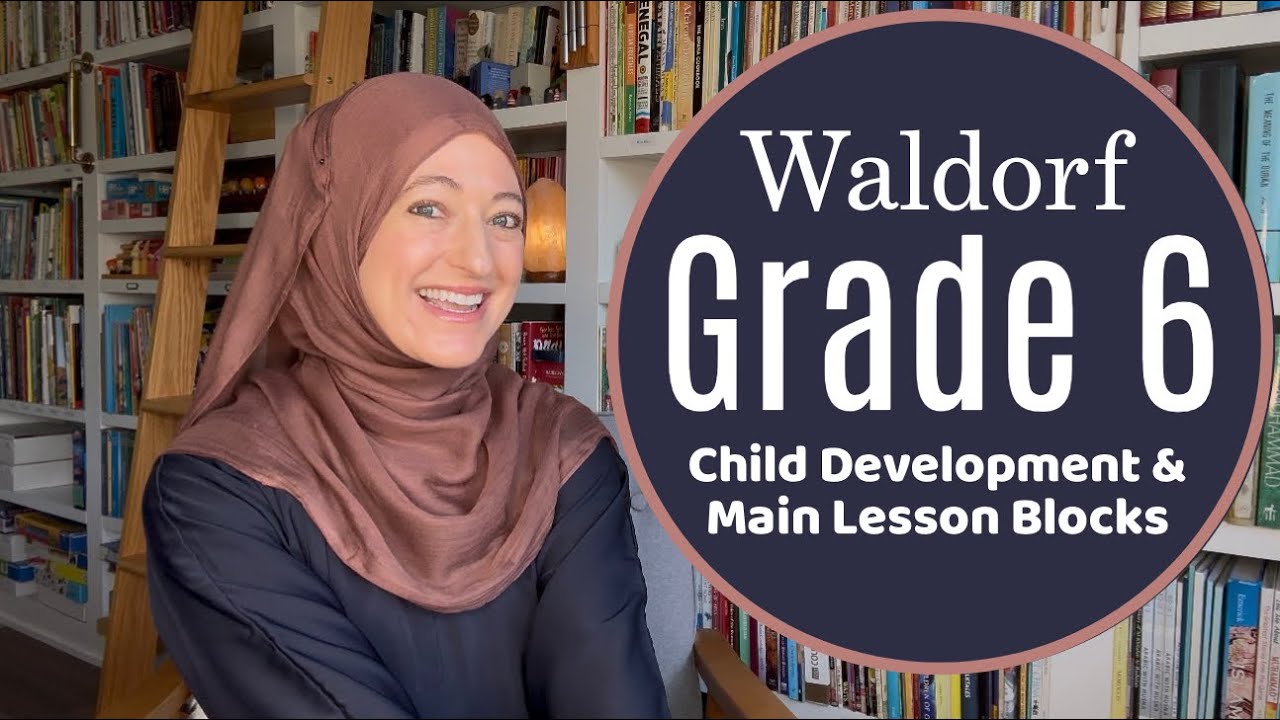
Grade 6 is a very exciting year, but it does pose a few challenges. Now that the student is in middle school, the curriculum supports that development with new approaches to the lessons and main lesson blocks that look remarkably different from the previous years. In the first years we were building foundational skills in reading, writing, and arithmetic, learning through images in a pictorial sense, and using stories for language arts. By third grade there is practical math with telling time, measurement, and money for that pivotal 9-year change. Grade four and five are transitional years where history and science begin to develop into more recognizable blocks, with the man and animal block as a spiritual encounter, and botany as a life science before what comes in middle school.
By grade six, we finally interact with the mineral kingdom with minology, not to be mistaken with geology, which is reserved for 9th grade. Minology is from the student’s sphere of understanding, what they can see and observe and interact with. We begin with the whole before moving to the parts, and the whole is two archetypal rocks, a fire rock, granite, and a water rock, limestone. Granite is a whole rock with minerals and crystals, quartz, mica, feldspar, and you can examine the parts after seeing the whole. Limestone is created in water over a long period of time with tiny organisms, and through the metamorphic process limestone can turn into marble, which ties beautifully into ancient Greece. What I love about this approach is the polarity and then the balance, with metamorphic rock in the middle, and how these main lessons coordinate.
History in sixth grade marks an important change too, because we are finally studying history from recorded sources with events and people that get us to modern history. The 12-year-old is moving closer to puberty, and there is a new sort of upheaval, and they are seeking structure and justice and laws and fairness on the outside. The Roman main lesson block satisfies that need. The history main lesson blocks are Greece, Rome, and the Middle Ages, and these blocks are dense, with many resources and a lot of time to cover. It helps to split blocks into two smaller blocks of about 3 to 4 weeks and separate them with another block, so the student has time to sleep on it, to rest, to process, to digest, and then return with deeper understanding.
The science main lesson blocks for grade six are minology, astronomy, and physics. Physics begins a three year approach with heat, light, and sound in grade six, then electricity and magnetism, then forces and motion. Astronomy begins with what the child can perceive, constellations, the moon, the sun, and then moves into Copernicus, Galileo, Kepler, Kepler’s three laws of motion, and Taiko Brahe, with observable astronomy like retrograde motion and the sun’s path. There is also geometry again, with circles and five division of a circle, and connections to crystals and tile work. Algebra is introduced, but we avoided it until mid 8th grade and really 9th grade, because it is abstract and about balancing equations with an unknown, and I never want students to feel incapable when they are simply not ready. Language arts can move into style and individualization, and specialty subjects continue, foreign language, music, handwork, and eurythmy, with handwork in grade six including knitting in the round or making animals from your own patterns.
Check out the blog post that accompanies this video:
https://pepperandpine.com/6th-grade#w...
Grade 6 playlist:
• 6th Grade
Middle Ages playlist:
• The Middle Ages Europe
Geometry playlist:
• Geometry
Silk Road playlist:
• Silk Road
West Africa playlist:
• West Africa Unit Study
Ibn Battuta playlist:
• Ibn Battuta Unit Study
Marco Polo playlist:
• Genghis Khan and Marco Polo

Информация по комментариям в разработке