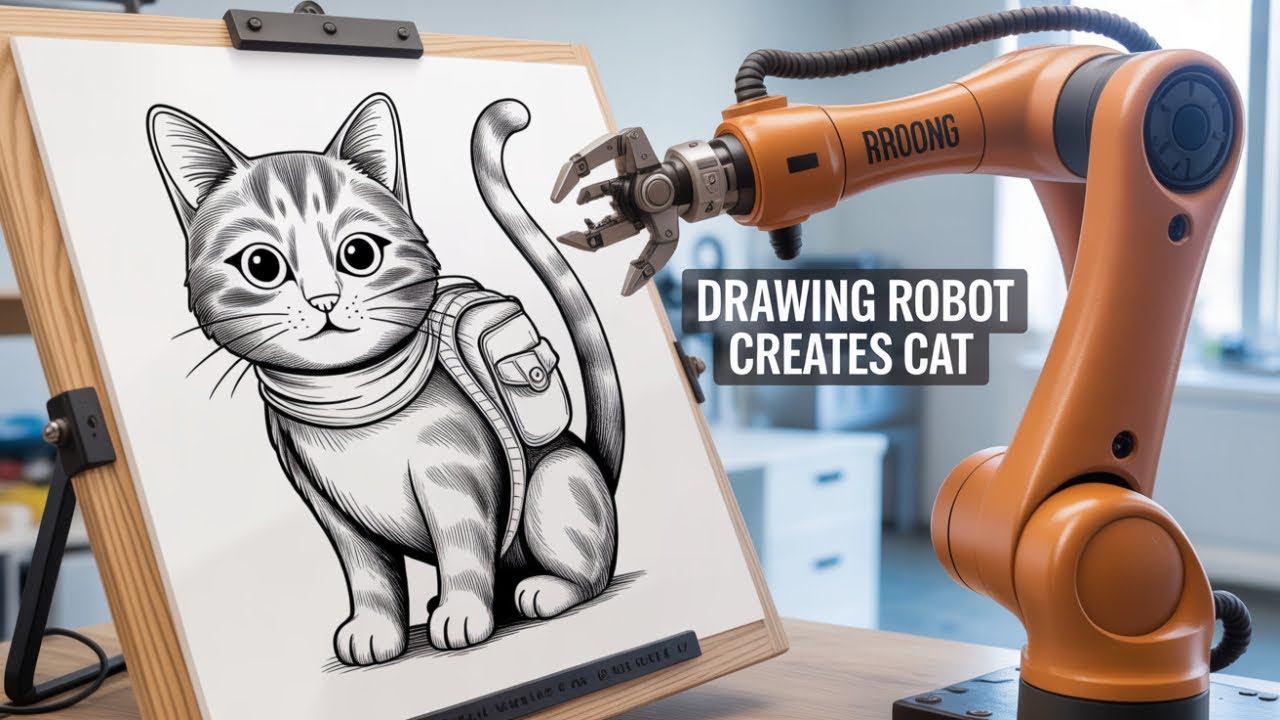
Watch a drawing robot create a charming cat illustration, perfect for those interested in drawing tutorials and drawing for beginners. This process demonstrates how to draw a cat with clear outlines and textures, making it easy to follow. The technical drawing highlights the precision of automated art, from initial outlines to final details.
Watch a charming storybook-style cat come to life as a robot draws a detailed cat portrait with markers. This easy drawing is built from bold outlines and small texture marks, showcasing the precision of robot art. The video progresses through the drawing tutorials, adding incremental lines to complete the artwork.
Pen plotting art meets generative art in this time-lapse pen plotter drawing - a plotter art, algorithmic drawing, technical drawing study made from thin, flowing curves that rise from a dense concentric core. This is a condensed view of a 34:29 run drawn on 24 lb 90 g/m2 white paper using a Sakura Pigma Graphic 1 black pen, with 55.94 m of path drawn across 63.22 m of total motion.
This timelapse sits inside a longer pen plotting journey focused on patience, repeatability, and clean analog linework. The point is to let structure reveal itself as the lines accumulate - not through shading or effects, but through spacing, direction, and disciplined restraint.
Pen plotter model - unknown
Pen - Sakura Pigma Graphic 1 black pen
Ink - black ink (pen-based), exact formulation unknown
Paper - 24 lb 90 g/m2 white paper, finish unknown
Paper size - unknown
Software - unknown
File format - unknown
Elapsed time - 34:29 (minutes, seconds)
Length of path drawn - 55.94 m
Total distance moved - 63.22 m
What is a pen plotting time-lapse?
A pen plotting timelapse is a sped-up view of a real pen plotter drawing, compressing a long run into a short watch. It is useful for quickly seeing overall structure and composition changes.
How is this abstract drawing arranged?
A tightly nested circular form sits at the bottom center, built from concentric lines like a fingerprint or whirlpool. From that core, dozens of long organic curves radiate upward and outward, sometimes converging, sometimes drifting apart.
Why do flow-field style lines feel calming?
The curves mimic directional patterns found in wind, water, and other natural flows, even when fully abstract. The eye can follow paths smoothly, and the density changes create a gentle visual rhythm without shading.
Which pen characteristics matter most for long plots?
Consistent ink delivery and stable line weight matter more than boldness in a piece like this. The Sakura Pigma Graphic 1 is used here, and the drawing depends on clean continuity rather than heavy texture.
What paper qualities help thin line drawings?
Paper that stays flat and supports smooth pen travel helps keep curves even and unbroken. This run uses 24 lb 90 g/m2 paper with an unknown surface finish.
What are common problems in dense line fields?
Overcrowding can turn motion into noise, and accidental gaps can interrupt the flow. Strong results rely on balanced spacing, controlled density, and long, uninterrupted curves that carry the viewer across the page.
The visual identity comes from pure linework: no fill, no shading, just continuous strokes and gentle undulation. The concentric core anchors the composition like a source point, while the outward lines read as currents, roots, hair, smoke, or magnetic-field traces depending on where you focus. The timelapse makes the density shifts easier to notice - the scene stays quiet, but the motion implied by the curves feels relentless and alive.

Информация по комментариям в разработке