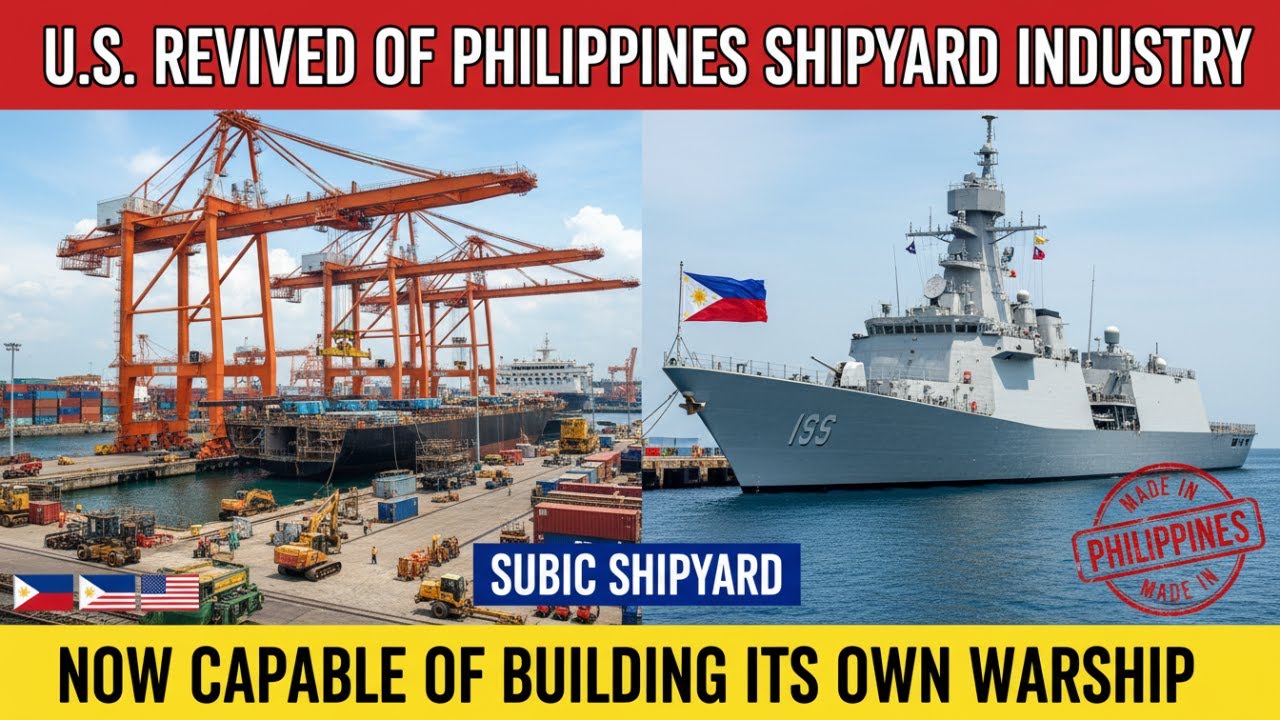
The Philippine shipyard industry is making a historic comeback, and the United States is playing a critical role in reviving one of Southeast Asia’s most strategic maritime hubs. In this video, we explore how the U.S. revived the Philippine shipyard industry, transforming Subic Bay Shipyard into a facility now capable of building its own warships — a major shift in regional defense, naval power, and geopolitical balance.
Once a thriving American naval base, Subic Bay has returned to global attention as a key center for shipbuilding, naval repair, and military modernization. With growing tensions in the South China Sea, strengthening maritime capabilities has become a national priority for the Philippines — and a strategic interest for the United States and its allies.
This video breaks down how U.S.–Philippines defense cooperation helped restart and modernize Philippine shipyards, the role of foreign investment and technology transfer, and why this development matters not just for the Philippines, but for the entire Indo-Pacific region.
⚓ THE RISE, FALL, AND REVIVAL OF PHILIPPINE SHIPYARDS
For decades, the Philippines possessed one of the most strategically located shipyard systems in Asia. During the Cold War, Subic Bay was among the largest U.S. naval bases in the world, supporting aircraft carriers, destroyers, submarines, and logistics fleets.
After the U.S. withdrawal in the early 1990s, the shipyard industry declined. Facilities were underutilized, skilled workers left, and the country became increasingly dependent on foreign-built naval vessels.
Today, that reality is changing.
With renewed U.S. engagement, infrastructure investment, and military cooperation, Philippine shipyards are being rebuilt, modernized, and reactivated — enabling the country to construct, repair, and maintain its own warships for the first time in modern history.
🇺🇸 WHY THE UNITED STATES IS INVESTING IN PHILIPPINE SHIPYARDS
The U.S. revival of the Philippine shipyard industry is not accidental — it is strategic.
Key reasons include:
Strengthening regional allies in Southeast Asia
Counterbalancing China’s expanding naval presence
Securing reliable forward maintenance hubs for allied fleets
Enhancing interoperability between U.S. and Philippine navies
Through defense agreements, joint exercises, technology sharing, and industrial cooperation, the U.S. is helping transform Philippine shipyards into dual-use facilities — serving both civilian and military needs.
This partnership also creates local jobs, rebuilds industrial expertise, and restores the Philippines as a maritime manufacturing power.
🏗️ SUBIC SHIPYARD: FROM REPAIR DOCK TO WARSHIP BUILDER
Subic Shipyard stands at the center of this transformation.
Once limited to ship repair and maintenance, Subic is now capable of:
Building naval patrol vessels
Constructing offshore patrol ships
Supporting frigates and future destroyers
Maintaining allied naval vessels operating in the region
With modern dry docks, gantry cranes, advanced fabrication systems, and a skilled workforce, Subic is evolving into a full-scale naval shipbuilding hub.
This shift dramatically reduces the Philippines’ dependence on foreign shipyards and shortens production timelines for the Philippine Navy.
⚔️ WHAT THIS MEANS FOR PHILIPPINE NAVAL POWER
For the first time, the Philippines is developing the ability to:
Design and assemble warships domestically
Maintain and upgrade its naval fleet locally
Respond faster to regional security threats
Protect its maritime borders and exclusive economic zone
This capability is crucial as the country faces challenges in the West Philippine Sea and beyond.
By building warships at home, the Philippines gains strategic autonomy, cost savings, and long-term defense sustainability.

Информация по комментариям в разработке