Abstract:
We are witnessing an ongoing authoritarian turn in global politics. Autocrats—ranging from Trump to Orbán, Al Sisi, Erdoğan—have ascended to power through democratic elections, primarily by exploiting populist policies, yet they erode fundamental democratic principles. Although their rhetoric is nationalist and their policies emphasize strengthening the state, they also indicate a continuation of the neoliberal global order.
Turkey’s Justice and Development Party (AKP) era (since 2002) has been marked by an interdependent logic of authoritarianism, populism, and developmentalism. These three pillars operate in concert to secure legitimacy, co-opt opposition, and manage dissent. The environment has emerged as a pivotal arena where these dynamics converge, shaping grievances arising from developmentalist projects. Surprisingly, social dissent related to these projects has remained relatively muted and fragmented, with many AKP supporters adversely affected by development continuing to back the party. Beyond formal coercion, a critical element in sustaining power appears to be the widespread belief that bearing environmental costs is a prerequisite for prosperity.
At the core of development projects lies extractivism. The AKP regime has institutionalized extractivist activities as a central strategy to extract and export natural resources in pursuit of economic development, frequently disregarding the associated health, social, and environmental costs.
Employing a Gramscian framework, we will examine how the AKP regime couples authoritarian rule with consent-building in the environmental domain. We will argue that the appeal to developmental prosperity—a narrative that links environmental costs to progress—has enabled the regime to legitimate its rule by mobilizing broad-based support. The prosperity logic of developmentalism, rather than organized opposition, has become central to the regime’s hegemony in Turkey.
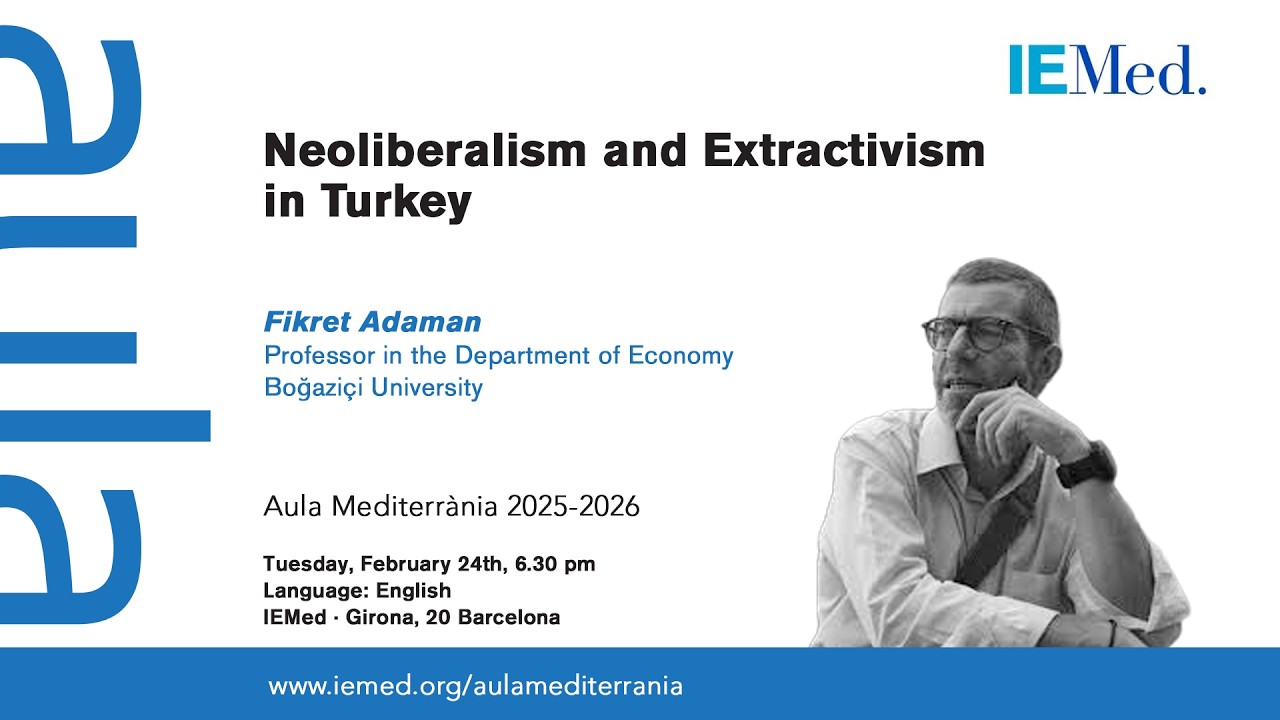
A conference by Fikret Adaman, a professor of economics at Boğaziçi University. Adaman received his PhD from the University of Manchester. His research focuses on environmental economics; the relationship between food, agriculture, and the economy; the history of economic thought; political ecology; the political economy of Turkey; and social policies. He was an advisor to the rector and chair of the department of Economics at Boğaziçi University. He has been a visiting researcher at the University of Bologna, Erasmus University, the University of Utah, Purdue University, and the University of Massachusetts. He works on the topic of social exclusion for the European Commission's team of experts on Turkey. Among his publications stand out “Decolonizing development economics: A critique of the late neoclassical reason” (with Yahya Madra and Bengi Akbulut; World Development, 2025); “The Political Economy of Environmental Policymaking in Turkey: A Vicious Cycle” (with Murat Arsel and Bengi Akbulut; Oxford Handbook of Turkish Politics, ed. by Güneş Murat Tezcür, 2022); “Green grabbing: A new form of appropriation” (with Duygu Avcı, Hande Paker and Gökçe Yeniev; Heinrich-Böll Stiftung); “Neoliberal Turkey and its Discontents: Economic Policy and the environment under Erdoğan” (ed. with Bengi Akbulut and Murat Arsel, IB. Taurus, 2017).
A session of the Aula Mediterrània 2025-26 lecture series moderated by Aurèlia Mañé, Senior Lecturer in the Department of Economic History, Institutions, Politics and World Economy (Universitat de Barcelona) and co-organised with the Master’s Degree in Internationalisation: Economic, Business and Legal-Political Aspects, UB









Информация по комментариям в разработке