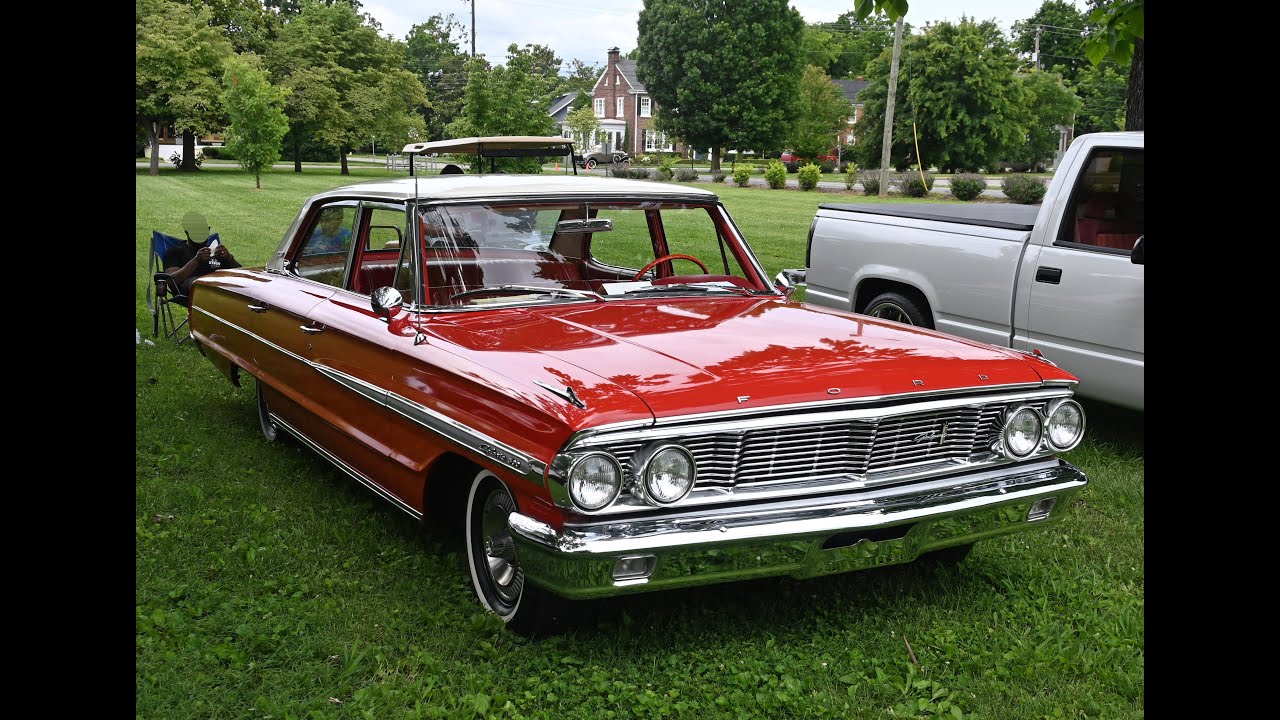
Not many cars take my breath away but this show winning 194 Ford Galaxie 500 did.....
Music: Bring It Up
Artist: Silent Partner
Please subscribe to be notified of future automotive slideshows
More vehicles on the website..... rustedbumper.com
Black & white photos available at rustedbumper.com
"Total Performance" was much, much more than just a slogan at Ford in the mid-Sixties. Its was a philosophy practiced throughout the company under the enthusiastic leadership of "Hank the Deuce", Henry Ford II, who had rescued the company from incipient ossification following WWII and overseen its regeneration into a force to be reckoned with not only in the salesrooms but also in almost every form of motorsport.
The Galaxie was part of Ford's full-size model lineup from 1959 through 1974, serving as its top-of-the-line full-size model from 1958 until 1961. The 1964 Galaxie 500 Series was positioned above the full-size Custom Series and offered in both six- and eight-cylinder engines. Styling was similar to designs introduced in 1960 and continually updated year-over-year.
The list of standard equipment on the Galaxie 500 Series included chrome windshield and rear window moldings, sun visors, armrests with ashtrays on all doors, a chrome horn ring, two-tone vinyl trim, chrome fender top ornamentation, and chrome window frames. The Ford crest was placed on the roof 'C' pillar and a chrome stripe traversed the entire body side. At the front and rear of the stripe, in an aluminum insert, was the words 'Galaxie 500' in script.
The Galaxie 500 XL models received special badging, all-vinyl bucket seats in the front, and a center console which most often was the home for the gear shift lever. They had rear reading lights in hardtop body styles, dual-lens courtesy and warning lights in the doors, and polished door trim panels.
The overhead-valve, six-cylinder engine displaced 223 cubic inches, had four main bearings, a Holley one-barrel carburetor, and delivered 138 horsepower at 4,200 RPM. The overhead-valve 289 CID V8 had five main bearings, a Holley two-barrel carburetor, and delivered 195 horsepower at 4,400 RPM. The Holley four-barrel version brought horsepower to 225 bhp. A high-performance version of the 289, complete with 10.5:1 compression, delivered 271 horsepower at 6,000 RPM. The Interceptor FE-block 352 CID V8 had a Holley four-barrel carburetor and 250 hp. The 390 CID V8 delivered 300 or 330 horsepower depending on the setup.
Ford's 'Total Performance' campaign during the 1960s witnessed the introduction of the 427 cubic-inch FE engine in mid-year 1963. It was offered in two levels, the 410 horsepower version with a single four-barrel carburetor, or the 425 hp 'R' code version with dual four-barrels. Known among fans as the 'side-oiler', these power-houses would propel full-size Fords into the front of the pack be it on the street, strip, or track.
1964 was a monumental year for Ford, with the introduction of the new Mustang. At the opening of the 1964 New York World's Fair, Ford's innovation and technology were on full display, with Ford convertibles transporting riders through the Walt Disney-designed Magic Skyway. Prior to entering the Magic Skyway, visitors were exposed to Ford's new 1964 vehicles, including the 1964 Galaxie 500XL Convertible. As a Ford Pavilion show car, the big Ford was loaded with options, including a4-speed manual transmission, power windows, the R-code 427 engine, AM/FM radio, dash clock, power driver's seat, and Perma-Tuned transistorized ignition system. As the top-of-the-line XL, the convertible came from the factory equipped with bucket seats and console, bucket-style rear bench seat, all-vinyl upholstery, special trim, and wheel covers with spinners and red, white, and blue XL centers. As part of Ford's Total Performance campaign during the early 1960s, the R-code 427 generated 425 horsepower thanks to its dual Holley 4-barrel carburetors, open-element oval air cleaner, solid lifters, and high-flow exhaust manifolds. The 427 also mandated a heavy-duty suspension, nylon tires, and fade-resistant brakes. Approximately 208 R-code convertibles were built in 1964.
The 1964 model year would be the final year of the designs first introduced in 1960. A new design was introduced for 1965, with vertically stacked dual headlights, a taller and bulkier profile, and a new LTD trim package. Engine choices would remain the same, except for the all-new 240 cubic-inch six-cylinder engine replacing the 223 'Mileage-Maker Six that had served the company since the 1950s. The 352 now came with dual exhausts and a four-barrel carburetor.

Информация по комментариям в разработке