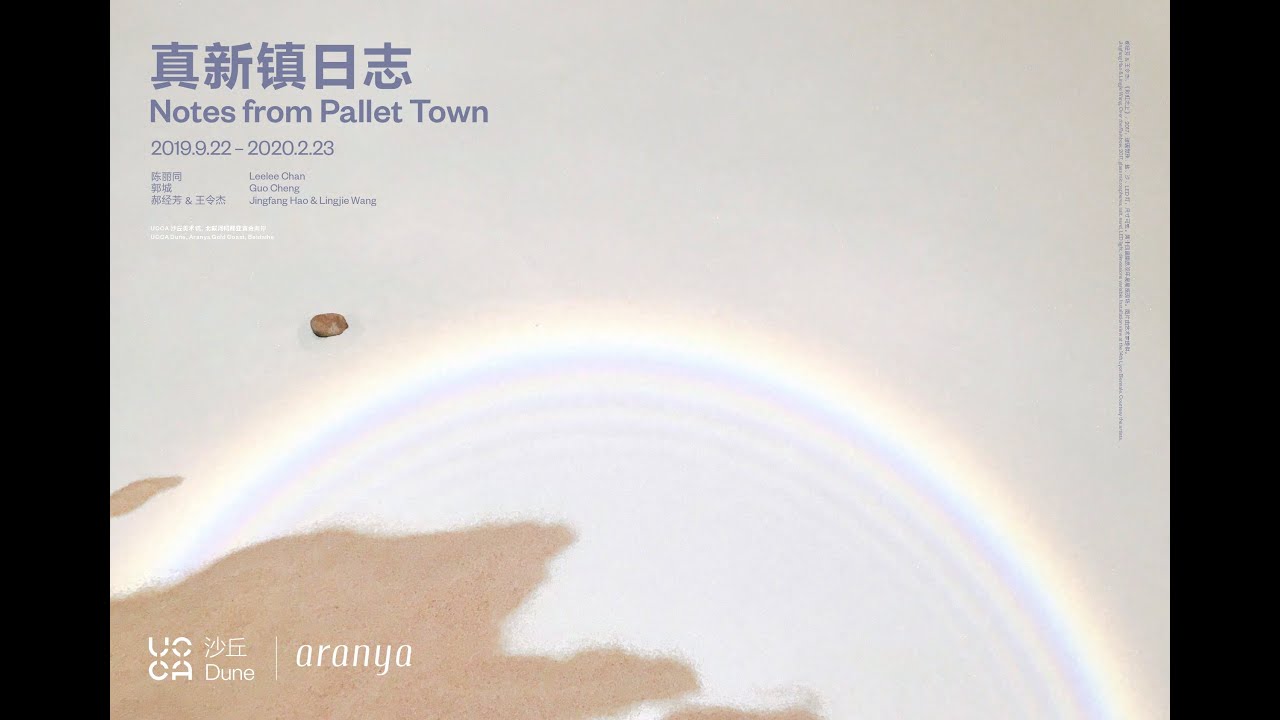
From September 22, 2019, to February 23, 2020, UCCA Dune presented "Notes from Pallet Town," showing work from Leelee Chan (b. 1984, Hong Kong), Guo Cheng (b. 1988, Beijing), and the artist duo of Jingfang Hao (b. 1985, Shandong province) and Lingjie Wang (b. 1984, Shanghai). The “Pallet Town” of the title refers to the hometown of the protagonist of a 1990s Japanese video game and anime series. In a certain sense, the built environment in China is close to achieving the futuristic, idyllic sheen found in the background of such cartoons, yet the deeper implications and potential by-products of such a perfect image warrant further exploration. In “Notes from Pallet Town” participating artists delivered reports from imagined utopias, asking viewers to re-imagine the structures underpinning contemporary life. Their work foregrounds technology, but pointedly uses it as a means to highlight natural phenomena or illusions, revealing moments of unexpected beauty.
The media franchise that the original Pallet Town appears in is in fact Pokémon. However, the exhibition is not directly concerned with the narrative of the Pokémon universe, rather taking the fictional town as a jumping-off point: all born after 1980, the participating artists came of age at a time when Japanese imports helped define the cultural imaginary of Greater China, with Pallet Town representing a particular dream image of contemporary East Asia. In the quietly prosperous community, society, technology, the natural world, and even the supernatural exist in harmony, while the white walls of tidy houses present a tabula rasa for fresh beginnings. Incidentally, Pallet Town was based on the real life city of Shimoda, which played an important role in the opening of Japan to foreign influence and technology in the 1850s. This small fictional town at the center of a generation’s memories proves surprisingly dense with meaning, not only presenting an image of utopia, but also implicitly evoking concepts underpinning the history of Asian modernization, such as the necessity of technological progress for development.
As sites of previously unmatched prosperity, where technology has smoothed out the rough edges of daily life, the metropolises where the participating artists live and work actively reach towards utopia. Yet such conditions have also led to new anxieties over environmental degradation, inequality, and the place of humanity in the face of automation and artificial intelligence. Pallet Town’s suburban fusion of society and nature also remains unrealized. The artists here have used—and intentionally misused—contemporary technology to celebrate the joys of sensation available in the present moment, while also expressing a certain sense of disquiet over issues that remain unresolved.
For more information on the exhibition, please visit https://ucca.org.cn/en/exhibition/not...
UCCA沙丘美术馆于2019年9月22日至2020年2月23日呈现展览“真新镇日志”,展出陈丽同(1984年出生于香港)、郭城(1988年出生于北京)与艺术家组合郝经芳(1985年出生于山东)&王令杰(1984年出生于上海)的作品。展览标题中的“真新镇”源自九十年代日本经典动画《精灵宝可梦》,“真新镇”既是人类与精灵初识之地,亦是梦想孕育之所。从某种意义上说,作为动画故事的发生地,象征光明、充满奇幻的真新镇趋近中国现代发展梦想的理想之地。然而,这种美好愿景可能造成的深远影响,以及潜在的负作用却值得深入探讨。“真新镇日志”通过艺术家对想象中乌托邦的审视,激发观者对当代生活本质进行反思。本次展览作品中艺术家对科技的运用引人注目,作为构建自然景象,营造幻象的特别手段,科技经艺术家之手为观者带来意外之美。
展览无意关注“真新镇”本源的叙事宇宙,而把虚构的小镇作为艺术言说的出发点: 1980年后出生的三位/组艺术家,成长于“真新镇”作为特定东亚幻想图景,正值日本文化输入激发大中华地区文化想象的时期。在故事里悄然繁荣的“真新镇”中,社会、技术、自然,甚至是超自然都和谐共处;同时,镇中规整房屋的纯白色则象征着全新的开始。事实上,“真新镇”原以日本下田市为原型,19世纪50年代在日本对外开放的过程中,这座城市发挥了重要作用。梦想中的“真新镇”在整整一代人记忆中留下了深刻的烙印,它不但承载着人们对理想乌托邦的想象,还在冥冥中激发了人们对亚洲现代化历史进程,如技术进步之于发展必要性的思考和讨论。
三位/组艺术家生活、工作的大都市发展日新月异,生活因科技而变得美好,正向期望中的乌托邦大步迈进。而城市的飞速发展也引发人们对环境退化、不平等、以及面对自动化和人工智能时产生的新兴焦虑。城市生活与自然和谐融洽依然只是“真新镇”中可望不可及的一个梦想。本次展览的艺术家借助当代科技手段,在看似有意、热烈拥抱当下可触及美好的同时,亦透露出其对隐藏在美好之下,尚未解决问题的隐忧与不安。如果梦想可以实现,又需要人类付出怎样的代价?
关于展览的更多信息,请前往 https://ucca.org.cn/exhibition/notes-...

Информация по комментариям в разработке