Eagle is the common name for the golden eagle, bald eagle, and other birds of prey in the family of the Accipitridae. Eagles belong to several groups of genera, some of which are closely related. True eagles comprise the genus Aquila. Most of the 68 species of eagles are from Eurasia and Africa.[1] Outside this area, just 14 species can be found—two in North America, nine in Central and South America, and three in Australia.
EagleFrom left to right, top row first: golden eagle (Aquila chrysaetos), brown snake eagle (Circaetus cinereus), solitary eagle (Buteogallus solitarius), black eagle (Ictinaetus malaiensis) and African fish eagle (Haliaeetus vocifer).Domain:EukaryotaKingdom:AnimaliaPhylum:ChordataClass:AvesOrder:AccipitriformesFamily:AccipitridaeSpecies
Eagles are not a natural group but denote essentially any kind of bird of prey large enough to hunt sizeable (about 50 cm long or more overall) vertebrates.
Etymology
The word "eagle" is borrowed into English from Anglo-Norman: eagle and Middle French: aigle, both derived ultimately from Latin: aquila ("eagle"). It is cognate with terms such as French: aigle, Portuguese: águia and Spanish: águila.[2] It is broadly synonymous with the less common English term "erne" or "earn", deriving from Middle English: ern, from Old English: earn, in which it acts as the usual word for the bird. The Old English term is turn derived from Proto-Germanic: *arnuz and is cognate with other synonymous words in Germanic languages such as Swedish: örn, German: Aar and Gothic: ara. Through the Proto-Indo-European root, it is further related to words such as Greek: ὄρνις ("bird") and Lithuanian: erelis ("eagle"). Although "erne" can be used to refer to any eagle, it is most commonly used for the golden eagle or sea-eagle.
Eagles are large, powerfully-built birds of prey, with heavy heads and beaks. Even the smallest eagles, such as the booted eagle (Hieraaetus pennatus), which is comparable in size to a common buzzard (Buteo buteo) or red-tailed hawk (B. jamaicensis), have relatively longer and more evenly broad wings, and more direct, faster flight, despite the reduced size of their aerodynamic feathers. Most eagles are larger than any other raptors, apart from some vultures. The smallest species of eagle is the Great Nicobar serpent eagle (Spilornis klossi), at 450 g (1 lb) and 40 cm (16 in). The largest species are discussed below. Like all birds of prey, eagles have very large hooked beaks for ripping flesh from their prey, strong, muscular legs, and powerful talons.
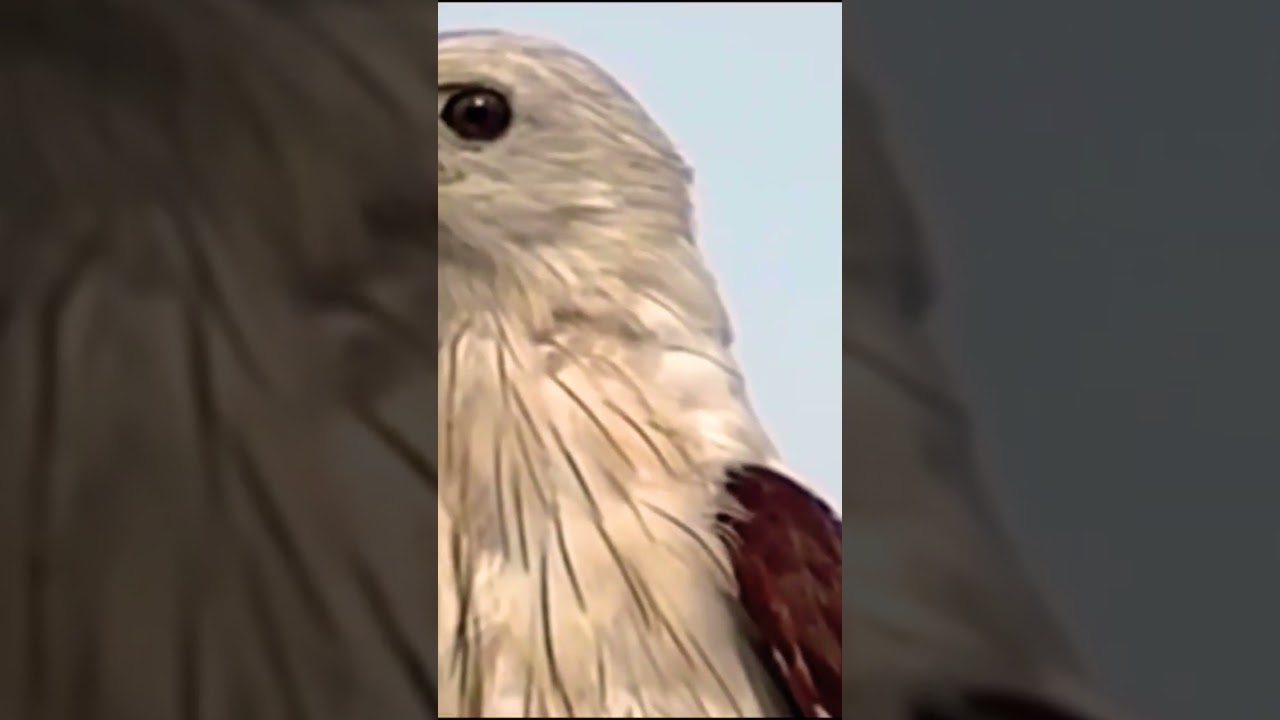
The beak is typically heavier than that of most other birds of prey. Eagles' eyes are extremely powerful. It is estimated that the wedge-tailed eagle has a visual acuity twice that of a typical human. This acuity enables eagles to spot potential prey from a very long distance. This keen eyesight is primarily attributed to their extremely large pupils which ensure minimal diffraction (scattering) of the incoming light. Like most diurnal raptors, eagles have little ability to see ultraviolet light.[8] The female of all known species of eagles is larger than the male.
Eagles normally build their nests, called eyries, in tall trees or on high cliffs. Many species lay two eggs, but the older, larger chick frequently kills its younger sibling once it has hatched. The parents take no action to stop the killing.[11][12] It is said[by whom?] that eagles fly above clouds but this is not true.[citation needed] Eagles fly during storms and glide from the wind's pressure. This saves the bird's energy. Due to the size and power of many eagle species, they are ranked at the top of the food chain as apex predators in the avian world. The type of prey varies by genus. The Haliaeetus and Icthyophaga eagles prefer to capture fish, though the species in the former often capture various animals, especially other water birds, and are powerful kleptoparasites of other birds. The snake and serpent eagles of the genera Circaetus, Terathopius, and Spilornis predominantly prey on the great diversity of snakes found in the tropics of Africa and Asia. The eagles of the genus Aquila are often the top birds of prey in open habitats, taking almost any medium-sized vertebrate they can catch. Where Aquila eagles are absent, other eagles, such as the buteonine black-chested buzzard-eagle of South America, may assume the position of top raptorial predator in open areas. Many other eagles, including the species-rich genus Spizaetus, live predominantly in woodlands and forests. These eagles often target various arboreal or ground-dwelling mammals and birds, which are often unsuspectingly ambushed in such dense, knotty environments. Hunting techniques differ among the species and genera, with some individual eagles having engaged in quite varied techniques based on their environment and prey at any given time. Most eagles grab prey without landing and take flight with it, so the prey can be carried to a perch and torn apart.

Информация по комментариям в разработке