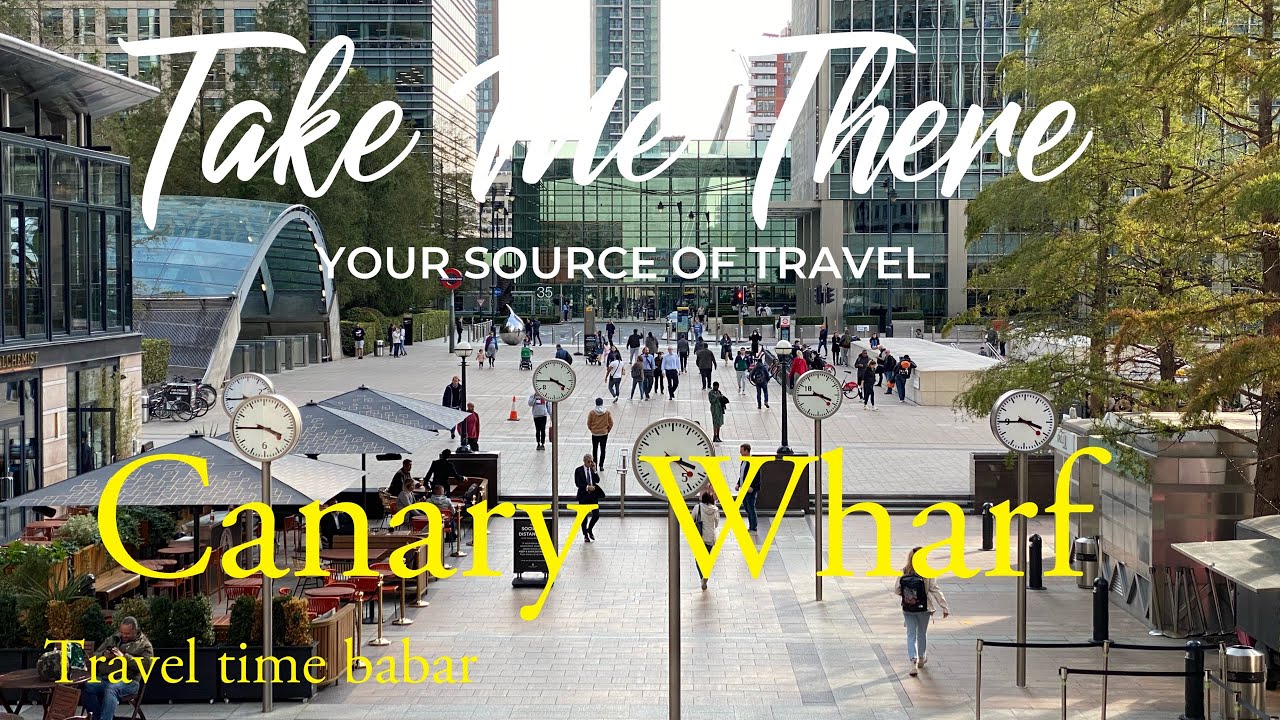
London walk 2020 | Canary Wharf round tour 2020
Today we’re going to walk around Canary Wharf city after this new rules of smart lockdown!
Canary Wharf!
Canary Wharf is the secondary central business district of London on the Isle of Dogs. Along with the City of London, it is one of the main financial centres of the United Kingdom and the world, containing many of their tallest buildings, including the third-tallest in the UK, One Canada Square.[1][2] Canary Wharf is 97 acres (39 hectares) and contains around 16,000,000 square feet (1,500,000 m2) of office and retail space. It comprises many open areas, including Canada Square, Cabot Square and Westferry Circus. Together with Heron Quays and Wood Wharf, it forms the Canary Wharf Estate.
History!
From 1802 to the late 1980s, what would become the Canary Wharf Estate was a part of the Isle of Dogs (Millwall), Limehouse and Poplar and was one of the busiest docks in the world. After the 1960s, the port industry began to decline, leading to all the docks being closed by 1980.[3][4] West India Docks was primarily developed by Robert Milligan (c. 1746–1809) who set up the West India Dock Company.
Port of London Authority
West India Dock was by this time owned by the Port of London Authority in 1909. Canary Wharf itself takes its name from No. 32 berth of the West Wood Quay of the Import Dock. This was built in 1936 for Fruit Lines Ltd, a subsidiary of Fred Olsen Lines for the Mediterranean and Canary Islands fruit trade. The Canary islands were so named after the large dogs found there by the Spanish (Canarias from Canine) and as it is located on the Isle of Dogs, the quay and warehouse were given the name Canary Wharf.[5]
London Docklands Development Corporation
After the docks closed in 1980, the British Government adopted policies to stimulate redevelopment of the area, including the creation of the London Docklands Development Corporation (LDDC) in 1981 and the granting of Urban Enterprise Zone status to the Isle of Dogs in 1982.[4]
The Canary Wharf of today began when Michael von Clemm, former chairman of Credit Suisse First Boston (CSFB), came up with the idea to convert Canary Wharf into a back office. Further discussions with G Ware Travelstead led to proposals for a new business district and included the LDDC developing a cheap light metro scheme, called the Docklands Light Railway to make use a large amount of redundant railway infrastructure and to improve access.
The project was sold to the Canadian company Olympia & York[6] and construction began in 1988, master-planned by Skidmore, Owings & Merrill with Yorke Rosenberg Mardall as their UK advisors, and subsequently by Koetter Kim. The first buildings were completed in 1991, including 1 Canada Square, which became the UK's tallest building at the time and a symbol of the regeneration of Docklands. By the time it opened, the London commercial property market had collapsed, and Olympia and York Canary Wharf Limited filed for bankruptcy in May 1992.
Initially, the City of London saw Canary Wharf as an existential threat. It modified its planning laws to expand the provision of new offices in the City of London, for example, creating offices above railway stations (Blackfriars) and roads (Alban Gate). The resulting oversupply of office space contributed to the failure of the Canary Wharf project.
Canary Wharf Group
In Oct. 1995, an international consortium that included investors such as Alwaleed, bought control for $1.2 billion. Paul Reichmann was named chairman, and Canary Wharf went public in 1999.[7] The new company was called Canary Wharf Limited, and later became Canary Wharf Group.
In 1997, some residents living on the Isle of Dogs launched a lawsuit against Canary Wharf Ltd for private nuisance because the tower interfered with TV signals. The residents lost the case.[8]
Recovery in the property market generally, coupled with continuing demand for large floorplate Grade A office space, slowly improved the level of interest. A critical event in the recovery was the much-delayed start of work on the Jubilee Line Extension, which the government wanted ready for the Millennium celebrations.
In March 2004, Canary Wharf Group plc. was taken over by a consortium of investors, backed by its largest shareholder Glick Family Investments[9] and led by Morgan Stanley using a vehicle named Songbird Estates plc.
ROUTE TIMESTAMPS
00:00 Canary Wharf Underground Station
02:40 Out Side Canary Wharf Station
03:05 Bank street
05:30 Station parade
11:50 Northside footbridge
12:35 Cabot Square fountain
14:03 West ferry Circus
15:40 west ferry pier
16:08 River Thames
17:23 Canary Wharf pier
17:58 Mackenzie Walk
24:13 Station parade
This video shoot on
28/09/2020
Video shoot location
Canary Wharf
Cabot Square
North footbridge
Canary Wharf pier
Meckenzie walk
Temperatures on the day
20 degrees Celsius
#canarywharf#london#traveltimebabar#londonwalk#walkingvideo#Walkingtour#4kwalk2020











![[4K] PARIS 2025 🇫🇷 1 Hour Aerial Drone Relaxation Film UHD | FRANCE](https://i.ytimg.com/vi/WHNNHAoaZD4/maxresdefault.jpg)

Информация по комментариям в разработке