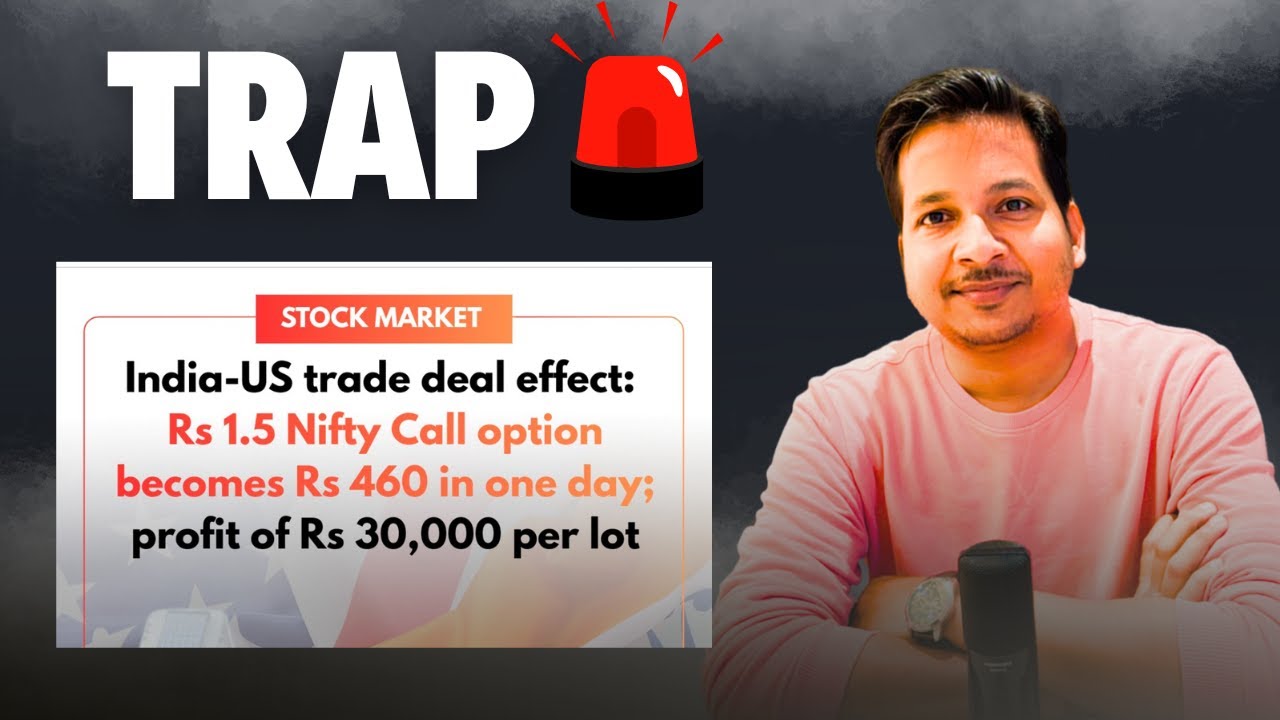
Option buying is often described as the riskiest form of trading for retail investors, with data suggesting that over 90% of individual traders in derivatives, specifically in India, incur net losses. While it offers the allure of high, quick returns with limited, known risk (the premium paid), it is designed as a "wasting asset" that works against the buyer. Don't Fall In This Trap In Stock Market
Here are the primary reasons why traders should not fall into the trap of option buying:
1. The Power of Time Decay (Theta)
Wasting Asset: Options have an expiration date. As that date approaches, the time value of the option erodes daily.
Constant Headwind: Even if the underlying stock moves in your direction, you can still lose money if it doesn't move fast enough to counteract the time decay.
Accelerated Erosion: Time decay is not linear; it speeds up significantly in the final weeks and days before expiration.
Weekend Effect: Premiums decay even when the market is closed, making it a "hidden" cost.
2. Low Probability of Success
High Break-even Needed: To profit, the stock must move significantly in your direction to cover both the entry premium and the time decay.
OTM Trap: Beginners often buy Out-of-the-Money (OTM) options because they are cheap. These have no intrinsic value and are the most likely to expire worthless.
Statistical Odds: Many studies show that option buyers are profitable only about 30–35% of the time, making it a "lose-a-little-often, make-a-lot-occasionally" strategy, which is psychologically difficult to manage.
3. Impact of Volatility (IV Crush)
IV Crush: Often, implied volatility (IV) is very high before an event (like earnings or news). After the event, IV drops drastically, causing the premium to shrink even if the stock price goes in your direction. This is a common "premium trap".
Overpaying: In a high-volatility environment, you pay a high premium, requiring an even larger move to make a profit.
4. Overleveraging and Psychological Traps
Excessive Leverage: Because options are cheaper than stocks, traders tend to buy more lots than they should. A small percentage move in the underlying can cause 100% loss of the premium.
Averaging Down: When a bought option goes against them, traders often "average down" (buy more at a lower price), which frequently leads to complete capital destruction.
5. High Transaction Costs
High Frequency = High Fees: Option buying often involves frequent, high-frequency trading. The cumulative impact of brokerage fees, STT (Securities Transaction Tax), and GST can eat up a significant portion of profits, as highlighted by SEBI.
Bid-Ask Spreads: Wide spreads in less liquid options mean you are losing money the moment you enter the trade.
6. The Institutional Edge
Algorithmic Competition: Retail traders are fighting against institutional players and proprietary traders who use algorithms for high-frequency trading and have a significant technological advantage.
Conclusion:
Option buying requires superior timing, accurate direction, and favorable volatility. Without proper education, discipline, and risk management, it is essentially gambling, not investing.
Instagram link:
/ c-xtaf. .
Disclaimer: My videos, presentations, and writing are only for educational purposes and are not intended as investment advice. I cannot guarantee the accuracy of any information provided please consult with your financial advisor before taking any decision
#swingtrading #swingtrader #swingtrades #swing #stockmarket #stockmarketindia #stockmarkets #nifty #banknifty #trader #trading #investing #tradingtips #stockmarket #stockmarketanalysis #investing #nifty #tradewithbooks

Информация по комментариям в разработке