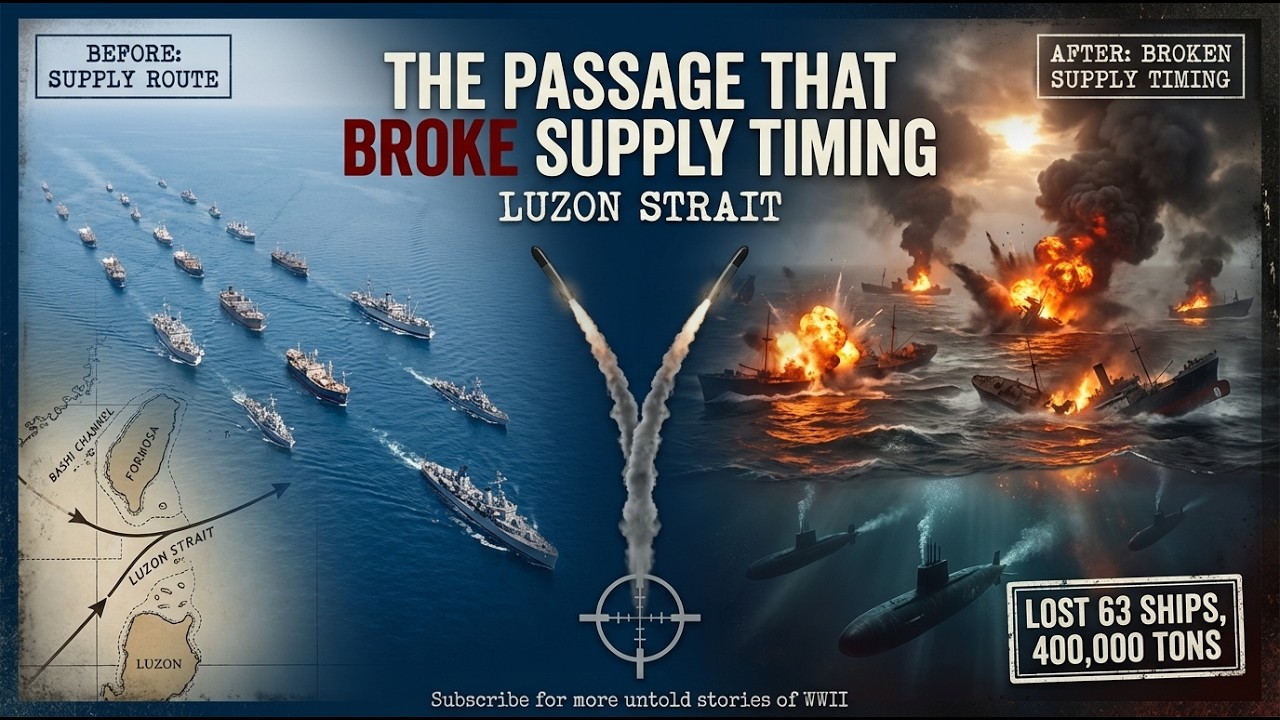
By late 1944, the most dangerous weapon in the western Pacific was not a battleship or an air raid—it was a narrow sea passage. In the Luzon Strait and its southern throat, the Bashi Channel, convoys entered on schedule and emerged late, damaged, or missing. The true casualty was not just shipping tonnage. It was timing. And once supply timing broke, entire operations began to collapse.
This documentary examines how American submarines turned geography into a strategic weapon. The corridor between Luzon and Formosa functioned like a clamp on Japan’s supply network. Oil, ammunition, spare parts, and food flowed north from the southern resource zones through forced nodes—Formosa, Luzon, Palawan, West Borneo—because coastal routing promised navigation aids and air cover. But chokepoints compress movement. In confined waters, convoys tightened formation, escorts repeated predictable arcs, and maneuver space vanished. Geography created ambush geometry.
On September 12, 1944, a coordinated wolfpack—USS Growler, USS Pampanito, and USS Sealion—attacked a Japanese convoy in the Luzon Strait. The event demonstrated a principle: submarines did not need to patrol everywhere. They only needed repeatable access to the miles ships could not avoid. Torpedo spreads shattered formations, escorts were forced into impossible choices between pursuit and protection, and the convoy’s schedule slipped in hours that compounded into days.
By war’s end, American submarines had destroyed roughly two-thirds of Japan’s merchant fleet. But the deeper impact was operational tempo. Convoys rerouted, escorts were diverted, fuel arrived late, sorties were reduced, and repairs were delayed. The passage became a “clock-breaker,” reshaping the Pacific theater not through visibility, but through control of movement.
On this channel, we explore the strategic realities of World War II naval warfare and reveal how undersea campaigns reshaped entire regions.
Subscribe for more in-depth WWII submarine warfare documentaries. Like this video if you learned something new, and comment below with the next Pacific naval campaign you’d like covered.
#WWIIHistory #SubmarineWarfare #PacificWar
⚠️ DISCLAIMER:
All visuals in this video have been generated using AI technology based on the historical narrative and descriptions provided in the script. These images are created for educational and illustrative purposes to enhance the storytelling of historical events. They are not actual photographs or footage from World War II. This content is intended solely for educational purposes to bring historical naval warfare strategies and operations to life for modern audiences.











Информация по комментариям в разработке