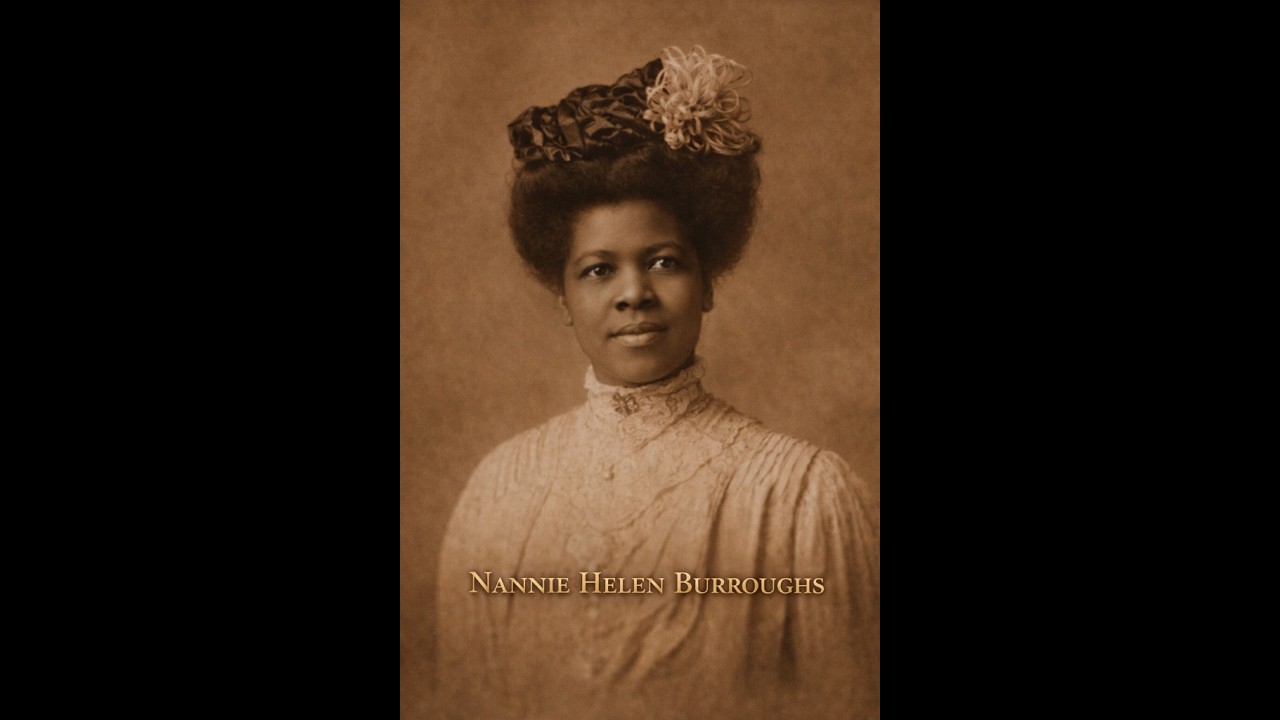
Nannie Helen Burroughs (1879–1961) transformed personal rejection into institutional revolution. Born in Orange, Virginia, to formerly enslaved parents and raised in Washington, D.C., she graduated with honors from M Street High School but was denied a teaching position—an exclusion widely attributed to colorism and class politics within the Black elite. Rather than accept marginalization, Burroughs resolved to build what she had been denied. In 1900, her speech “How the Sisters Are Hindered from Helping” before the National Baptist Convention launched her into national leadership and led to the formation of the Woman’s Convention, which she served for nearly fifty years. She framed Black women as the moral and economic backbone of the race and began envisioning an institution that would convert faith, discipline, and education into autonomy.
That vision became reality in 1909 with the founding of the National Training School for Women and Girls in Northeast Washington, D.C. Funded largely by small donations from Black women and children rather than white philanthropy, the school stood as a model of economic self-determination. Burroughs’ motto—“We Specialize in the Wholly Impossible”—captured her refusal to accept imposed limits. Her curriculum blended classical academics with industrial training and moral formation, structured around the “Three B’s”: the Bible, the Bath, and the Broom. These principles elevated spiritual grounding, personal discipline, and vocational excellence into tools of political defense and racial uplift. She also required Black history instruction long before it was standard, insisting that students understand their own narrative as a foundation for leadership.
Beyond the campus, Burroughs wielded education as a political instrument. She advocated for women’s suffrage, calling the ballot a “weapon of moral defense,” and participated in national reform efforts, including a presidential appointment under Herbert Hoover. Despite institutional friction—including an attempt by the National Baptist Convention to withdraw support—her school endured through grassroots backing. By the time of her death in 1961, Burroughs had built more than a campus; she had constructed a durable framework for Black women’s autonomy. Renamed in her honor in 1964 and later designated a National Historic Landmark, her institution remains a testament to her belief that the impossible is not a barrier, but a specialty.
RESOURCES:
Archival Collections and Primary Sources
• The Nannie Helen Burroughs Papers (1900-1963), Manuscript Division, Library of Congress.
• National Training School for Women and Girls Photographic Collection (LOT 12571), Library of Congress Prints & Photographs Division.
• Historic Newspapers via Chronicling America (including The Broad Ax, The Denver Star, The Bee, Richmond Planet, and The Christian Banner).
• Archives of Women's Political Communication, Iowa State University.
Books Focused on Burroughs
• Graves, Kelisha B., ed. Nannie Helen Burroughs: A Documentary Portrait of an Early Civil Rights Pioneer, 1900-1959 (University of Notre Dame Press, 2019).
• Easter, Opal V. Nannie Helen Burroughs (Garland Publishing, 1995).
• Johnson, Karen Ann. Uplifting the Women and the Race: The Lives, Educational Philosophies, and Social Activism of Anna Julia Cooper and Nannie Helen Burroughs (Garland / Modern Library, 2000/2004).
Academic Articles and Essays
• Harley, Sharon. "Nannie Helen Burroughs: 'The Black Goddess of Liberty.'" The Journal of Negro History 81, No. 1 (1996): 62-71.
• Taylor, Traki L. “'Womanhood Glorified': Nannie Helen Burroughs and the National Training School for Women and Girls, Inc., 1909-1961.” The Journal of African American History 87 (Autumn 2002): 390-402.
• Wolcott, Victoria W. "'Bible, Bath, and Broom': Nannie Helen Burroughs's National Training School and African-American Racial Uplift." Journal of Women's History 9, No. 1 (1997): 88–110.
• Smith, Karen E. “Nannie Helen Burroughs (1879-1961): A Voice for Social Justice and Reform.” In Twentieth-Century Shapers of Baptist Social Ethics, edited by Larry L. McSwain (Mercer University Press, 2008).
• Mason, Ann Michele. Nannie Helen Burroughs' Rhetorical Leadership During the Inter-War Period (University of Maryland).
Broader Historical Texts and Biographical Dictionaries
• Higginbotham, Evelyn Brooks. Righteous Discontent: The Women's Movement in the Black Baptist Church, 1880–1920 (Harvard University Press, 1993).
• Giddings, Paula. When and Where I Enter: The Impact of Race and Sex on Black Women in America (William Morrow, 1996).
• Fitzpatrick, Sandra & Maria R. Goodwin. The Guide to Black Washington: Places and Events of Historical and Cultural Significance in the Nation's Capital (Hippocrene Books, 2001)
• Hine, Darlene Clark, et al., eds. Black Women in America: An Historical Encyclopedia (Carlson Publishing / Oxford University Press, 1993/2005)

















Информация по комментариям в разработке