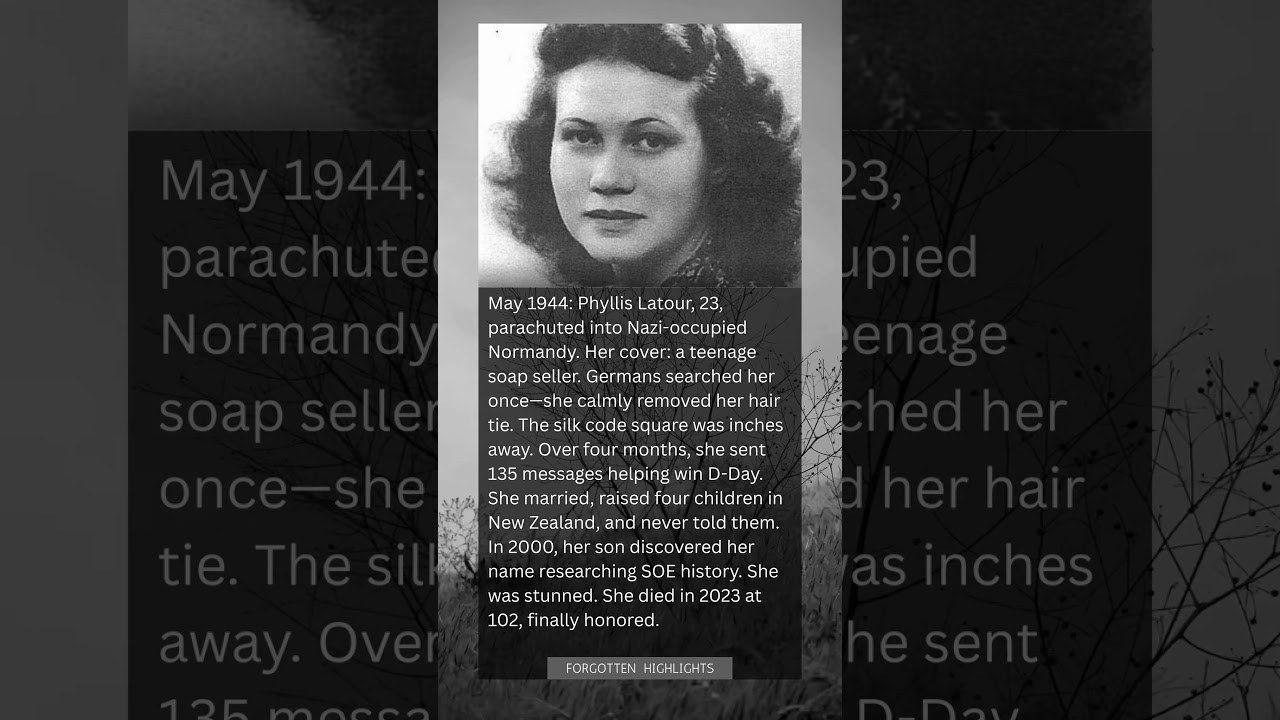
May 1944: A 23-year-old woman parachuted into Nazi-occupied France, posed as a teenage soap seller, and sent 135 coded messages hidden in her hair that helped win D-Day. Her own children didn't know until 2000. She died last year at 102.Her name was Phyllis Latour, and her story is one of the most extraordinary from World War II.The Training:Phyllis Latour was born March 8, 1921, in South Africa. Her father was a Belgian doctor, her mother British. She grew up partly in Belgium, partly in Britain, speaking fluent French and English.When the Nazis invaded Belgium, they killed her godfather—a Belgian diplomat Phyllis loved deeply.She wanted revenge.In her early twenties, Phyllis was recruited by the Special Operations Executive (SOE)—Churchill's secret organization created to "set Europe ablaze" through sabotage, espionage, and supporting resistance movements across occupied Europe.The SOE needed agents who could blend into occupied France. Young, bilingual women were ideal—less suspicious than men, able to move around more freely, often underestimated by Nazi soldiers.Phyllis's training was intense:Scottish Highlands: Brutal physical conditioning alongside male commandos. Phyllis proved she could handle it.Morse code and wireless operation: She learned to send and receive coded messages—a critical and dangerous skill. German detector vans could triangulate radio transmissions, and captured wireless operators were executed.Parachute training: Rare for women at the time. Phyllis would jump from a bomber into enemy territory—alone.Tradecraft: Surveillance, counter-surveillance, maintaining cover stories, living under constant suspicion.The cat burglar: One of her instructors was a former cat burglar recruited by SOE to teach agents how to pick locks, climb walls, break into buildings, and move silently without leaving traces.Phyllis absorbed it all. By spring 1944, she was ready.The Jump: May 1944In May 1944—one month before D-Day—Phyllis Latour, age 23, boarded a US Air Force bomber.She was heading to occupied Normandy, where Allied forces would soon land. Her mission: gather intelligence on German positions, troop movements, and fortifications. Send it back to Britain. Help the bombers find their targets.It was a night jump. Solo. Into enemy territory crawling with Nazi patrols and Gestapo agents hunting spies.As the plane flew over Normandy, Phyllis jumped.She parachuted into darkness, landed, and immediately buried her parachute and jump suit. She changed into the clothes of a poor French peasant girl.From that moment, Phyllis Latour ceased to exist.She became "Genevieve"—a poor, simple, teenage French girl trying to survive the occupation.The Mission: Four Months Behind Enemy LinesPhyllis's mission would last four months—from May through September 1944, covering D-Day (June 6) and its aftermath.Her cover: A poor peasant girl, age 14-16 in appearance (though she was 23), who traveled by bicycle selling soap or doing odd jobs. She acted "silly" and harmless, chatting innocently with German soldiers, playing the role of a country girl who posed no threat.It was brilliant. German soldiers dismissed her as too young, too poor, too stupid to be dangerous.They had no idea she was a British-trained spy gathering intelligence on their positions.The dangers were extreme:Previous agents captured: Phyllis later said, "The men who had been sent before me were caught and killed. I was chosen because I would be less suspicious."Male agents in her operational area had been captured by the Gestapo and executed. The Nazis were hunting spies relentlessly.Radio detection: Every time Phyllis set up her wireless radio to transmit, she risked detection. German vans equipped with direction-finding equipment could triangulate transmissions. She had to transmit quickly, from different locations, then dismantle and move.Constant surveillance: Gestapo and Wehrmacht patrols were everywhere. Checkpoints. Searches. Suspicion.Living rough: Phyllis moved constantly to avoid detection. She often slept in forests, barns, or with Resistance families when safe houses were available. She found her own food—foraging, begging as part of her cover, or receiving help from the Resistance.The Silk Code:Phyllis's most famous piece of tradecraft: how she hid her codes.The SOE provided agents with encryption codes printed on silk squares. Silk was chosen because it was durable, silent (didn't crinkle like paper), and could be sewn into clothing.Phyllis kept her silk code square hidden in her hair tie.She used a pin to prick the silk each time she used a particular code, ensuring she never repeated and risked German code-breakers detecting patterns.The incident everyone remembers:One day, Germans stopped Phyllis and searched her.They were looking for papers, weapons, anything suspicious.As they searched, Phyllis calmly removed her hair tie and let her hair fall, appearing to cooperate fully and showing she had nothing to hide.

Информация по комментариям в разработке