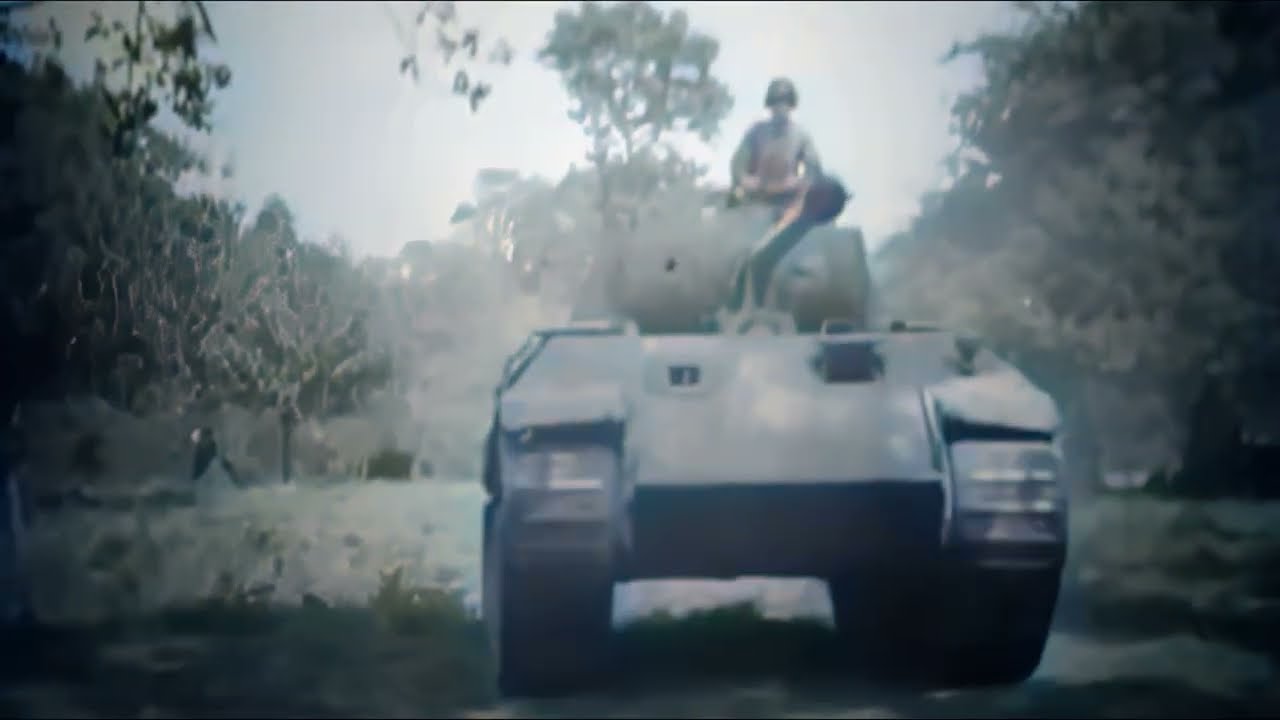
The Panther tank, officially Panzerkampfwagen V Panther (abbreviated Pz.Kpfw. V) with ordnance inventory designation: Sd.Kfz. 171, is a German medium tank of World War II. It was used in most European theatres of World War II from mid-1943 to the end of the war in May 1945.
The Panther was intended to counter the Soviet T-34 medium tank and to replace the Panzer III and Panzer IV. Nevertheless, it served alongside the Panzer IV and the heavier Tiger I until the end of the war. While having essentially the same Maybach V12 petrol (690 hp) engine as the Tiger I, the Panther had better gun penetration, was lighter and faster, and could traverse rough terrain better than the Tiger I. The trade-off was weaker side armour, which made it vulnerable to flanking fire, and a weaker high explosive shell. The Panther proved to be effective in open country and long-range engagements. The Panther had excellent firepower, protection and mobility, though early variants suffered from reliability issues. The Panther was far cheaper to produce than the Tiger I. Key elements of the Panther design, such as its armour, transmission, and final drive, were simplifications made to improve production rates and address raw material shortages.
The Panther was rushed into combat at the Battle of Kursk in the summer of 1943 despite numerous unresolved technical problems, leading to high losses due to mechanical failures. Most design flaws were rectified by late 1943 and early 1944, though the Allied bombing of production plants in Germany, increasing shortages of high-quality alloys for critical components, shortage of fuel and training space, and the declining quality of crews all impacted the tank's effectiveness. Though officially classified as a medium tank, at 44.8 metric tons the Panther was closer in weight to contemporary foreign heavy tanks. The Panther's weight caused logistical problems, such as an inability to cross certain bridges; otherwise, the tank had a very high power-to-weight ratio which made it highly mobile.
The naming of Panther production variants did not follow alphabetical order, unlike most German tanks - the initial variant, Panther "D" (Ausf. D), was followed by "A" and "G" variants.
The Western Allies were aware of the Panther and had access to technical details through the Soviets, but there was a difference in the American and British camps as to the significance of the tank. After taking two years to catch up with German tank design in Africa, the British were wary of falling behind yet again. They had developed the excellent 17-pounder anti-tank gun, but did not yet have a vehicle in service that could fit this large gun into its turret. For its part, the U.S. Army did not believe that the Panther would be a significant problem, and did not foresee their armoured forces having to fight pitched engagements against large numbers of Panthers. The Panther was not seen in combat by the Western Allies until early 1944 at Anzio in Italy, where Panthers were employed in small numbers. Until just before D-Day (6 June 1944), the Panther was thought to be another heavy tank that would not be built in large numbers.
Shortly before D-Day, Allied intelligence reported that large numbers of Panthers were being used in the Panzer divisions, and an attempt was made to investigate Panther production. Using a statistical analysis of the serial numbers on the road wheels on two captured tanks, U.S. intelligence estimated Panther production for February 1944 to be 270 units, much greater than what had been anticipated. This estimate was very accurate, especially compared to previous methods, as German records after the war showed production of Panthers for the month of February 1944 was 276. This indicated that the Panther would be encountered in much larger numbers than had previously been thought.[155] In the planning for the Battle of Normandy, the U.S. Army expected to face a handful of German heavy tanks alongside large numbers of Panzer IVs. At this point, it was too late to prepare to face the Panther. As it turned out, 38% of the German tanks in Normandy were Panthers, whose frontal armour could not be penetrated by the 75 mm guns of the US M4 Sherman.
#worldwar2 #panzer #documentary

Информация по комментариям в разработке