This… is the most magical tree in the world.
You can eat it, you can drink from it, and in hard times, you can even live inside it.
Yes — live inside a tree.
In parts of Africa where drought and hunger are part of daily life,
this one tree has become a symbol of hope, survival, and even life itself.
Its name? The Baobab Tree.
Also known as the “Monkey Bread Tree” — and trust me, it’s just as cool as it sounds.
At first glance, the baobab looks almost… upside down.
Its thick, towering trunk shoots into the sky,
while its branches look like tangled roots reaching into the clouds.
Some African legends even say the gods planted it upside down — by mistake or maybe for a reason.
But what makes this tree so incredible isn't just how it looks.
It's what it does.
Let’s start with its size.
A baobab tree can grow up to 15 meters wide — that's as wide as a small house.
And some can live for over a thousand years.
That’s right. These trees are older than many civilizations.
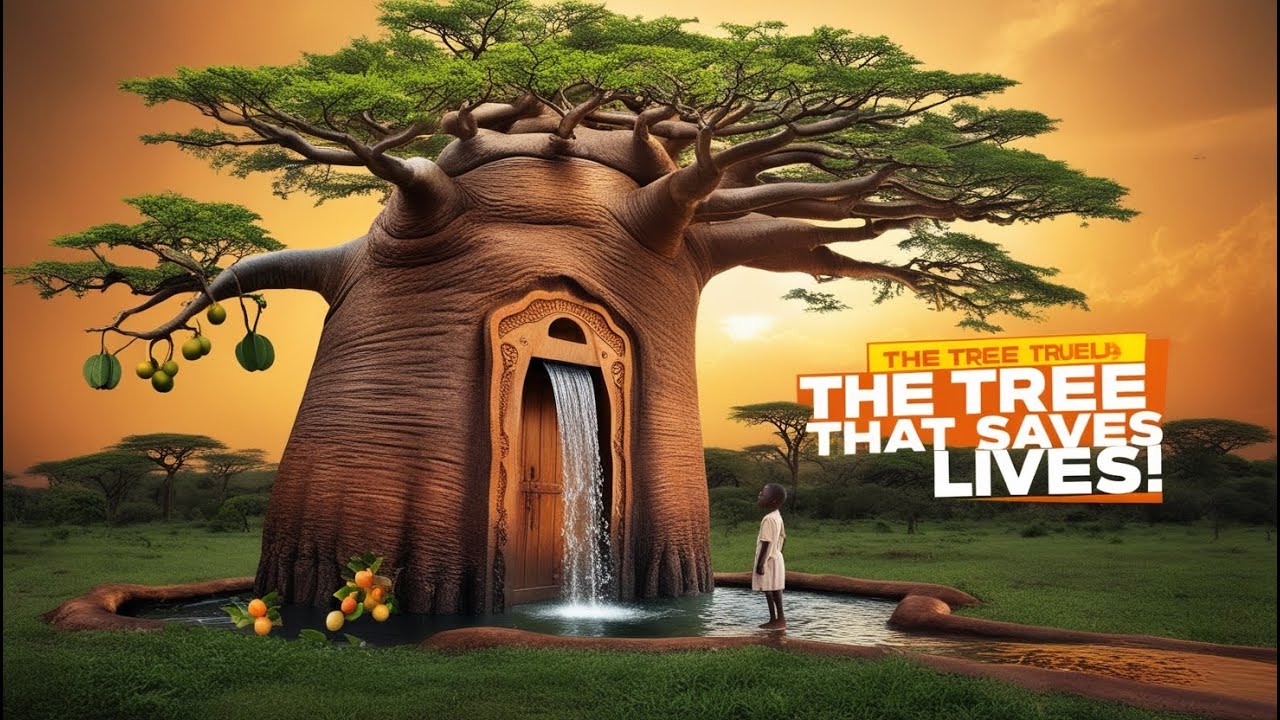
When the rainy season comes, the baobab becomes like a giant sponge.
Its trunk soaks up and stores water —
up to 4,500 liters, just sitting quietly inside.
That’s enough to fill over 20 bathtubs.
Then, when the dry season hits and water becomes nearly impossible to find,
people know where to turn.
They gently tap into the tree — just a small hole —
and out comes clean, drinkable water.
Natural. Fresh. Life-saving.
It’s like the tree is saying,
"Here. Take what you need."
But wait — it doesn’t stop there.
The baobab produces fruit. A lot of fruit.
In one season, it can grow over a thousand fruits —
Each one packed with more vitamin C than oranges,
and more antioxidants than blueberries.
Locals dry the fruit, grind it into powder, and mix it into drinks or food.
It’s used to treat fevers, digestive problems, even skin infections.
Some people call it the “superfruit of Africa” — and now, it’s even being exported around the world.
Still not impressed?
Well, here’s something you probably didn’t expect:
The baobab is also a home.
Yep. Its wide trunk, which often becomes hollow over time,
can be turned into a shelter.
People have used baobab trees as homes, grain storage, even as makeshift schools.
Imagine children learning their ABCs inside a tree!
That’s not fantasy. That’s real life in some remote African villages.
So when you think about the baobab, don’t just see a tree.
See a life-giving force.
A water tank. A pantry. A medicine cabinet. A shelter.
All in one.
And in places where the land is dry and resources are scarce,
this tree isn’t just part of the environment.
It’s part of the community.
Part of the culture.
Part of survival.
The baobab teaches us something powerful:
That even in the harshest conditions, nature finds a way to care for us —
if we listen, and if we respect it.
So next time you see a strange tree that looks like it's growing upside down,
just remember —
it might be holding a thousand stories,
a thousand meals,
and a thousand years of wisdom…
inside its trunk.

Информация по комментариям в разработке