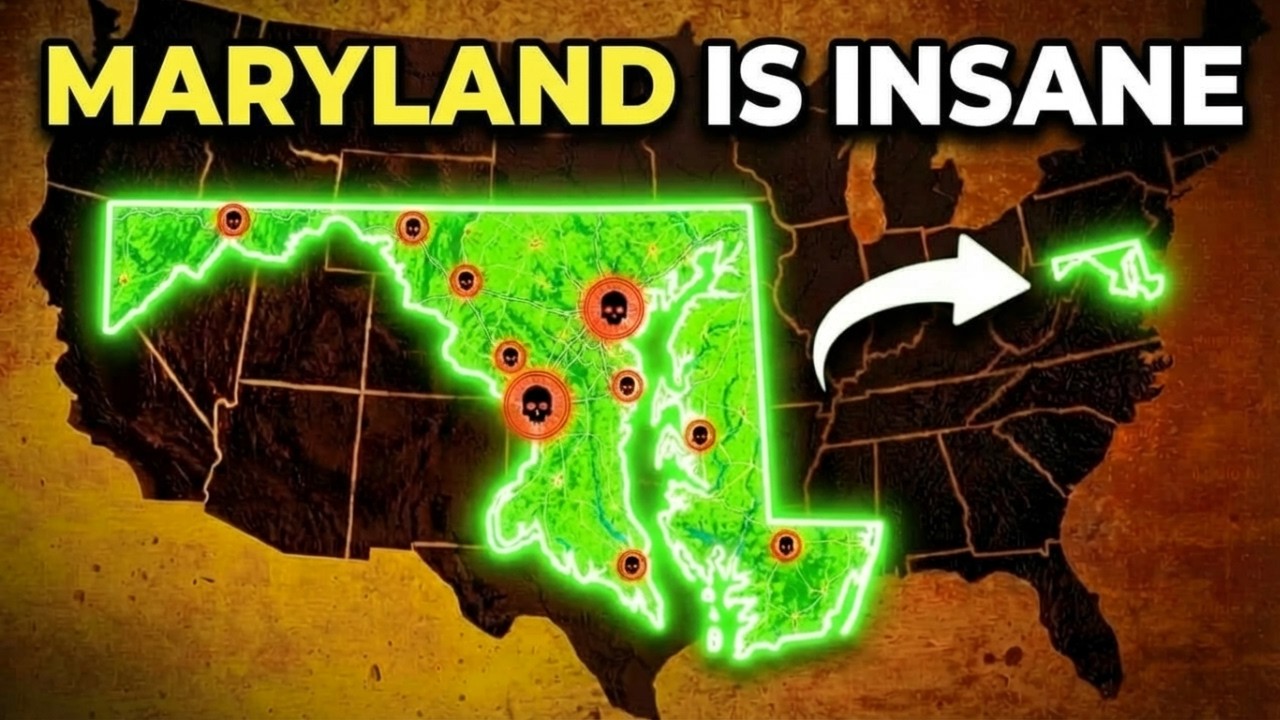
Maryland looks simple on a map. A small East Coast state wrapped around Washington D.C. But nothing about Maryland is simple.
It’s the richest state in America, with the highest median household income in the country. Yet its largest city, Baltimore, struggles with deep poverty and decades of economic decline. Just across the border lies West Virginia — the poorest state in the nation — creating one of the sharpest wealth contrasts anywhere in the United States.
Maryland is called “America in Miniature” for a reason. In just 12,000 square miles, it contains Appalachian mountains, farmland, major cities, the vast Chesapeake Bay, and Atlantic beaches. But the Chesapeake Bay doesn’t just define Maryland — it divides it. The Eastern Shore and Western Shore are culturally, politically, and economically different worlds.
Its state flag still reflects Civil War divisions between Union and Confederate sympathizers. Its economy thrives on federal power, defense contracts, and proximity to Washington D.C. And the Chesapeake Bay — the heart of Maryland’s identity — is facing environmental crisis, collapsing fisheries, and rising sea levels.
Mountains to ocean. Wealth next to poverty. North and South in one place.
Maryland isn’t just a state. It’s a compressed version of America itself.
This is why Maryland is the opposite of every other state in the Union.
Subscribe for more deep-dive geography documentaries exploring the hidden contradictions of U.S. states and places around the world.
Maryland geography, Maryland explained, Maryland documentary, Maryland facts, Chesapeake Bay geography, Baltimore geography, Annapolis Maryland, Delmarva Peninsula, Eastern Shore Maryland, Maryland shoreline, tidal estuaries, Chesapeake Bay watershed, Maryland rivers, Potomac River Maryland, Susquehanna River, coastal plain Maryland, piedmont Maryland, Appalachian Maryland, how geography shaped Maryland, US geography documentary, states explained, geography explained, travel Maryland
Информация по комментариям в разработке