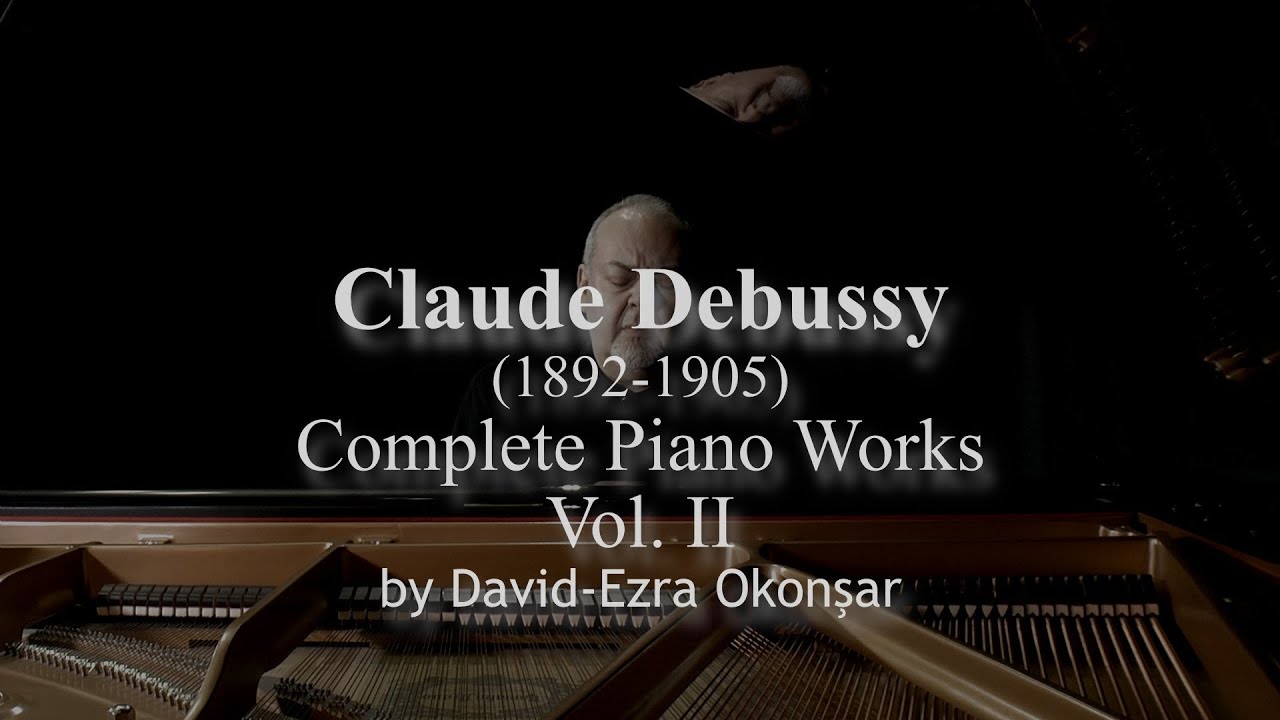
L 75, Suite bergamasque (1890-1905)
Prélude
Menuet
Clair de lune
Passepied
L 82, Nocturne (1892)
L 87, Images oubliées (1894)
Lent
Souvenir du Louvre
Quelques aspects de "Nous n'irons plus au bois"
L 95, Pour le piano suite (1894–1901) [approx. dur: 12:40]
Prélude
Sarabande
Toccata
[..]
For the piano works the ascending curve of the originality of his output was somehow late but steeper than anywhere else. The pivoting date seems to be 1903 with "Estampes". With this work the piano becomes for the first time a "Debussy piano".
The piano music of Debussy can be divided into six parts which are not always in sync with his compositions in other fields.
From 1880 to 1890, youth works: "Danse bohémienne" (L 9, 1880); L 50, Suite for orchestra (piano reduction) (1885); L 66, "Deux arabesques" (1888, 1891); L 67, Mazurka (1890); L 68, "Rêverie" (1890); L 69, "Tarantelle styrienne" (Danse) (1890); L 70, Ballade slave (Ballade) (1890); L 71, "Valse romantique" (1890).
Transition works, 1890 to 1901: L 75, "Suite bergamasque" (1890-1905); L 82, Nocturne (1892); L 87, "Images oubliées" (1894); L 95, "Pour le piano" suite (1894–1901). A fast and bewildering evolution shows in the "Suite" which is the start of the "real" Debussy at the piano.
First maturity works, intense research on sound-colors and the use of evocative titles. Here Debussy is truly "impressionist". L 99, "D'un cahier d'esquisses" (1903); L 100, "Estampes" (1903); L 105, "Masques" (1904); L 106, "L'isle joyeuse" (1904); L 108, Morceau de concours (Pièce pour piano) (1904); L 110, "Images", Set 1 (1905).
A kind of break (1908-1909) with principally the Children's Corner and less revealing works like L 114, "The Little Nigar" ("Le petit Nègre") (1909); L 115, "Hommage à Joseph Haydn" (1909).
The two volumes of Preludes: 1909-1912. These raise to the summit the evolution started with "Estampes" and specially the second volume will trigger the last period: that of the Etudes (1915) where the piano of Debussy is at its apogee.
I find interesting to note that in the piano music of Claude Debussy one can find all keys except the "great" Beethoven-ian ("tragic") key of C minor! The only tonic key absent from the 24 Preludes is E major and from the 12 Etudes: E-flat major and B major.
For one thing the choice of key center is strongly set by the technicalities of the performance of the piece. Just like Chopin, Debussy is a pianist-composer and a piece like "Etude pour les huit doigts" (study for eight fingers, not using the thumbs) will best run, of course, on the black-keys written in the tonality of G-flat Major. Besides that practical aspect, many keys seem to have for Debussy, as they just had for Mozart and Beethoven too, a particular signification.
C major is neutrality, purity (Doctor Gradus ad Parnassum, Les tierces alternées, Pour les cinq doigts) but also, pure tint without any hue it is "gray" (Brouillards).
The A minor key is, in Debussy, is the deployment of power. It is the key for strong chords, repeated notes and chords: Prelude "Pour le piano", Masques, Etude pour les accords.
D minor, often handled in a Dorian mode style is the snow, the emptiness, the silence and the loneliness. "The snowflakes are dancing", "Des pas sur la neige", "Canope".
Satyr and cold humour is often expressed in F major: "General Lavine", "Hommage a S. Pickwick", "Etude pour les agrements".
[..]
[read more: okonsar.com] ............................................................
Album available at: SPOTIFY - ITUNES / Apple Music - SOUNDCLOUD - AMAZON-MUSIC
Licensing: POND5

Информация по комментариям в разработке