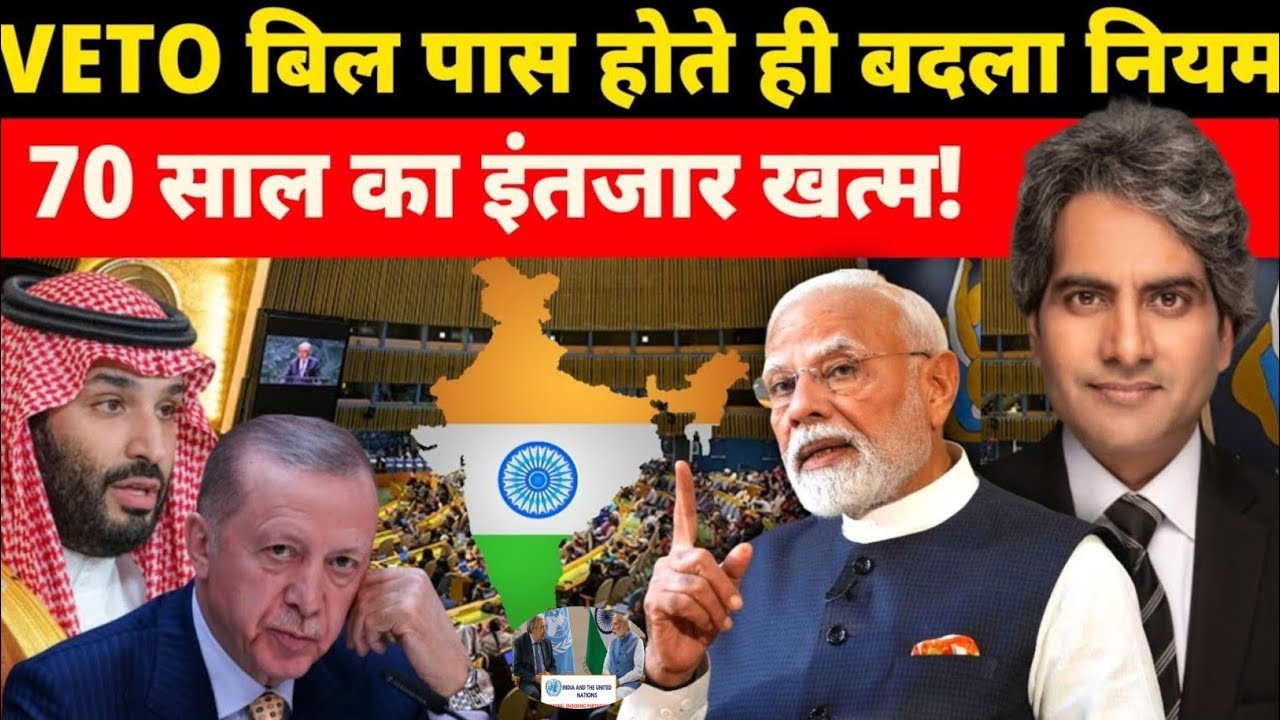
UN Security Council Reform: Will India Get Permanent Membership with Veto Power? |Shudhir chaudhary
India UNSC Permanent Seat
India United Nations Security Council
UNSC reform explaine
Why India deserves UNSC seat
India veto power demand
UN Security Council reform 2025
India UN membership explained
Jaishankar UNSC speech
India vs China UNSC
UNSC permanent members explained
India G4 countries UNSC
UN reform India demand
India UN Security Council history
UNSC veto power explained
United Nations reform 2025
#IndiaVsTurkey
#unitedstates
#IndiaTurkeyConflict
#IndianNavy
#TurkeyNews
#Geopolitics
#BreakingNews
#MediterraneanSea
#INSTrikand
#NATO #WorldNews
#DefenceUpdates
#IndiaBreakingNews
#TurkeyCrisis
#IndiaStrong
UN Security Council Reform: Will India Get Permanent Membership with Veto Power?”
The United Nations Security Council (UNSC) is considered the most powerful body in the world, responsible for maintaining global peace and security. Whenever there is war, terrorism, or a humanitarian crisis, the UNSC takes the final call. But the irony is that the Council’s structure, created in 1945, has remained the same even after more than seven decades.
The five permanent members—USA, Russia (then Soviet Union), UK, France, and China—were given veto power, which means any one of them can block a resolution, no matter how many nations support it. This arrangement was made after World War II to prevent another global conflict. But today’s world is completely different. New powers have emerged, yet the Security Council has failed to represent this new reality.
India has been demanding reforms for decades, seeking a permanent seat with veto power. The reasons are strong and undeniable:
Peacekeeping Role: India has contributed the highest number of soldiers to UN peacekeeping missions in countries like Congo, Lebanon, Sudan, and Somalia, even sacrificing the lives of its soldiers for world peace.
Rising Global Power: India is now the world’s most populous country and the fifth-largest economy, projected to become the third-largest soon. From IT and pharma to space and nuclear technology, India is among the fastest-growing global players.
Voice Against Terrorism: India has consistently raised its voice against terrorism, calling for a unified global strategy. Yet, due to the veto power of other nations, strong actions often get blocked.
However, India’s path is not easy. Any reform in the UN Charter requires the support of two-thirds of the General Assembly and unanimous approval from all five permanent members. China remains the biggest obstacle, fearing India’s rise and often backing Pakistan to counter New Delhi.
At the same time, many powerful nations support India’s claim. The US, France, Russia, and even the UK have expressed clear support. More than 140 countries recognize India as a responsible power and believe it deserves a permanent seat. Along with Japan, Germany, and Brazil, India is part of the G4 group, pushing for reforms to make the Council more representative.
India’s External Affairs Minister S. Jaishankar recently voiced strong criticism of the UN, pointing out its failure in stopping wars, preventing terrorism, and ensuring fair vaccine distribution during the COVID-19 crisis. His speech was a clear warning: without reform, the UN risks becoming irrelevant.
If India gets permanent membership with veto power, it will not only strengthen its position against hostile resolutions but also bring greater balance to Asia and the developing world. However, if India is denied, it raises serious questions about the UN’s credibility and relevance in the 21st centur

Информация по комментариям в разработке