“Colossus”
oil paintings by Peter Winterhalter Aspell (1918-2004)
January 25 to February 22, 2025
Gallery Jones
1 – 258 East First Avenue
Vancouver, BC
open Tuesday to Friday from 11am to 6pm
Saturday from Noon to 5pm
catalogue text from “Black is a Colour” by Darrin Morrison, 2017
Peter Aspell (1918–2004) was among a core group of influential artists to gain early recognition in postwar Vancouver. After WWII, Aspell attended the Vancouver School of Art, where he would later return to teach. He was one of a few young artists selected by Lawren Harris in 1947 to participate in an exhibition held at the World Youth Festival in Prague. In 1959 he was included in a seminal nationally touring exhibition entitled “7 West Coast Painters”.
By the early 1950s the prevailing international mode of expression in contemporary art was painterly abstraction. While abstraction was making inroads in Canada, landscape remained a preoccupation. Vancouver painters (many of whom had studied with artists such as Hans Hofmann in New York) focused on creating a regional style of abstraction responsive to nature and landscape and to its destruction by urban development. Scott Watson notes that there was a common underlying dark current in work being produced at the time and artists such as Aspell and others were producing works that “emphasize dread and loneliness.” [1]
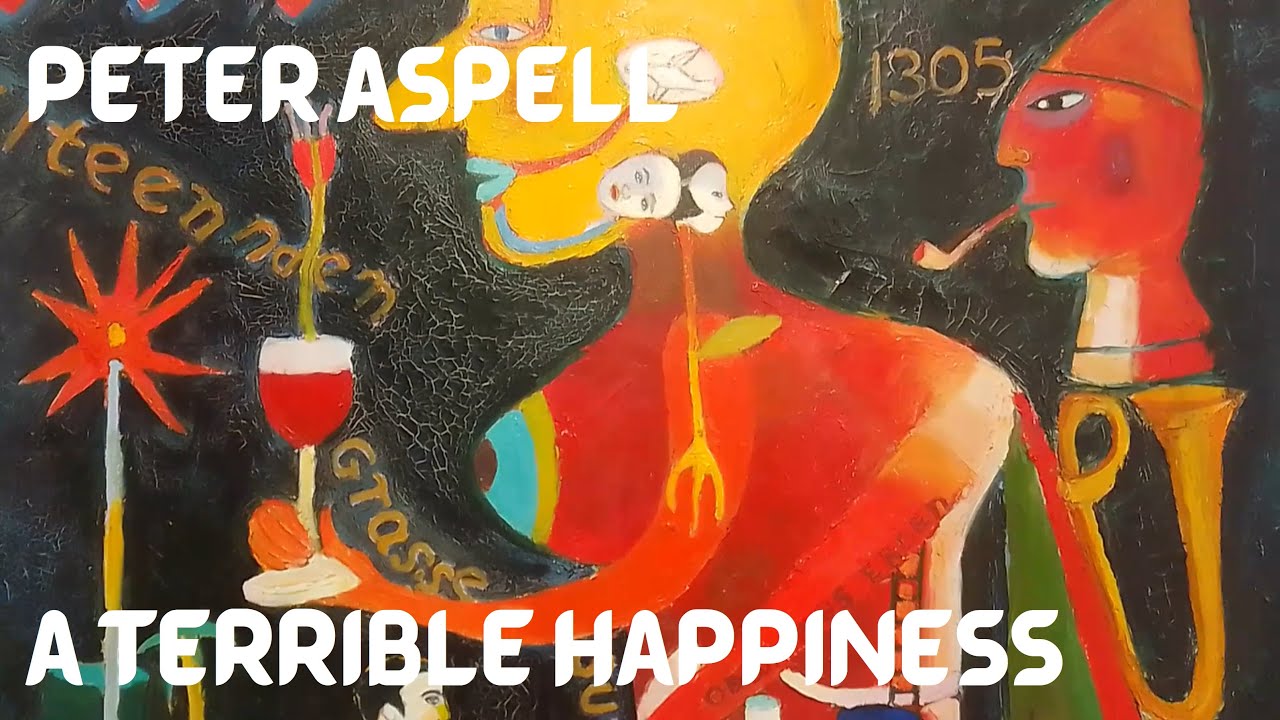
Aspell and a few others chose figuration as their principal subject matter. Their approach set them apart from the prevailing interest in nature-based abstraction; instead they looked to the human form to express “modern anxiety and isolation.” [2] Aspell, reflecting on portraiture, said, “the distilled image revealed by [a person’s] movement and expression, shows the hidden workings of their soul.” [3] Despite developing an intense colour palette, an introspective, mystical, and at times menacing overtone pervaded much of Aspell’s work. In the 1970s, Aspell departed from figuration, producing abstract forms referred to as “T” paintings. Then in the 1980s he began to incorporate mythical and non-Western imagery. Honing a distinct colour palette using oil paint applied with knives and brushes, then scraped and scratched with sticks, Aspell developed a vocabulary that included ominous flaming vessels, floating figures, masks, and Egyptian motifs.
Raised in a Catholic household, Aspell was both imbued with its teachings and conflicted by its complex history and abuses of power. This is most apparent in Aspell’s later works from the 1990s, when he returned to portraiture and the critical depiction of popes and cardinals, industrialists, dictators, and generals. These were followed by probing works exposing the inner workings of the figures’ bones and organs in his X-ray series, followed by another series showing humans intertwined with machines.
In the 1980s Aspell gained wider attention, exhibiting locally and in Los Angeles, New York, Chicago, Toronto, and Europe, but he remained on the periphery in curatorial circles despite this success. Art in Vancouver by this time was focusing first on conceptual art then photo-conceptualism. Notably, there was resurgence of painting on the West Coast demonstrated by the artists included in the 1985 Young Romantics exhibition at the Vancouver Art Gallery. By challenging the conventions of their predecessors, post-war artists including Peter Aspell had established a foundation for modern art in Vancouver. Aspell continued to work until his death, producing some of his most ambitious and mature work in his later years, including the monumental and apocalyptic “March of the Machines” in 1999.
[1] Scott Watson, “The Lost City: Vancouver Painting in the 1950s,” in A Modern Life: Art and Design in British Columbia 1945–1960, Vancouver Art Gallery, 2004, p. 114.
[2] Scott Watson, “Art in the Fifties: Design, Leisure, and Painting in the Age of Anxiety,” in Vancouver Art and Artists 1931–1983, Vancouver Art Gallery, 1983, p. 87.
[3] David Gordon Duke, The Terrible Happiness of Peter Aspell, Vancouver Sun, May 24, 2004, Section C3
For more information, please visit ...
https://www.galleryjones.com/

Информация по комментариям в разработке