Dan Westervelt, a Lamont Associate Research Professor at Columbia University and Lamont-Doherty Earth Observatory, speaks to SoMAS at the Topics in Atmospheric and Oceanic Sciences seminar on November 12, 2025 on the topic "Air Pollution and Climate Change in the Global South: from air sensors to supercomputers."
His research focuses on aerosol, air quality, atmospheric chemistry, and climate change, with a specific focus on the global south. For more information about Dr. Westervelt, please visit: https://aerosol.ldeo.columbia.edu/
Dr. Daniel M. Westervelt is an Associate Research Professor at Lamont-Doherty Earth Observatory (LDEO). Dr. Westervelt is also an affiliate faculty member of the Columbia University Data Science Institute, an affiliated scientist with NASA Goddard Institute for Space Studies, and an air pollution advisor to the US State Department. He is also a Columbia University Climate and Life Fellow. He was awarded the 2024-2025 Faculty Mentorship Award for Columbia University’s Graduate School of Arts and Sciences. His current research spans climate change and atmospheric chemistry and physics using models, advanced in-situ instrumentation, and remote sensing, with an emphasis on applications in Low and Middle Income Countries (LMICs). Prior to his faculty position at Lamont-Doherty Earth Observatory, he worked as an Associate Research Scientist at LDEO, and as a Science, Technology, and Environmental Policy (STEP) postdoctoral research associate at Princeton University. He completed his PhD degree in May 2013 in Civil and Environmental Engineering from Carnegie Mellon University.
Abstract:
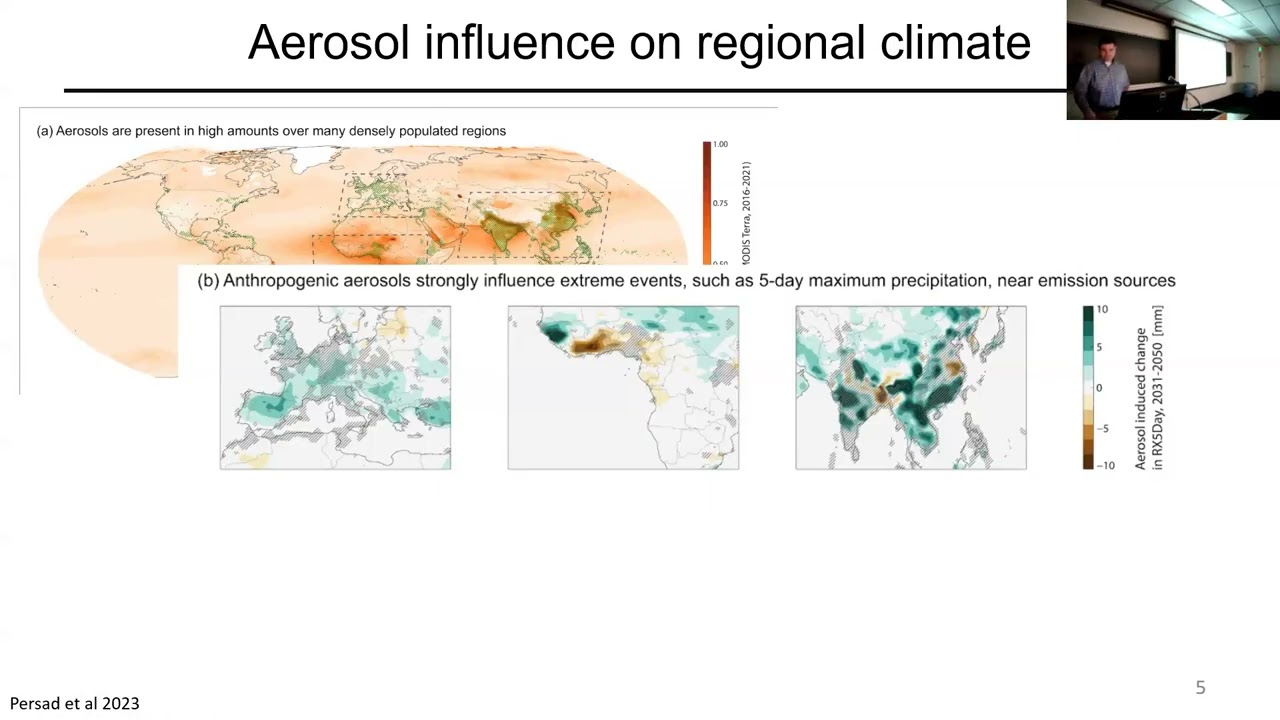
In Africa, air pollution exposure has been linked to 1.1 million premature deaths annually and, without intervention, these numbers are likely to climb. Sparse pollutant monitoring across the continent makes these estimates uncertain and also hinders the development of mitigation policies and regulations. Additionally, some of the most severe climate impacts are also felt in Africa, despite the continent's relatively small contribution to global greenhouse gas emissions. This talk will highlight some recent efforts to close the air pollution data gap in Africa using a variety of methods spanning from research grade mass spectrometers, to traditional reference monitors, to consumer-grade low-cost sensors, to satellite retrievals, and to air quality and climate models. In particular we demonstrate the effectiveness of well-calibrated low cost particulate matter sensors in several previously-unmonitored megacities including Kinshasa (DRC), Lomé (Togo), Accra (Ghana), Nairobi (Kenya), and more. These well-calibrated sensors form the basis of dense urban networks of PM2.5 monitors in several African megacities, for example in Kinshasa (DRC), where the annual mean PM2.5 in 2019 was approximately 45 µg m-3, or ~8 times the WHO annual guideline. Finally, I will present climate modeling results that quantify how both local and remote aerosol emissions changes can have a substantial impact on African climate, in particular rainfall in the drought-stricken Sahel region of Africa.
For more information about the School of Marine and Atmospheric Sciences, please visit https://somas.stonybrook.edu

Информация по комментариям в разработке