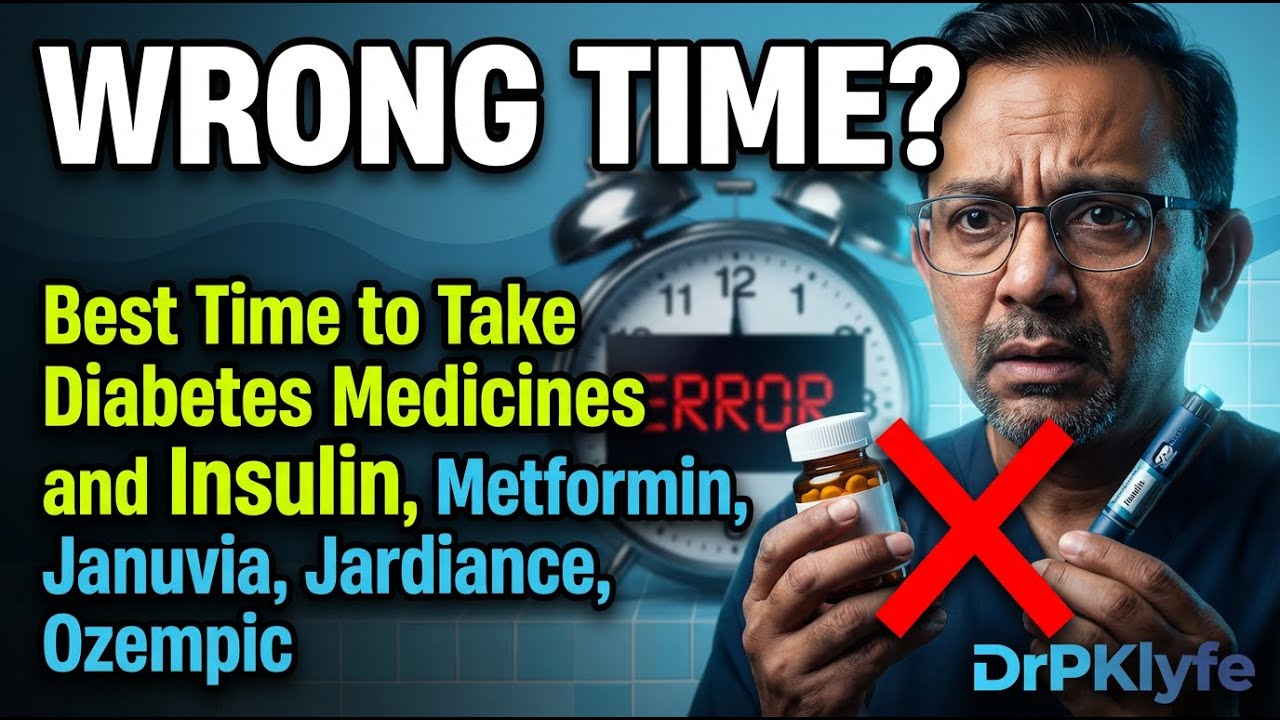
🩸 Best Time to Take Diabetes Medicines and Insulin
Taking diabetes medicine at the right time can make all the difference.
In this educational video, Dr. Karan from DrPKLyfe explains the best timing for common U.S. diabetes medications and insulin — and how to synchronize them with your body’s circadian rhythm.
📋 Covered in this video:
✅ Why timing matters for blood sugar control
✅ Morning vs Evening medicines
✅ When to take Metformin, Glipizide, Januvia, Actos, Jardiance, and Farxiga
✅ Best time for Insulin (Lantus, Tresiba, Humalog, Novolog, etc.)
✅ Weekly injections (Ozempic, Trulicity, Mounjaro) explained
✅ Herbal support: Berberine, Gymnema, Cinnamon, Fenugreek
💊 Synchronize your medicines, meals, and metabolism — for steady glucose and fewer side effects.
(Doctor-Explainer Style — Integrative Medicine)
👨⚕️ Intro (0:00 – 0:30)
“Hello everyone, I’m Dr. Karan from DrPKLyfe.
Today we’ll discuss something most people with diabetes don’t fully realize — that when you take your medicines can be just as important as what you take.
Let’s understand the best timing for diabetes medicines and insulin so your blood sugar stays stable throughout the day and night.”
🕒 Why Timing Matters (0:30 – 1:30)
“Our body’s blood sugar fluctuates with meals, hormones, stress, and sleep.
Taking a tablet or insulin at the wrong time can cause sugar spikes or sudden drops.
The goal is to match the medicine’s peak action with your body’s sugar peak — usually after meals or early morning.
Correct timing also helps prevent side effects like hypoglycemia, stomach upset, or fatigue.”
🌞 Morning Medicines (1:30 – 2:15)
“In the morning, your blood sugar naturally rises — the dawn phenomenon.
That’s why certain medicines work best with breakfast or shortly after you wake up:
Metformin (Glucophage or Fortamet) — the most common first-line medicine. Take it with breakfast to reduce stomach irritation and to help your liver reduce morning glucose output.
Januvia (Sitagliptin) or Tradjenta (Linagliptin) — DPP-4 inhibitors that help control post-meal spikes; usually once daily in the morning.
Jardiance (Empagliflozin) or Farxiga (Dapagliflozin) — SGLT-2 inhibitors that help eliminate excess sugar through urine; morning is best since they may increase urination.
Glipizide (Glucotrol) or Glyburide (Diabeta) — should be taken about 30 minutes before breakfast so that insulin release peaks when you start eating.
Actos (Pioglitazone) — can be taken any time of day, but consistency matters; many prefer morning.
🌿 For natural support, take DrPKLyfe Berberine Complex or Cinnamon + Gymnema capsules with breakfast — these improve insulin sensitivity and help blunt that early glucose rise.”
🌙 Evening Medicines (2:15 – 3:00)
“Some medicines act better when taken at night:
Metformin ER (extended-release) or Glumetza ER — evening dosing helps control overnight liver glucose release.
Basal insulin such as Lantus, Basaglar, Tresiba, or Toujeo — usually taken before bedtime for stable fasting sugar.
Statins (e.g., Simvastatin, Pravastatin) — best taken at night since the liver produces cholesterol while you sleep.
Fenugreek or Ceylon Cinnamon capsules — slow glucose absorption from dinner and help keep fasting sugar stable overnight.”
💉 Insulin Timing Logic (3:00 – 4:00)
“Insulin timing depends on the type you use:
Rapid-acting insulin (Lispro / Humalog, Aspart / Novolog, Fiasp) — inject 10–15 minutes before meals to control meal-related spikes.
Regular insulin (Humulin R, Novolin R) — inject 30 minutes before eating since it acts slower.
Basal or long-acting insulin (Lantus, Tresiba, Toujeo, Levemir) — take it at the same time daily, usually bedtime.
And for people on once-weekly injectables like Ozempic (Semaglutide), Trulicity (Dulaglutide), or Mounjaro (Tirzepatide) — choose a consistent day each week; time of day doesn’t matter much.
Never skip meals after insulin or a sulfonylurea like Glipizide — and always rotate injection sites to prevent lipohypertrophy.”
🌿 Integrated Lifestyle & Summary (4:00 – 5:00)
“Medicines and insulin work best when supported by good lifestyle habits:
✅ Eat dinner early and light.
✅ Walk for 10–15 minutes after meals.
✅ Sleep on time — poor sleep raises fasting sugar.
✅ Manage stress — cortisol pushes glucose higher.
And if your doctor agrees, add herbal adaptogens such as Berberine, Gymnema, and Cinnamon for additional natural insulin support.
Remember — blood-sugar control isn’t just about lowering numbers; it’s about synchronizing your medicines, meals, and metabolism.
I’m Dr. Karan from DrPKLyfe — let nature and knowledge help you heal.
Stay healthy and balanced.”

Информация по комментариям в разработке