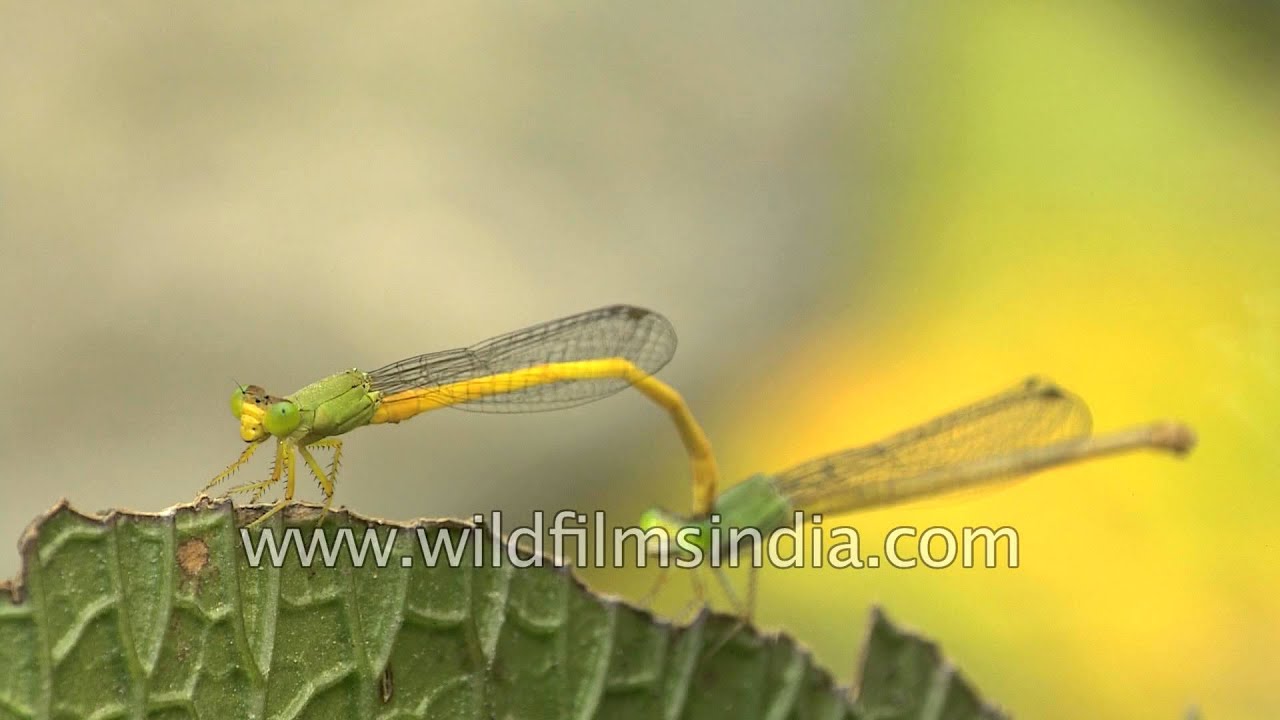
Look at the damselfly's face in close-up - it looks strangely mouse-like!
Damselfly (suborder Zygoptera), any of a group of predatory, aerial insects that are in the order Odonata. Damselflies are found mainly near shallow, freshwater habitats and are graceful fliers with slender bodies and long, filmy, net-veined wings. Damselflies are generally smaller, more delicate, and fly weakly in comparison with dragonflies (suborder Anisoptera). Their colours can be stunningly vivid. Wingspans among the 2,600 damselfly species range from 18 mm (0.71 inch) to about 19 cm (7.5 inches) in Megaloprepus caerulatus, a giant damselfly of tropical Central and South America.
Damselflies can usually be distinguished from dragonflies by their thinner, needlelike abdomens and by the way they hold their wings when at rest. With few exceptions, damselflies hold their wings vertically and together, rather than horizontally and spread apart. Also, the four wings are almost identical in size and shape and in the vein patterns. The large eyes of damselflies differ from those of dragonflies in that they are always widely separated, rather than close together or touching each other.
The adults prey in flight, mainly on small insects. They are indiscriminate feeders except for the members of one family (Pseudostigmatidae), which are specialists that pluck spiders from their webs. In some species mating is preceded by elaborate courtship by the male. In two families the male hovers in front of the female while displaying his brightly coloured wings, abdomen, or legs, sometimes in combination. To mate, damselflies join together in the “wheel” position and commonly fly in tandem this way. Afterward, the male will usually remain attached to the female as she lays eggs. When doing so he retains his grip on the front portion of the female’s thorax, using claspers located at the tip of his abdomen.
Female damselflies normally use a bladelike ovipositor to place eggs inside plant tissue. Several species frequently lay eggs under water, the female at times remaining submerged for an hour or more. A male, usually her last mate, often waits above and may help her rise from the water after she surfaces.
Source: www.britannica.com/animal/damselfly
To SUBSCRIBE click the below link:
/ subscription_c. .
Like & Follow Us on:
Facebook: / wildernessfil. .
Twitter: / wildfilmsindia
Website: http://www.wildfilmsindia.com/
This footage is part of the professionally-shot broadcast stock footage archive of Wilderness Films India Ltd., the largest collection of HD imagery from South Asia. The collection comprises of 100, 000+ hours of high quality broadcast imagery, mostly shot on HDCAM / SR 1080i High Definition, Alexa, SR, XDCAM and 4K. Write to us for licensing this footage on a broadcast format, for use in your production! We are happy to be commissioned to film for you or else provide you with broadcast crewing and production solutions across South Asia. We pride ourselves in bringing the best of India and South Asia to the world...
Please subscribe to our channel wildfilmsindia on Youtube for a steady stream of videos from across India. Also, visit and enjoy your journey across India at www.clipahoy.com , India's first video-based social networking experience!
Reach us at rupindang [at] gmail [dot] com and [email protected]

Информация по комментариям в разработке