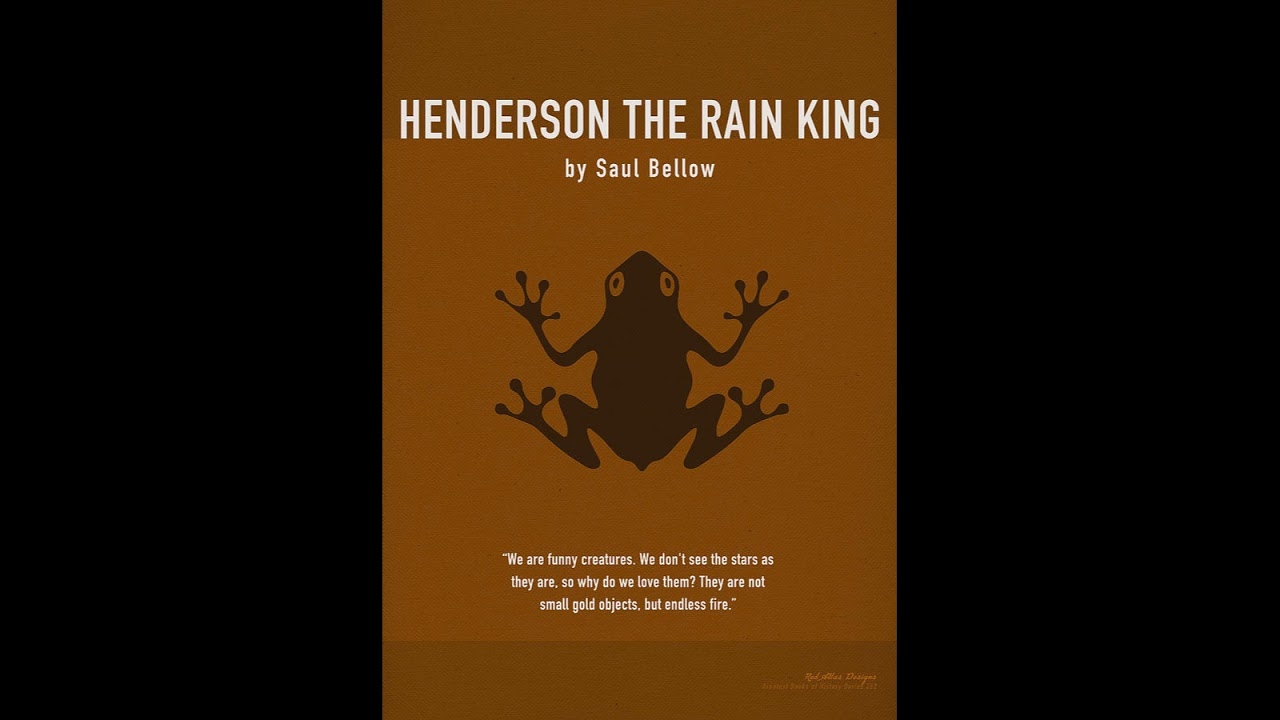
"Henderson the Rain King" by Saul Bellow is a novel that explores the existential crisis of its protagonist, Eugene Henderson, a wealthy and troubled American who embarks on a journey to Africa in search of meaning and fulfillment. The novel delves into themes of identity, self-discovery, and the human condition, using Henderson's journey as a metaphor for the broader quest for purpose in life.Henderson is portrayed as a man who is deeply dissatisfied with his life despite his material wealth. He is plagued by an inner voice that constantly tells him, "I want, I want." This desire, however, is nebulous, and Henderson struggles to identify what it is he truly seeks. His restlessness leads him to Africa, where he hopes to find answers and possibly some form of spiritual enlightenment.In Africa, Henderson encounters two distinct tribes: the Arnewi and the Wariri. His interactions with these tribes serve as pivotal moments in his journey of self-discovery. With the Arnewi, he attempts to help them solve a problem with their water supply, driven by a desire to do something meaningful. However, his efforts lead to disaster, symbolizing his inability to find satisfaction through external actions alone.Henderson's time with the Wariri tribe is marked by his relationship with their king, Dahfu. Dahfu is a wise and introspective leader who recognizes Henderson's inner turmoil and becomes a mentor of sorts to him. Through his conversations with Dahfu, Henderson begins to confront the deeper aspects of his own psyche. Dahfu introduces him to the concept of becoming a "rain king," a figure of spiritual authority who can bring rain and life to the tribe. This concept resonates with Henderson's internal struggle, as it represents the possibility of transformation and fulfillment.The novel's exploration of Henderson's psyche is rich with symbolism and philosophical inquiry. Henderson's quest is not just a physical journey but a metaphysical one, where he grapples with questions of existence, purpose, and the nature of happiness. His interactions with the African tribes serve as a backdrop for his introspective journey, highlighting the contrast between Western materialism and the more spiritual and communal values of the tribal societies.Bellow's use of humor and irony in the novel adds depth to Henderson's character. Henderson is often depicted as a bumbling and larger-than-life figure, whose attempts to find meaning are as absurd as they are sincere. This portrayal underscores the human condition's inherent contradictions, where the search for meaning is fraught with both profound insight and ridiculous folly.The novel also touches on the theme of cultural clash, as Henderson, a representative of Western civilization, tries to impose his values and solutions on the African tribes. His failures highlight the limitations of his worldview and suggest that true understanding and fulfillment may require a deeper connection with different cultures and perspectives.Ultimately, "Henderson the Rain King" is a novel about the human desire for transcendence and the struggle to find one's place in the world. Henderson's journey is one of self-discovery, where he confronts his fears, desires, and limitations. By the end of the novel, Henderson has undergone a significant transformation, but Bellow leaves the question of whether he has truly found what he was seeking open to interpretation. The novel suggests that the search for meaning is an ongoing process, one that requires constant questioning and self-examination.Saul Bellow's "Hend

Информация по комментариям в разработке