Video Details
• Poem Title: Deng Gao (Climbing High / The Zenith of Autumn),
• Author: Du Fu (712–770), known as the "Poet Sage" and "Poet Historian"
• Composition Date: Autumn, 767 AD (Tang Dynasty),
• Location: Kuizhou (near White Emperor City, present-day Fengjie County),
• Form: Seven-Regulated Verse (Qiyan Lüshi)
Description
In this video, we explore what many critics consider the greatest Seven-Regulated Verse (Qiyan Lüshi) ever written: Du Fu's Deng Gao (Climbing High),.
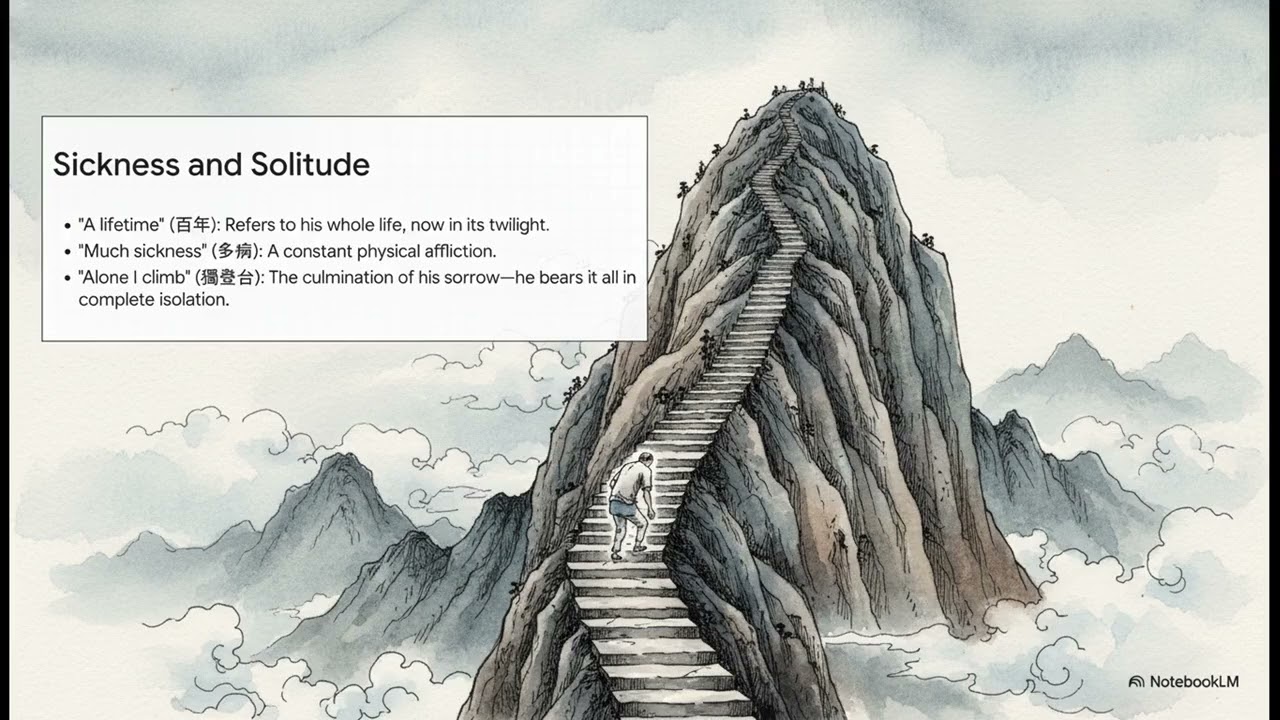
Written in the autumn of 767 AD, when Du Fu was 56 years old, this poem is a profound meditation on aging, illness, and displacement,. Living in Kuizhou after years of wandering due to the aftermath of the An Lushan Rebellion, Du Fu climbed a high terrace outside White Emperor City, where the desolate autumn landscape triggered a flood of personal and patriotic grief,.
In this analysis, we cover:
1. The Masterful Imagery: The poem opens with a "micro" ink painting of the scene: urgent winds, high skies, whistling apes, and birds circling over white sands,. This expands into the famous "macro" view of the second couplet:
"The boundless forest sheds its leaves shower by shower, / The endless river rolls its waves hour after hour". These lines are praised for their "10,000-pound force," depicting the relentless passage of time.
2. The Depth of Emotion: The second half of the poem shifts from scenery to the poet's internal world,. We analyze how Du Fu uses the word "century" (bainian) to symbolize his late years and "miles" (wanli) to emphasize his distance from home,. The poem concludes with a heartbreaking image of the poet, his hair turned white by hardship, forced to stop drinking his "muddy wine" due to lung illness,,.
3. Structural Perfection: Critics have noted that Deng Gao is unique because all eight lines utilize strict parallelism (antithesis), a feat rarely achieved so naturally,. From the sound of the wind to the sorrow of the poet, the structure is so tight that not a single word can be moved, earning it the reputation of the "Crown of Seven-Regulated Verse",.
Join us to discover why Ming Dynasty scholar Hu Yinglin called this work "unprecedented and unrepeatable," describing it as "deep and unfathomable as coral beneath the sea"
Информация по комментариям в разработке