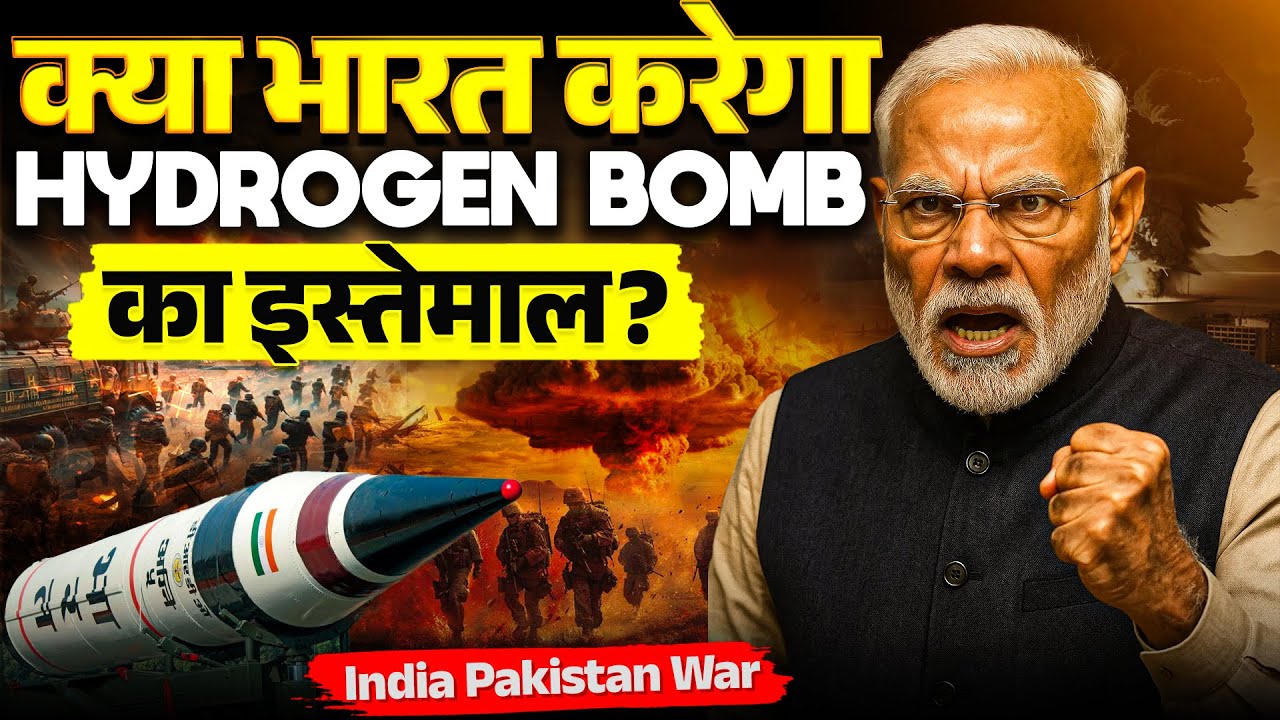
With India-Pakistan tensions peaking after the Pahalgam terror attack (April 22, 2025) and Operation Sindoor, fears of a nuclear war have spotlighted India’s hydrogen bomb capabilities. Does India truly possess thermonuclear weapons, and how do they stack up against Pakistan’s arsenal? This video dives into India’s nuclear history, the thermonuclear debate, and the risks of escalation in 2025.
What’s Covered?
India’s Hydrogen Bomb Claims:
Operation Shakti (1998): India conducted five nuclear tests in Pokhran, claiming Shakti-I was a thermonuclear (hydrogen) bomb with a yield of 45 kilotons (kt), deliberately limited to avoid damage to nearby villages.
Controversy: Indian scientist K. Santhanam (2009) called Shakti-I a “fizzle,” arguing the thermonuclear stage failed to ignite, yielding only 10–15 kt. Other scientists, like R. Chidambaram, insist fusion occurred, backed by radio-chemical data.
Current Status: Experts debate whether India has deployable two-stage thermonuclear weapons. Some claim India can build bombs up to 200 kt, while others suggest only boosted fission devices are operational.
Global Context: Only six nations (US, Russia, UK, France, China, India) are believed to have tested hydrogen bombs. Pakistan is not considered to possess thermonuclear weapons, relying on atomic bombs (20–150 kt).
India-Pakistan Nuclear Arsenal:
India: ~172 warheads (2024), including potential thermonuclear and fission bombs, deliverable via Agni-V missiles, Rafale jets, and INS Arihant submarines. India’s No First Use policy is under review since 2019.
Pakistan: ~170 warheads, primarily uranium-based atomic bombs (12–150 kt), with tactical nuclear weapons for battlefield use. Pakistan has no No First Use policy, emphasizing first-strike capability.
Risks: A nuclear exchange could kill 20 million instantly and trigger a nuclear winter, risking 2 billion lives globally due to famine.
India-Pakistan War Context (2025):
Pahalgam Attack: 26 killed, blamed on Pakistan-backed The Resistance Front, prompting India’s Operation Sindoor (May 7-8, 2025), targeting terror camps in Pakistan/PoK.
Pakistan’s Response: Operation Bunyan al-Marsus (May 10, 2025) involved missile/drone strikes on Indian sites, escalating fears of nuclear use.
Ceasefire: A US-mediated ceasefire on May 10, 2025, halted hostilities, but tensions remain high, with India warning that future attacks will be treated as an act of war.
Thermonuclear vs. Atomic Bombs:
Atomic Bomb: Uses nuclear fission (splitting uranium/plutonium), like Hiroshima’s 15 kt “Little Boy.” Pakistan’s arsenal is fission-based.
Hydrogen Bomb: Uses fission-fusion (Teller-Ulam design), combining hydrogen isotopes (deuterium, tritium) for yields up to megatons. India claims this capability, but doubts persist. The Tsar Bomba (50 megatons, USSR) is the largest ever tested.
Power Difference: Hydrogen bombs are 100–1000 times more destructive than atomic bombs, capable of wiping out entire cities.
Countries with Hydrogen Bombs:
Confirmed: US (1952, Ivy Mike), Russia (1955), UK (1957), China (1967), France (1968).
Claimed: India (1998, disputed), North Korea (2016, 2017, unverified due to low seismic yield).
Uncertain: Israel (possible 1979 test, no confirmation). Pakistan lacks thermonuclear capability.
Why It Matters:
India’s Advantage: If India’s hydrogen bomb claims are true, it holds a strategic edge over Pakistan, potentially deterring escalation.
Nuclear Risks: Misinformation on X, like claims of India’s bombs being “pathetic” or Pakistan’s nukes being neutralized, fuels dangerous narratives.
Global Stakes: The May 10 ceasefire is fragile, and any miscalculation could lead to catastrophic nuclear use, especially with Pakistan’s tactical nukes and India’s reconsidered No First Use.
Why Watch?
From India’s hydrogen bomb debate to the India-Pakistan war risks in 2025, we uncover the truth behind thermonuclear claims and the nuclear shadow over South Asia. Is India’s arsenal as powerful as claimed, and can the ceasefire hold? Watch now for facts, not rumors! Subscribe and hit the bell for updates on this critical issue!
#IndiaHydrogenBomb #IndiaPakistanWar #ThermonuclearBomb #NuclearRisk #OperationSindoor #KashmirConflict

Информация по комментариям в разработке