A Little Wisdom Helps You Become Smarter !
Trench cover is a plate-like component used to cover trenches such as gutters, sewers, and cable trenches !
From the perspective of materials, there are cast iron trench covers, stainless steel trench covers, cement trench covers, composite material trench covers, etc. Trench covers of different materials have different characteristics !
Cast iron trench covers are sturdy and durable but prone to rust !
Stainless steel trench covers are corrosion-resistant and beautiful but have a high cost !
Cement trench covers have a low cost but are relatively heavy !
Composite material trench covers have the advantages of light weight, corrosion resistance, and high strength !
In terms of usage, trench covers mainly play a role in protecting the facilities inside the trench (such as cables, pipelines, etc.) and preventing people, animals, etc. from falling into the trench. It is usually installed in places such as roads, sidewalks, squares, and factories. It must not only bear a certain load of vehicles and pedestrians but also have good drainage performance to ensure that rainwater and other substances can flow into the trench smoothly !
In appearance, trench covers are generally rectangular or square, and the surface may have anti-slip patterns or holes to increase friction and drainage effect !
The Production Process Of Cement Trench Cover :
1. Prepare materials including cement, aggregate, reinforcement and clean water !
2. Make steel or wooden molds with sufficient strength and stability, and apply release agent !
3. Process and install reinforcement !
4. Mix concrete and stir adequately !
5. Pour concrete and vibrate to remove bubbles and ensure flat surface !
6. Cure for 7-14 days with plastic film or wet cloth !
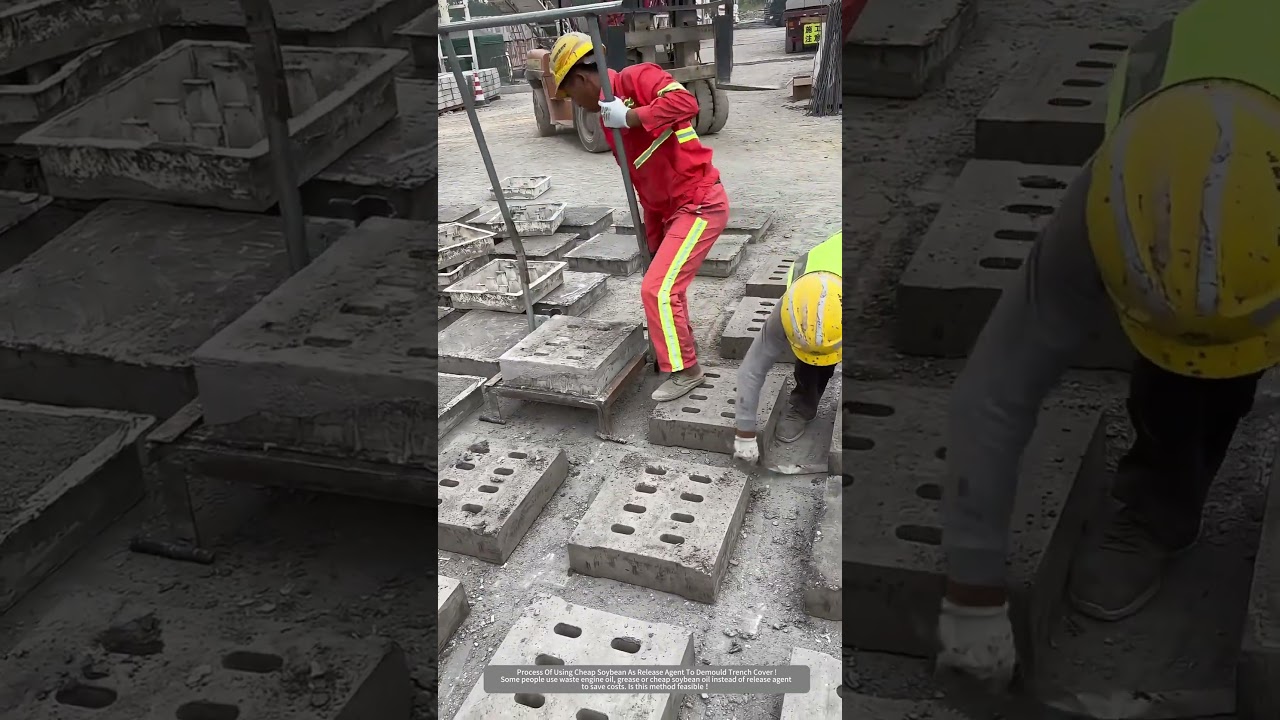
7. Demold carefully when concrete strength is enough and inspect for defects !
8. Inspect and store qualified trench covers in a flat and dry place !
Waste Engine oil, Grease, Soybean Oil, etc. Cannot Be Used To Replace Regular Release Agents.
There are many problems with waste engine oil as a release agent !
First of all, waste engine oil has a complex composition and high instability, which may cause pollution to the concrete surface and affect the appearance quality of trench covers !
Secondly, waste engine oil is difficult to apply evenly, which may lead to inconsistent demolding effects and adhesion may occur in some areas !
Lubricating oil cannot be used as a release agent for trench covers either. Although lubricating oil has a certain degree of lubricity to some extent, it is not specially designed for demolding concrete. Lubricating oil may not be able to form a uniform and stable film on the mold surface, resulting in poor demolding effects. It may cause adhesion and damage to trench covers during demolding. At the same time, lubricating oil may have an adverse effect on the performance of concrete and affect the quality of trench covers. In contrast, professional release agents have better demolding performance, stability and adaptability, and can ensure smooth demolding and good quality of trench covers !
Soybean oil is also not advisable. Soybean oil is prone to oxidation and deterioration in the air, and may form difficult-to-clean stains on the mold surface. Moreover, its demolding effect is far inferior to that of professional release agents and may also affect the performance of concrete !
Regular release agents are specially designed for demolding concrete products and have the advantages of good demolding performance, stability and no adverse effects on concrete products !

Информация по комментариям в разработке