Imagine a multinational company aiming to cut energy costs and meet sustainability goals. To achieve this, it deploys the NEPHELE solution featuring advanced energy management and dynamically controlled HVAC systems that activate only in occupied spaces. Presence prediction, integrated into IoT devices like Siemens Target 5, uses Tiny Machine Learning (Tiny ML) and a Micro Complex Event Processing (Micro CEP) engine to locally process sensor data—for example, temperature, humidity, and CO2—for occupancy detection, enhancing efficiency while preserving privacy.
Target 5 devices follow the W3C Web of Things (WoT) standard for seamless integration with existing building systems. They can be orchestrated via the NEPHELE meta-orchestration framework and are deployable across the edge-cloud continuum.
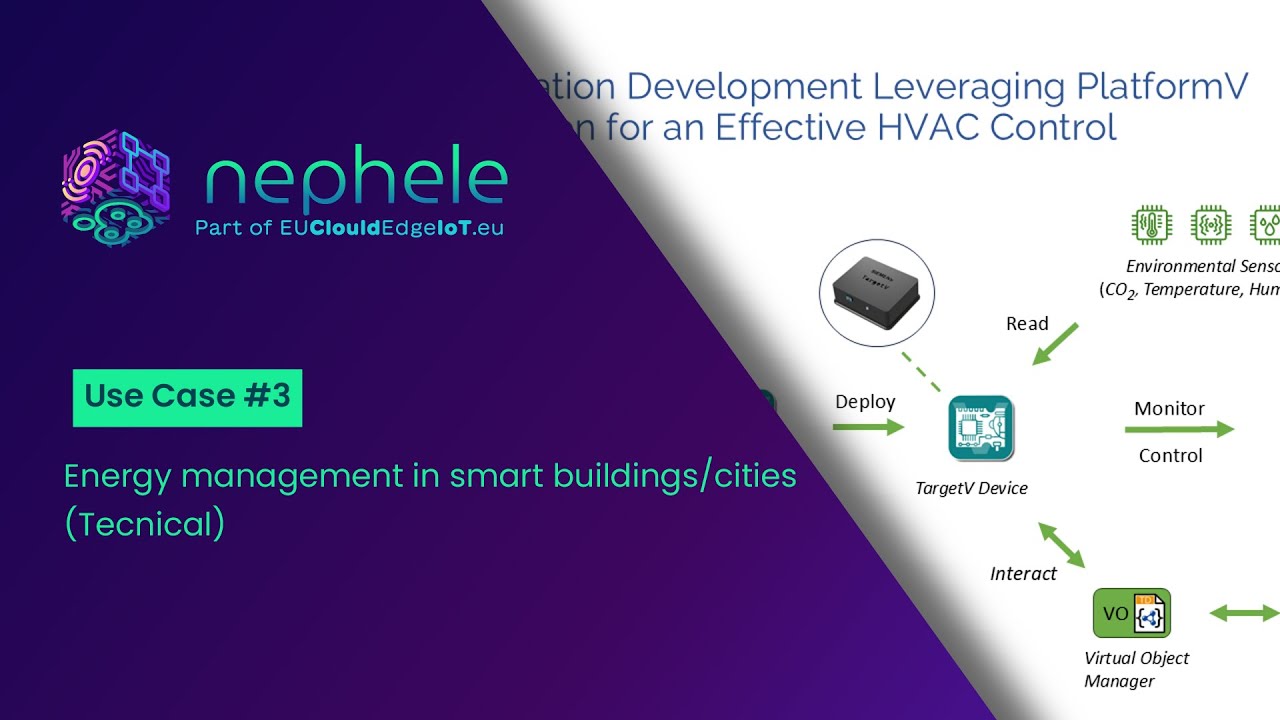
Energy Balancer Application Development
In this demo, we show how NEPHELE technologies are used to build the energy balancer application using so-called Composed Virtual Objects.
We begin by developing the firmware for an IoT device using Platform 5 which integrates the Tiny ML and Micro CEP engine, two core components that enable local intelligence. We define the Tiny ML model and the CEP rules that form the heart of the application logic. We enable interoperability by following the W3C Web of Things standard.
Building and Deploying the Embedded Application
Now we show how to build an embedded energy balancer application using Platform 5 and deploy it on the Target 5 device.
We start by selecting the board used in this setup. The firmware includes essential components like a database, CLI, Modbus TCP/IP stack, and a control chart for application logic.
For the energy balancer, we add three key modules: Tiny ML, a Micro CEP engine, and MQTT. These components are developed as reusable assets within Platform 5.
Next, we configure all components and build the firmware.
Application Logic Implementation
Now let's engineer the application logic using Tiny ML and Micro CEP engines, integrating sensor data seamlessly into the system.
We upload a TensorFlow model capable of detecting room occupancy based on temperature, CO2, and humidity data.
This is followed by integrating a Micro CEP engine to control the HVAC system accordingly.
Finally, we generate the embedded project that can be flashed to the hardware.
Real-Time Testing
The project is flashed onto the Target 5 device, which is equipped with CO2, temperature, humidity, and radar motion sensors. It connects to an IoT edge device for MQTT. The edge hosts the virtual representation of the Target 5 and its application, and facilitates the transmission of Micro CEP rules from a laptop to the embedded device.
After starting the application:
The serial port output shows raw sensor data along with occupancy inferences from the Tiny ML model.
An MQTT client is used to send the Micro CEP rules to the Target 5 device.
Once the rules are uploaded, new events appear immediately. Since the current CO2 level is 524 ppm and the model inference is below 50, the system issues a command to run the HVAC fan at 50% speed, indicating good air quality in an occupied room.
If a person is detected in the room, the system instructs the HVAC to operate at full speed (100%). This ensures optimal air circulation when the space is occupied, maintaining comfort and air quality.
Ensuring Interoperability with W3C Web of Things
Finally, we explore how NEPHELE ensures interoperability across devices using different protocols, based on the W3C Web of Things standard.
We start with the smart energy balancer application graph deployed by OdinS. Most devices are integrated as Virtual Objects (VOs) over MQTT, except one: a Siemens radiator valve actuator using CoAP (Constrained Application Protocol) over IPv6 and the Thread protocol.
This actuator is wrapped in a Thing Description (TD)-based Virtual Object, making it accessible via a unified HTTP interface like any other OdinS device.
The OdinS dashboard displays sensor data from a room. To integrate new devices, their Thing Descriptions are simply placed in the things directory.
Siemens' Web of Things servant automatically discovers them and exposes their interfaces via HTTP and WebSocket.
For example, the Thing Description of the actuator shows its CoAP IPv6 base URAP, along with metadata and supported properties.
Opening developer tools for an OdinS VO reveals a unified HTTP or WebSocket interface. Despite different underlying protocols, all devices now expose their properties uniformly. For instance, CO2 values are returned as standardized W3C JSON objects.
Integration into Siemens Portfolio Platform 5
The Siemens team has successfully integrated Nephele's key results into Platform 5, an end-to-end solution for constrained IoT devices in building automation. Platform 5 offers:
Reusable hardware and software components.
Firmware engineering.
Mobile app support.

Информация по комментариям в разработке