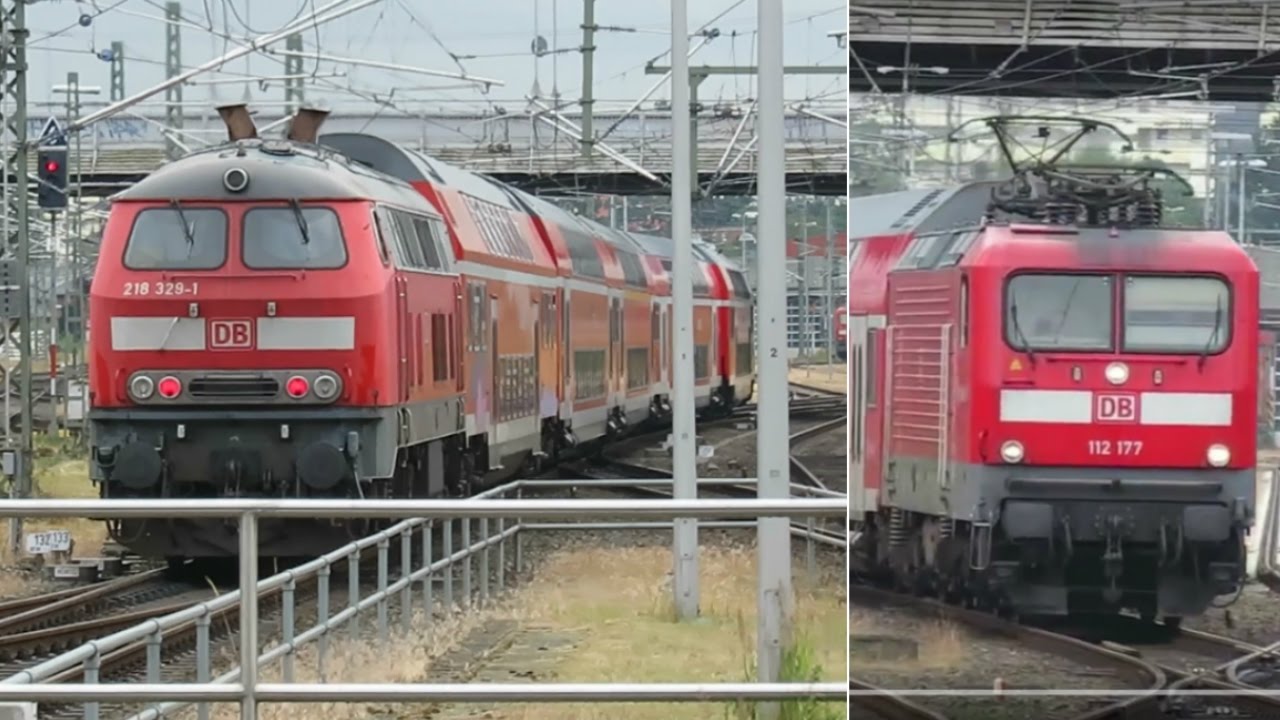
Two clips showing action at the western side of Lubeck Hauptbahnhof on the 5th July 2016.
Firstly we see Class 218 329 'Rabbit' leaving the station with the empty stock having earlier arrived on train RE21629, the 1644 from Kiel.
The second clip (from 0:40) shows Class 112 177 arrive on train RE21426, the 1704 from Hamburg.
The DB Class 218 (before 1968 the DB Class V 164) are a class of 4 axle, diesel hydraulic locomotives acquired by the Deutsche Bundesbahn for use on main and secondary lines for both passenger and freight trains.
The class represents the final major revision of the DB V 160 family of locomotives; having the preferred features of the antecedent locomotives, including a hydrodynamic brake, and a single engine providing electrical train heating via a generator as well as tractive power. The class were also the most numerous of the family, providing the backbone of the Deutsche Bundesbahn's main-line diesel locomotive traction from the 1970s up to the reunification of Germany.
With a power of 2500 to 2800 hp and a top speed of 140 km/h, and the ability to work in multiple with related classes 215, 216, 217 and 218 as well as other classes, and coupled with electric heating and a low speed gear for heavier freight trains the locomotives became the main source of motive power in West Germany on both passenger and freight trains outside electrified sections.
The turn of the second millennium and the preceding few years saw a change from locomotive hauled trains to increasing use of 'diesel railcars' (or DMUs, diesel multiple units). This led to a reduction in the demand for these locomotives on passenger services, with many falling out of use, or only finding work pulling freight trains.
-+-+-+-+-+-+-+-+-+-+-+-+-+-+-+-+-+-+-+-+
Deutsche Bahn AG (DB AG, DBAG or DB) is the German railway company, a private joint-stock company (AG) with the federal government being its majority shareholder with its headquarters in Berlin. It came into existence in 1994 as the successor to the former state railways of Germany, the Deutsche Bundesbahn of West Germany and the Deutsche Reichsbahn of East Germany. It also gained ownership of former railway assets in West Berlin held by the Verwaltung des ehemaligen Reichsbahnvermögens. Its name means "German Railway" in German.
Deutsche Bahn describes itself as the second-largest transport company in the world, after Deutsche Post AG, and is the largest railway operator and infrastructure owner in Europe. It carries about two billion passengers each year.
At its creation, DBAG took over the abbreviation and logo DB from the West German state railway Deutsche Bundesbahn, although it has since modernised the logo. Erik Spiekermann designed the new corporate font DB type.
-+-+-+-+-+-+-+-+-+-+-+-+-+-+-+-+-+-+-+-+
DB Regio AG is a subsidiary of Deutsche Bahn which operates short and medium distance commuter train services in Germany.
DB Regio train in Wrocław, Poland
Unlike its long-distance counterpart DB Fernverkehr, DB Regio does not operate trains on its own account. Services are ordered and paid for by the Bundesländer or their Landkreise. Some states have awarded long-term contracts to DB Regio (usually 10 to 15 years).
-+-+-+-+-+-+-+-+-+-+-+-+-+-+-+-+-+-+-+-+
Lübeck is a city in Schleswig-Holstein, northern Germany, and one of the major ports of Germany. On the river Trave, it was the leading city of the Hanseatic League, and because of its extensive Brick Gothic architecture is listed by UNESCO as a World Heritage Site.
-+-+-+-+-+-+-+-+-+-+-+-+-+-+-+-+-+-+-+-+
Lübeck Hauptbahnhof (German for Lübeck main station) is the main railway station serving the Hanseatic city of Lübeck, in the German state of Schleswig-Holstein. It is a through station at the western edge of the city centre. With approximately 31,000 travelers and visitors each day, Lübeck Hbf is the busiest of all the railway stations in Schleswig-Holstein. It is classified by the Deutsche Bahn as a Category 3 station.
The present station building was built in 1908 by the Lübeck-Büchener Eisenbahn (LBE). At that time, the LBE operated most of the railway connections around Lübeck, including the express trains. The station building was designed by Fritz Klingholz, and replaced the previous, outdated building.
Lübeck Hbf is a Reiterbahnhof, or station with a reception building laid out as a bridge "riding" over the tracks. Its reception building spans a total of 10 tracks with four platforms. A special feature is its wide wooden steps leading down to the platforms. The station was recently modernised and completely electrified, and is now fully connected with Germany's electric railway network.
-+-+-+-+-+-+-+-+-+-+-+-+-+-+-+-+-+-+-+-+
@FrontCompVids - Follow us on Twitter!
More FrontCompVids clips are regularly added to so don't forget to Like and Subscribe!
Click / frontcompvids for more details :-)

Информация по комментариям в разработке