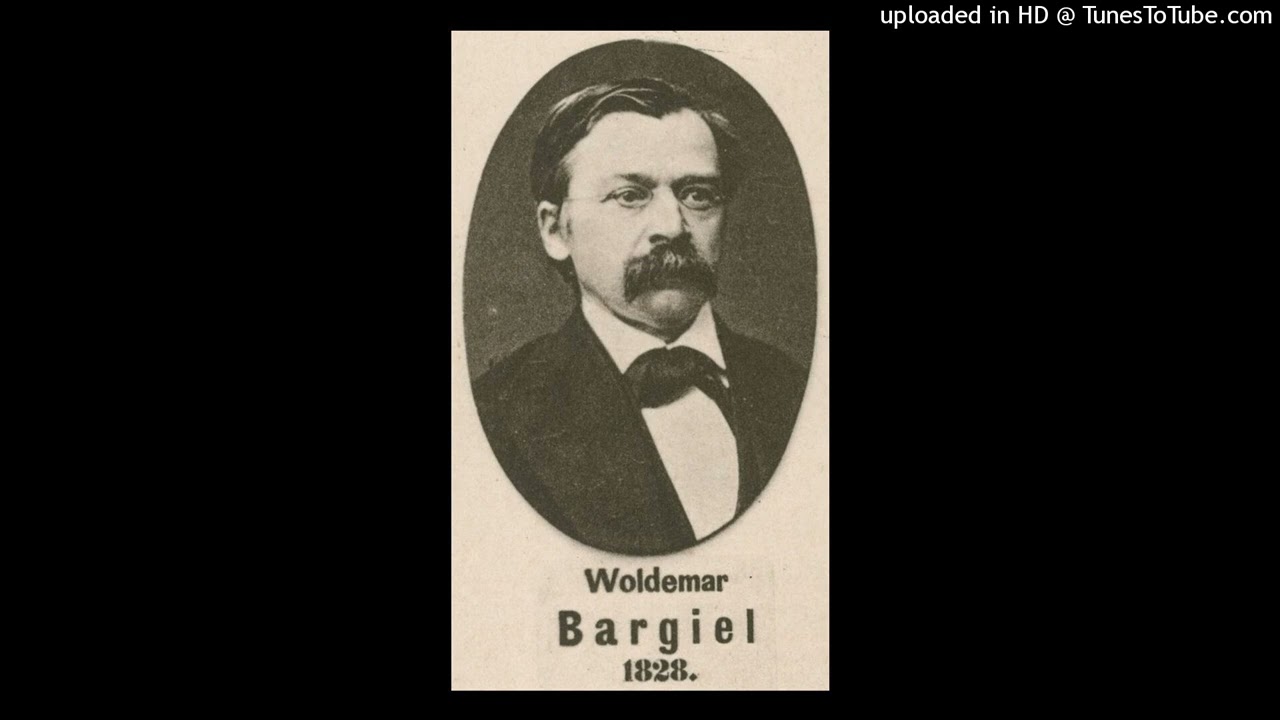
Woldemar Bargiel's Opus 8, titled Drei Charakterstücke (Three Character Pieces) for solo piano, represents a pivotal early work in the composer's oeuvre, encapsulating the Romantic sensibilities of mid-19th-century German music. Born on October 3, 1828, in Berlin, Bargiel emerged from a musically enriched family. His father, Adolph Bargiel, was a respected piano and voice teacher who provided initial instruction in piano, violin, and harmony. His mother, Mariane Tromlitz, a talented musician and soprano, had previously been married to Friedrich Wieck, making Woldemar the half-brother of the renowned pianist Clara Schumann. This familial connection profoundly shaped his career, fostering close ties with Clara and her husband, Robert Schumann, who became instrumental mentors. Clara, nine years his senior, introduced him to influential figures like Felix Mendelssohn and Robert Schumann, paving the way for his formal education.
Bargiel's early training included studies with Siegfried Wilhelm Dehn in Berlin, focusing on theory and composition. At age 18, in 1846, he enrolled at the Leipzig Conservatory—founded by Mendelssohn—upon recommendations from Schumann and Mendelssohn. There, he honed his skills under luminaries such as Ignaz Moscheles and Louis Plaidy for piano, Ferdinand David for violin, and composers Niels Gade, Julius Rietz, and Moritz Hauptmann for theory and composition. This period immersed him in the progressive Romantic environment, blending Mendelssohn's elegance with Schumann's introspective lyricism. By 1850, Bargiel returned to Berlin, supporting himself through private teaching while composing. The Schumanns actively championed his work, arranging publications for early pieces like his Opus 6 Piano Trio in F major (1851), which gained popularity.
Composed in 1853 during this transitional Berlin phase, Opus 8 reflects Bargiel's maturation as a composer amid personal and professional challenges. At 25, he was navigating the post-1848 revolutionary era's cultural flux, where composers grappled with innovation versus tradition. Bargiel's output from 1848 to 1864—encompassing two-thirds of his catalog—shows stylistic pluralism, drawing from Schumann's poetic introspection and Mendelssohn's harmonic clarity, without succumbing to eclecticism. Opus 8, dedicated to Clara Schumann, underscores their sibling bond and her influence; she not only promoted his music but embodied the virtuosic piano tradition he admired.
The three pieces exemplify Romantic character pieces—short, evocative forms popular in the era. The first, Allegro appassionato, bursts with fervent energy, featuring dramatic contrasts and virtuosic runs that demand technical prowess. The second, Andante con moto, offers lyrical introspection with flowing melodies and subtle harmonic shifts, evoking Schumann's Fantasiestücke. The third, Allegro vivace, concludes with playful vigor, incorporating folk-like rhythms and unexpected modulations. These works showcase Bargiel's "markante Vorhaltsharmonik" (striking suspension harmonies) akin to Mendelssohn and structural ambiguity reminiscent of Schumann, including mottos and allusions.
Published in 1854 by Breitkopf und Härtel in Leipzig, Opus 8 marked Bargiel's growing recognition. It appeared during a prolific period, following Opus 7 (Suite for piano four hands, 1853) and preceding Opus 9 (Three fantasy-pieces, 1853–54). Reception was positive within Schumann's circle; Robert mentioned Bargiel in his 1853 essay Neue Bahnen as a promising talent. However, as Bargiel shifted to teaching roles—in Cologne (1859), Rotterdam (1865), and Berlin's Hochschule für Musik (1874)—his compositional output slowed, focusing on pedagogy and editions of Schumann and Chopin with Brahms.
In legacy, Opus 8 endures as a testament to Bargiel's "Kleinmeister" status— a mediator between epochs, blending conservatism with subtle innovation. Though overshadowed by contemporaries, recordings like Kathrin Schmidlin's 2025 performance revive its charm. Available on IMSLP, it highlights his contribution to piano literature, bridging Schumann's fantasy with emerging neoclassicism. Bargiel's death on February 23, 1897, closed an era, but Opus 8 remains a vibrant echo of Romantic idealism.

Информация по комментариям в разработке