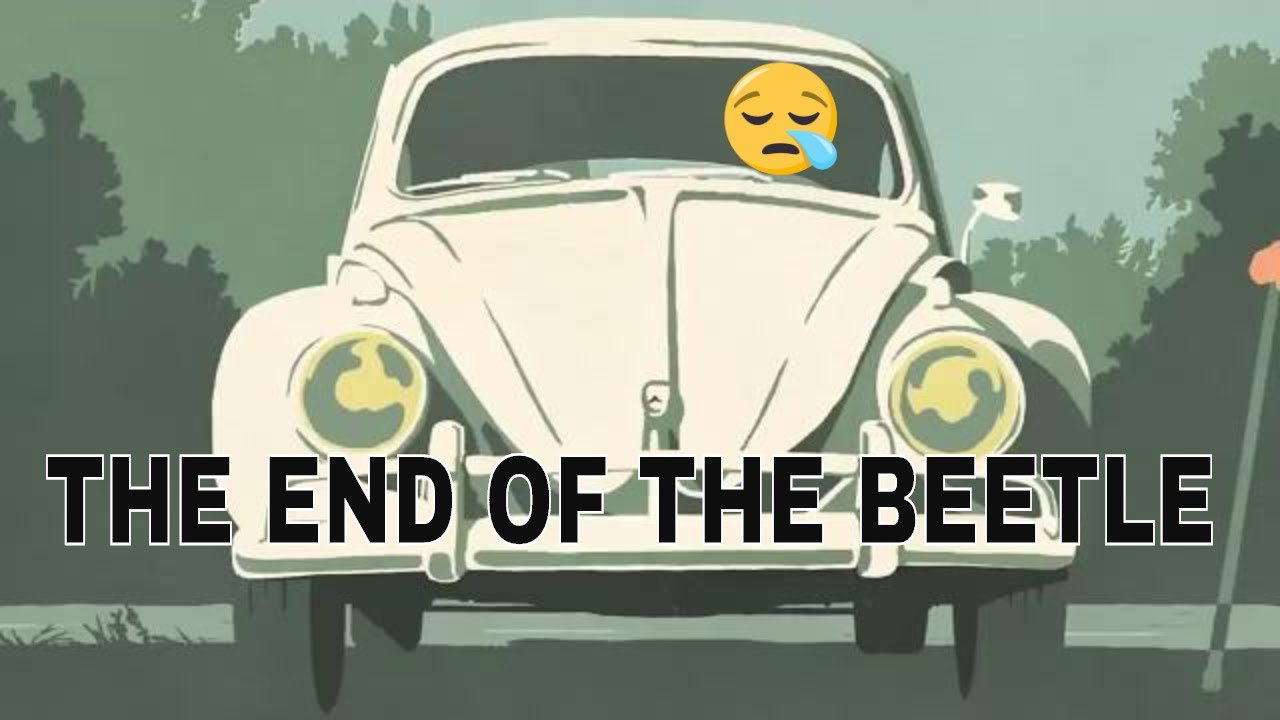
A tribute video to the VW Beetle made by Volkswagen as the production ends after 70 years.
The Beetle was commissioned in the 1930s by Adolf Hitler as the "people's car" (or volks wagen in German). Designed by Ferdinand Porsche, the curvy car was affordable, practical and reliable. Three decades later, the "Bug" (as it was affectionately known) became a symbol of the 1960s and the "small is beautiful" ethos.
Germany stopped producing Beetles in the late 1970s, but in 1998 Volkswagen rolled out the New Beetle, which was meant to be a visual flashback to the original Type 1 design but was essentially a VW Golf. Another variation was introduced in 2012, but sales have been steadily declining—down to around 15,000 last year from some 43,000 in 2013—so now the Bug will be squashed.
The Volkswagen name however wasn’t to become official until a few years down the line. The new car was initially tagged the Porsche Type 60, then christened the KdF-Wagen, KdF being the initials of the leisure arm of the Third Reich (Kraft durch Freude or Strength through Joy).
October 1935 saw the first Type 60 prototype, known as the "V1" ready. By 1936, testing of the first three "V3" prototypes, built in Porsche's Stuttgart shop, began. By 1937 Thirty "W30" pre-production models, manufactured by Daimler-Benz, had undergone 1,800,000 mi (2,900,000 km) of further testing. All cars already had the distinctive round shape and the air-cooled, rear-mounted engine.
Hitler's plan had been that the new car would be affordable to everyone, and introduced a form of part payment for them, not dissimilar to that of the “Green-Shield” system. Consumers would purchase a “Sparkarte” (a savings card) at a cost of 1 Reichsmark, the equivalent of about 30p, or around 40 US cents. Following the purchase of the Sparkarte, they were obliged to buy at least 5 Reichsmark of stamps per week, this worked out at roughly £1.35 or $2 USD. The average Germans salary at the time was around 32 Reichsmark a week. The sum total payable for the basic car was 990 Reichsmark.
In 1938, the Stadt des KdF-Wagens had been built around the village of Hesslingen, as a town to house workers at the KdF-Wagen factory.
By the outbreak of World War 2 in 1939, only a handful of consumer cars had been produced, and all customer orders had been cancelled as production was switched from civilian vehicles to that of military vehicles.
The main two vehicles produced during the war period were both Beetle based variants, the flat 4 air cooled engine and rugged suspension being ideal for the harsh desert environments of Africa.
The first was the Type 82 Kubelwagen, a utilitarian off-road vehicle of very basic construction. German military officials had stipulated that the fully laden Kubelwagen (including 4 battle dressed troops) shouldn’t weigh more than 950kg, this left the unladen vehicle with a maximum weight of 550kg. The experienced military coachbuilder Trutz was subcontracted by Porsche to assist with the body design.
Initial testing began in 1938, with successful results, and continued in Poland in 1939. The resulting tests had the German military request some important changes. Whilst the vehicle had impressive off-road credentials, even when compared to some of the existing 4x4s already in service, it was felt it could still be improved, and the vehicles slowest speed of 5mph needed to be reduced to that of marching troops, around 2.5mph.
Porsche responded to these requests by installing “reduction boxes” (effectively a 2nd gearbox, resulting in more torque), larger wheels, and revised suspension. The reduction boxes alongside the self locking ZF differentials increased the vehicles off-road ability, as well as allowing a lower speed to stay level with the troops. Kubelwagens were mass produced as soon as the factories in Stadt des KdF-Wagens had been completed.
The second vehicle produced during the period was the Type 166 Schwimmwagen, based on prototype 4x4 Kubelwagens, the Schwimmwagen was produced as an offroad amphibious vehicle, utilizing an extended crankshaft to drive a folding propeller mounted to the rear of the vehicle.
Due to the simple nature of the propeller coupling, the Kubelwagen could only use propeller power for forward motion, reversing was done by either rowing, or using the land wheels to slowly reverse the vehicle. Steering was controlled by the steering wheel on both land and water, with the front wheels acting as rudders when in boat mode.

Информация по комментариям в разработке