Korolev Crater: A Vast Reservoir of Persistent Water Ice on Mars
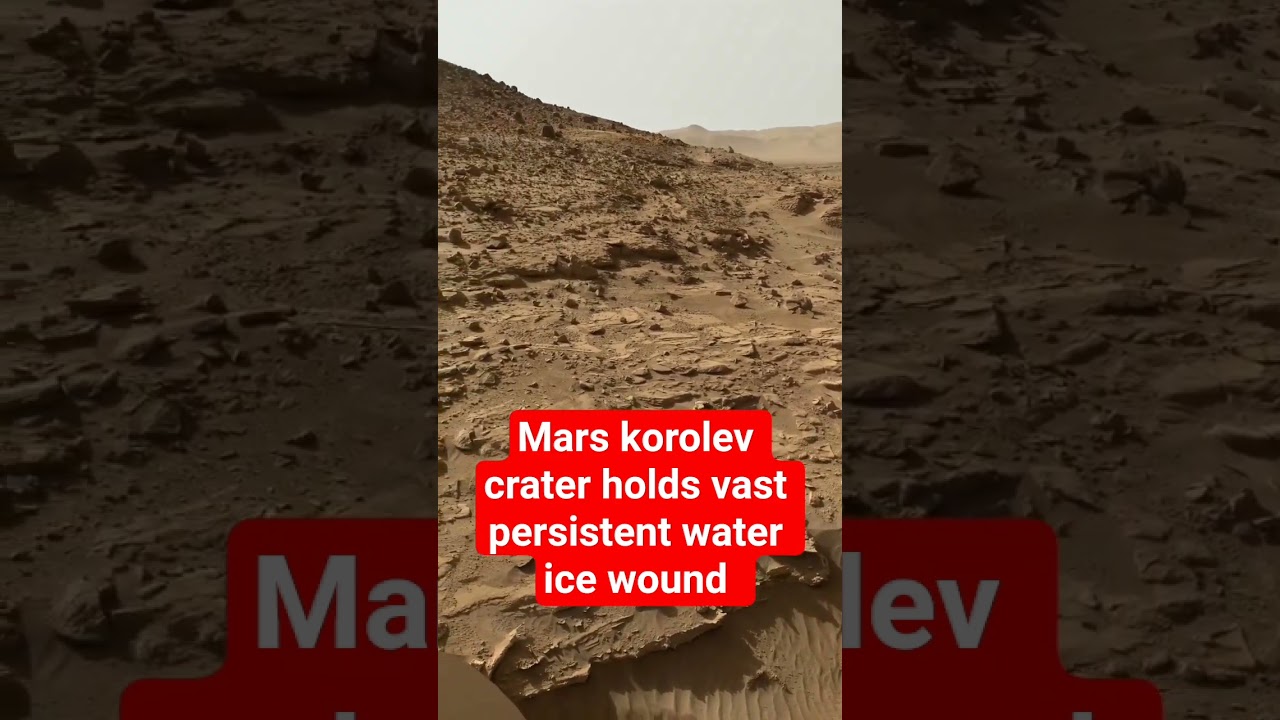
Yes, the statement is accurate. Korolev Crater, located in Mars' northern lowlands, is renowned for its massive, year-round mound of water ice, making it one of the most significant non-polar ice deposits on the Red Planet. Discovered and imaged by missions like ESA's Mars Express and NASA's Mars Reconnaissance Orbiter, this feature acts as a natural "cold trap" that preserves the ice despite seasonal changes. Below, I'll break down the key details.
Location and Size
Coordinates: 73° N latitude, 165° E longitude, in the Mare Boreum quadrangle, just south of the Olympia Undae dune field that encircles part of Mars' north polar cap.
Diameter: Approximately 82 km (51 miles), making it a mid-sized impact crater.
Depth: The crater floor sits about 2 km (1.2 miles) below the rim, which rises 2 km above the surrounding plains.
The Water Ice Mound
Dimensions: The central mound spans up to 60 km (37 miles) in diameter and reaches a thickness of 1.8 km (1.1 miles), forming a domed glacier-like structure.
Volume: It holds around 2,200 cubic kilometers of water ice—roughly equivalent to the volume of Great Bear Lake in Canada or 50 times that of Lake Constance in Europe. This represents a substantial portion of Mars' accessible subsurface water resources outside the polar caps.
Composition: Primarily pure water ice (H₂O), with possible minor dust inclusions, but not mixed with seasonal carbon dioxide (dry ice) like the polar caps. Radar data from NASA's SHARAD instrument confirms layered stratigraphy, indicating atmospheric deposition over time rather than remnants of a larger ancient ice sheet.
Why It Persists Year-Round
The ice's stability is due to a unique atmospheric phenomenon:
Cold air above the mound cools further upon contact with the ice and sinks, forming a dense, insulating layer that hovers over the surface.
This "cold trap" prevents heat transfer, shielding the ice from sublimation (direct transition from solid to gas) even during Mars' six-month northern summer, when temperatures can rise above freezing at the equator.
Unlike polar ice, which waxes and wanes seasonally, Korolev's mound shows little variation, with consistent reflector geometry in radar profiles over years of observations.
Scientific Significance
Discovery and Imaging: First detailed in thermal infrared data from NASA's Thermal Emission Spectrometer (TES) in the early 2000s, showing high thermal inertia consistent with thick ice layers. High-resolution images from ESA's Mars Express High Resolution Stereo Camera (HRSC) in 2018 revealed its stunning "winter wonderland" appearance, and SHARAD radar in 2016 mapped its 3D structure.
Implications: This deposit could inform Mars' climate history, as its layers may record past atmospheric conditions similar to the north polar layered deposits 600 km away. It's also a prime target for future human exploration, potentially providing water for fuel, drinking, or agriculture—equivalent to billions of liters if extracted.
Cultural Note: Named after Sergei Korolev, the Soviet rocket engineer behind Sputnik and Yuri Gagarin's flight, the crater even features in sci-fi like For All Mankind as a site for methane and life-hunting missions.
If you're interested in visuals, ESA has released simulated flyover videos based on HRSC data, showing the crater's ethereal, snow-like expanse. For more on Mars' water resources, this site highlights how such features challenge our view of the planet as a dry desert. Ongoing missions continue to refine estimates, but as of 2025, no major changes to the ice mound have been reported.

Информация по комментариям в разработке