Keywords: Alpha Particles from Americium 241, Weak Radiation, 241Am, Bubble Chamber, LET (Linear Energy Transfer), Bragg Curve, RBE (Weighting Factor, Quality Factor), ICRP, Tritium, Fukushima, Time Lapse
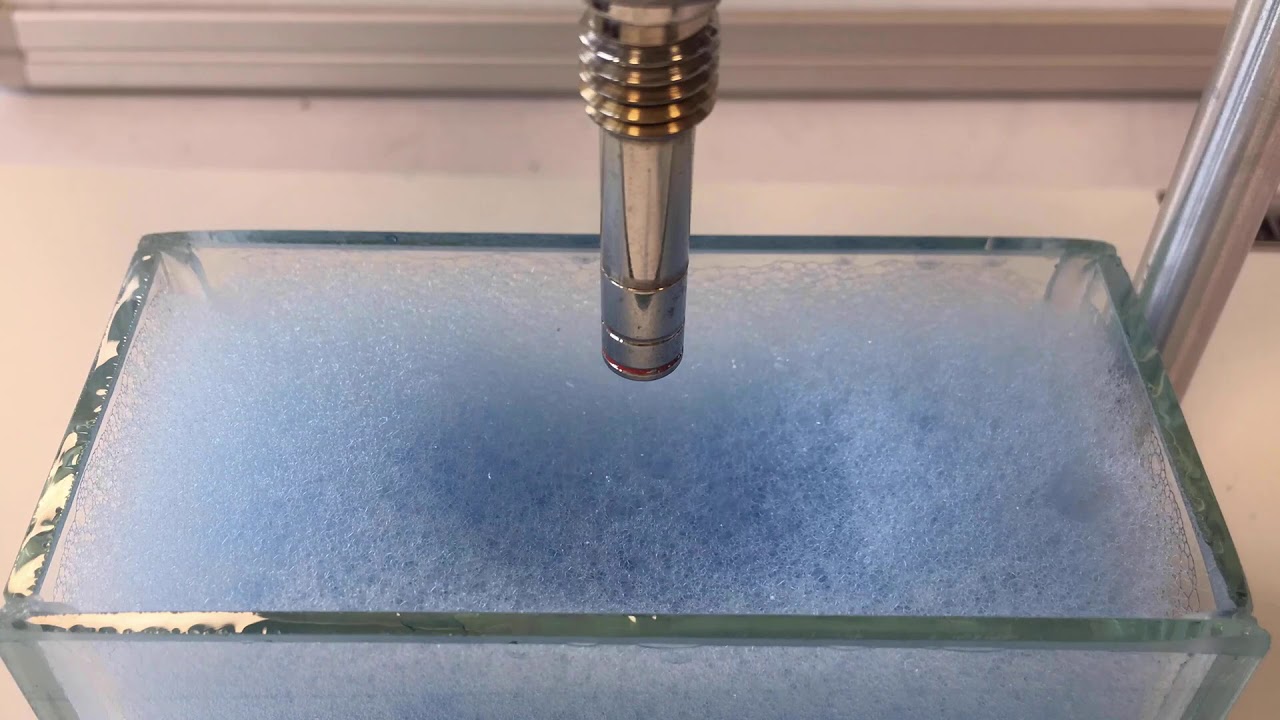
The Alpha- source with about 300 kBq of Americium 241 is placed 1cm above the surface of a foam made from detergent. The foam is left sitting for some minutes, before placing the source. The whole experiment is covered under glass to keep the influence of stray wind currents away.
The movie was shot in time-lapse mode and covers about one hour: the alpha particles are slowly eating away the tiny bubbles.
The destructive process begins at the end of the range of the particles in air; about 3 cm. Directly under the source, the foam remains almost not affected by the fast alpha "rays".
Here the so called Bragg-Curve, well known from theory, becomes visible reality.
Well, what contradicts our everyday experience:
The slow particles are more powerful than the fast ones!
The same is true with beta "rays": the slow ones (low energy) are dangerous indeed.
They have a high linear energy transfer (LET).
*********
For example, Tritium beta-particles have a LET value of 4.7 keV/μm, whereas for 60Co it is only 0.22 keV/μm. (Alpha particles reach a LET of about 200 keV/μm).
With a LET above 3.5 keV/μm, Ionization is considered as "dense".
The ionization-density of beta- particles from Tritium-decay is in fact HIGH.
*********
The International Commission on Radiological Protection ICRP assumes a Weighting Factor (Quality Factor, RBE ) of "1" for ALL betas, x-rays and gamma- rays; of all energies.
All of them are considered loosely ionizing; not "dense".
*********
In the past, this Weighting Factor was seen different, closer to biological reality:
A comprehensive book about industrial sensor-techniques recommends the following Weighting Factors for Electrons:
All Energies (Energy not known): Weighting Factor 1
Energy below 10 keV: Weighting Factor 5
Energy between 10 and 100 keV: Weighting Factor 10
Even ICRP publication 9 (1966) recommended a value of 1.7 as a weighting factor for all beta, X-ray and gamma rays with maximum energies below 30 keV.
But then, an amendment to ICRP Publication 9, in April 1969 (ICRP, 1969), reduced the Weighting Factor to 1! It was concluded that:
"a value of unity is appropriate within the degree of precision required" ...
(non-scientific considerations perhaps involved)... Things had to be simple again.
But it was already known then that soft beta radiation is biologically very effective!
*********
Weighting Factors for tritium beta particles were established in many studies: The calculated values were up to 4 with the majority of values below 3. The data for fish are from 1 to nearly 4 with aquatic invertebrates around 1; these data are consistent with the data observed for mammals.
I wonder if the ICRP will ever be willing to raise the Weighting Factor for Tritium again?
Albert Einstein once said: Everything should be as simple as possible, but not simpler.
To increase the Weighting Factor for Tritium (and Radiocarbon?) would cost the nuclear industry money. And maybe the manyfold cases of damage, which epidemiologists see around the nuclear power plants, would become better explainable?
Can TEPCO safely pour away one million tons of tritiated Water at Fukushima?

Информация по комментариям в разработке