My Substack: https://ethankho.substack.com/
Spotify: https://open.spotify.com/show/0hQrPxi...
Apple Podcasts: https://podcasts.apple.com/us/podcast...
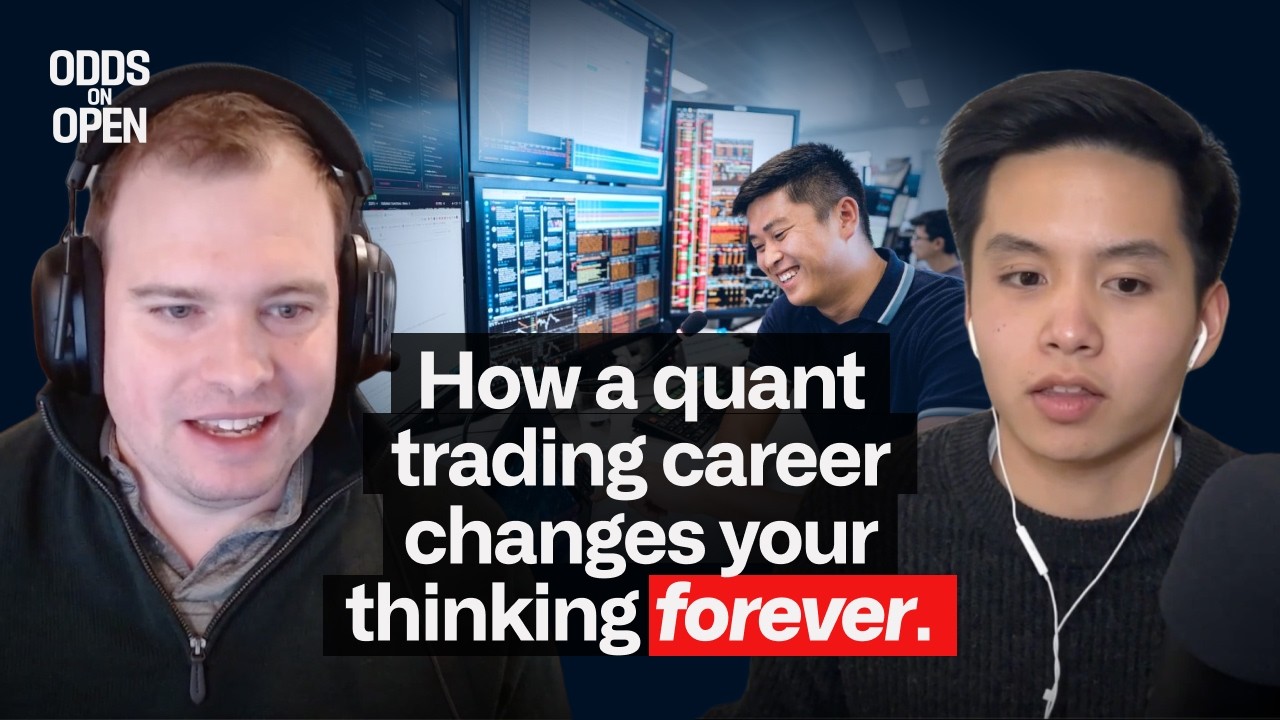
Former Susquehanna International Group (SIG) Head Trader Andrew Courtney breaks down the reality of being a quant trader and market maker at one of the world's elite proprietary trading firms. He reveals what trading floors actually look like—multiple monitors covered with flashing numbers, signals, and price movements that traders analyze all day with zero lunch breaks and constant attention on market microstructure.
Andrew explains how SIG's legendary poker training culture shapes traders' ability to think probabilistically, make decisions under uncertainty, and justify every bet both quantitatively and qualitatively. He shares candid insights about who should (and shouldn't) pursue trading careers, the transition from floor trading to electronic markets, and how the tight-knit network at prop trading firms differs dramatically from consulting or investment banking paths.
Andrew now runs Kalshinomics, a prediction markets analytics tool, and writes The Whirligig Bear on Substack where he analyzes opportunities in Kalshi, Polymarket, and emerging prediction market platforms. He goes deep on finding edge in prediction markets—from identifying inefficient markets with liquidity incentives to using ChatGPT and AI tools for handicapping obscure Grammy categories.
We also talk about...
The real day-to-day of quant trading and market making at SIG: staring at screens all day, monitoring signals, and staying alert for when markets go off the rails
Why SIG's poker training program—playing for hours daily, turning over cards after every hand, and defending each decision quantitatively—builds world-class traders
How thinking in bets becomes second nature and why Andrew now frames every decision (like private school vs public school) as an expected value calculation
The cultural differences between floor trading (loud voices, physical presence in the pit) versus upstairs electronic trading (surrounded by sharp peers and data)
Why prop trading careers build narrow, dense networks compared to consulting or investment banking, and what that means for long-term career optionality
Finding edge in prediction markets: liquidity incentives, identifying who you're trading against, and why some markets are wildly inefficient
Using AI and LLMs for forecasting: prompting ChatGPT as a "super forecaster," the limitations of current models, and why the LLM layer was the weakest part of his Grammy bet
Trading strategy and bet sizing: when to use Kelly criterion, how to scale into positions, and Bayesian updating based on how the market reacts to your trades
Why hyped markets (meme coins, viral events) often present contrarian opportunities and how to identify which side casual money is on
The insider trading debate in prediction markets and why Andrew thinks it's corrosive to incentives, trust, and long-term market quality
Whether prediction markets are good for society: the value of probabilistic news context versus the risk of casino-ification and degenerate gambling
Career advice for aspiring traders: evaluating if you can handle constant screen time, limited networks, and high-variance outcomes
How to apply expected value thinking to everyday life: insurance decisions, risk tolerance, and when not to over-optimize (don't EV calculate marriage)
Why Kalshinomics focuses on analytics and custom interfaces for serious traders rather than trying to be the "Bloomberg Terminal" of prediction markets
Lessons from SIG on decision-making, probability, and building systems that extract signal from noise in high-frequency, high-stakes environments
00:00 Intro
05:00 Floor trading vs. electronic trading
06:28 What makes an upstairs trader
10:16 Poker as trader training
13:00 Thinking in bets as a mental framework
15:11 Decision trees in real life
16:40 Where prediction markets actually have edge
19:00 Why the LLM forecasting layer falls short
19:40 Liquidity incentives and trading low-volume markets
22:00 Limiting downside even when the model is wrong
24:32 Executing in illiquid markets
25:44 Fair value vs. directional conviction
27:11 Bayesian updating when liquidity responds
28:40 Fading hype and crowded narratives
31:07 Longshot bias vs. fanbase bias
34:20 How to judge whether you really have edge
36:40 Building analytics tools for prediction markets
38:20 The temporary edge for smart amateurs
40:35 Where prediction markets fit best
41:20 Markets that shouldn’t exist
43:20 Why insider trading corrodes incentives
46:52 Are prediction markets a net good or bad
50:47 Minimizing degeneracy and maximizing signal
53:32 A simple EV mindset anyone can use

Информация по комментариям в разработке