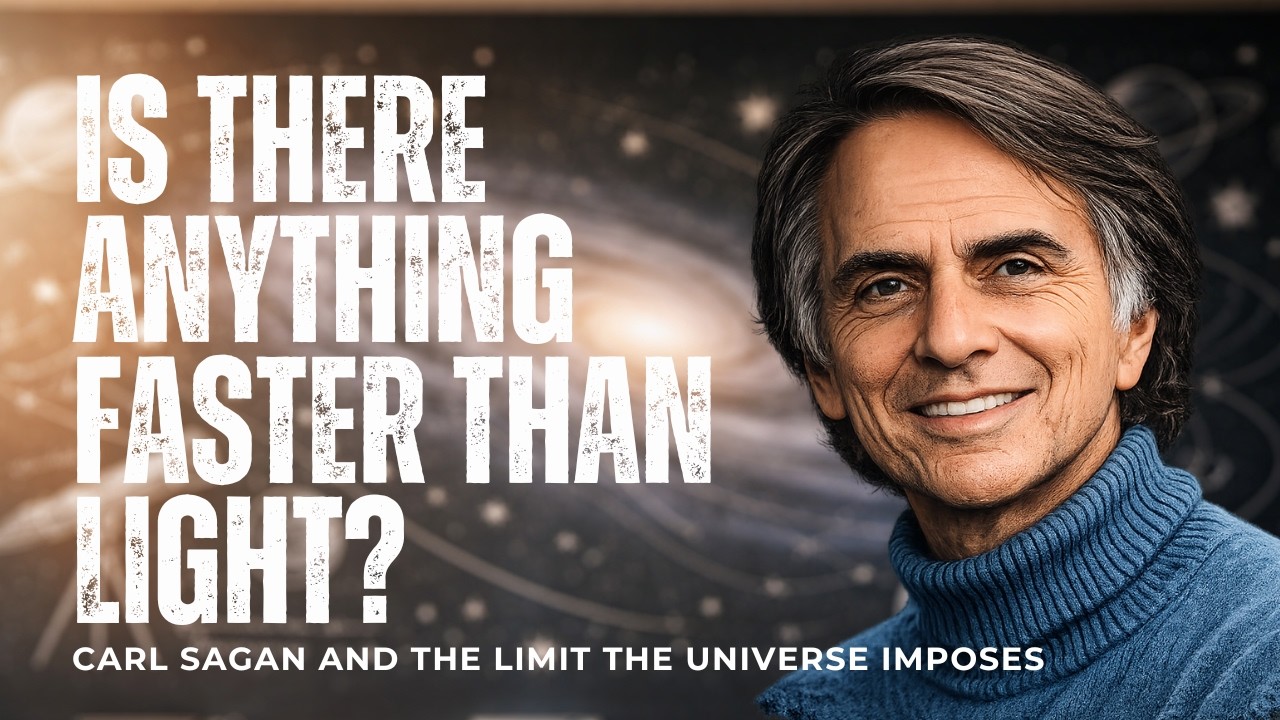
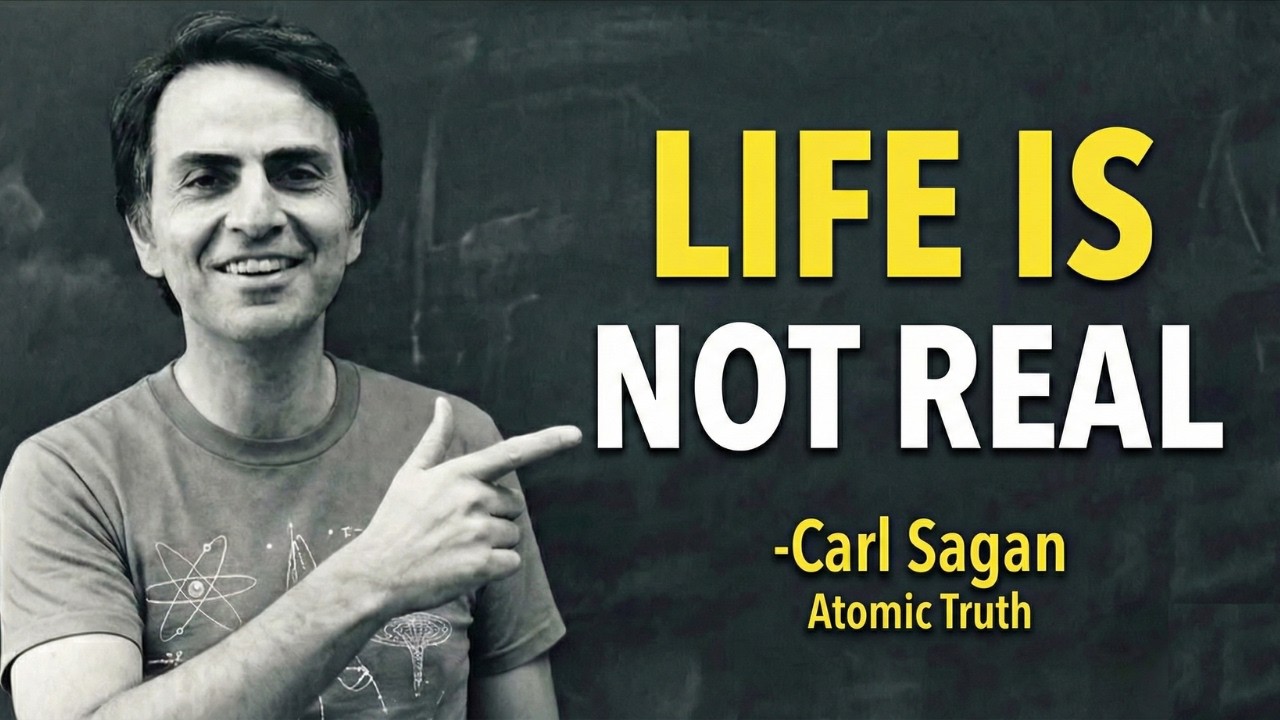
Is There Anything Faster Than Light? Carl Sagan and the Limit the Universe Imposes
Explore the cosmic speed limit through the eyes of legendary astronomer Carl Sagan. This educational journey examines one of physics' most fundamental constants—the speed of light—and asks whether anything in the universe can exceed it.
From Einstein's revolutionary theory of relativity to quantum entanglement, from the expansion of spacetime to hypothetical tachyons, we investigate the nuances and apparent exceptions to this universal law. Discover why light travels at exactly 299,792,458 meters per second, what happens when objects approach this limit, and how this constraint shapes everything from the observable universe to our potential as a spacefaring civilization.
Narrated in the contemplative, poetic style that made Carl Sagan beloved by millions, this video combines rigorous scientific accuracy with accessible explanations and profound philosophical insights about our place in the cosmos.
SCIENTIFIC SOURCES AND REFERENCES:
PRIMARY SCIENTIFIC FOUNDATIONS:
1. Einstein, Albert (1905). "On the Electrodynamics of Moving Bodies" (Zur Elektrodynamik bewegter Körper). Annalen der Physik, 17: 891-921.
Original paper introducing Special Relativity and the constancy of light speed
2. Einstein, Albert (1916). "The Foundation of the General Theory of Relativity". Annalen der Physik, 49: 769-822.
General Relativity and spacetime curvature
3. Maxwell, James Clerk (1865). "A Dynamical Theory of the Electromagnetic Field". Philosophical Transactions of the Royal Society of London, 155: 459-512.
Electromagnetic theory establishing light as electromagnetic wave
CARL SAGAN WORKS:
4. Sagan, Carl (1980). "Cosmos". Random House.
Primary inspiration for narrative style and philosophical approach
5. Sagan, Carl (1994). "Pale Blue Dot: A Vision of the Human Future in Space". Random House.
Perspective on humanity's place in the cosmos and space exploration limitations
6. Sagan, Carl (1985). "Contact". Simon & Schuster.
Exploration of faster-than-light travel concepts and SETI
QUANTUM MECHANICS AND ENTANGLEMENT:
7. Einstein, A., Podolsky, B., & Rosen, N. (1935). "Can Quantum-Mechanical Description of Physical Reality Be Considered Complete?" Physical Review, 47 (10): 777-780.
EPR paradox and "spooky action at a distance"
8. Aspect, Alain et al. (1982). "Experimental Test of Bell's Inequalities Using Time-Varying Analyzers". Physical Review Letters, 49 (25): 1804-1807.
Experimental confirmation of quantum entanglement
COSMOLOGY AND EXPANSION:
9. Hubble, Edwin (1929). "A Relation Between Distance and Radial Velocity Among Extra-Galactic Nebulae". Proceedings of the National Academy of Sciences, 15 (3): 168-173.
Discovery of cosmic expansion
10. Riess, Adam G. et al. (1998). "Observational Evidence from Supernovae for an Accelerating Universe". The Astronomical Journal, 116 (3): 1009-1038.
Accelerating expansion of the universe
RELATIVISTIC PHYSICS:
11. Hafele, J.C. & Keating, R.E. (1972). "Around-the-World Atomic Clocks: Predicted Relativistic Time Gains". Science, 177 (4044): 166-168.
Experimental verification of time dilation
12. Bailey, J. et al. (1977). "Measurements of relativistic time dilation for fast moving particles". Nature, 268: 301-305.
Particle physics confirmation of relativistic effects
FASTER-THAN-LIGHT CONCEPTS:
13. Feinberg, Gerald (1967). "Possibility of Faster-Than-Light Particles". Physical Review, 159 (5): 1089-1105.
Original tachyon theory paper
14. Alcubierre, Miguel (1994). "The warp drive: hyper-fast travel within general relativity". Classical and Quantum Gravity, 11 (5): L73-L77.
Theoretical warp drive mechanism
INSTITUTIONAL SOURCES:
15. NASA - "What is the Speed of Light?"
https://www.nasa.gov/
16. CERN - "The Standard Model"
https://home.cern/
DISCLAIMER:
This video is created for educational purposes. All scientific concepts presented are based on peer-reviewed research and established physics. While narrated in the style of Carl Sagan as a tribute to his legacy of science communication, this is an original educational work and not a reproduction of Sagan's own content.
The speed of light in vacuum (c) = 299,792,458 m/s is a defined constant as per the International System of Units (SI).
For the most current research on topics discussed, please consult recent publications in journals such as Physical Review Letters, Nature Physics, Science, and The Astrophysical Journal.
#CarlSagan #Physics #SpeedOfLight #Einstein #Relativity #QuantumMechanics #Cosmology #ScienceEducation #Astronomy #Spacetime #Universe #ScienceCommunication #STEM #EducationalVideo #CosmicPerspective












Информация по комментариям в разработке