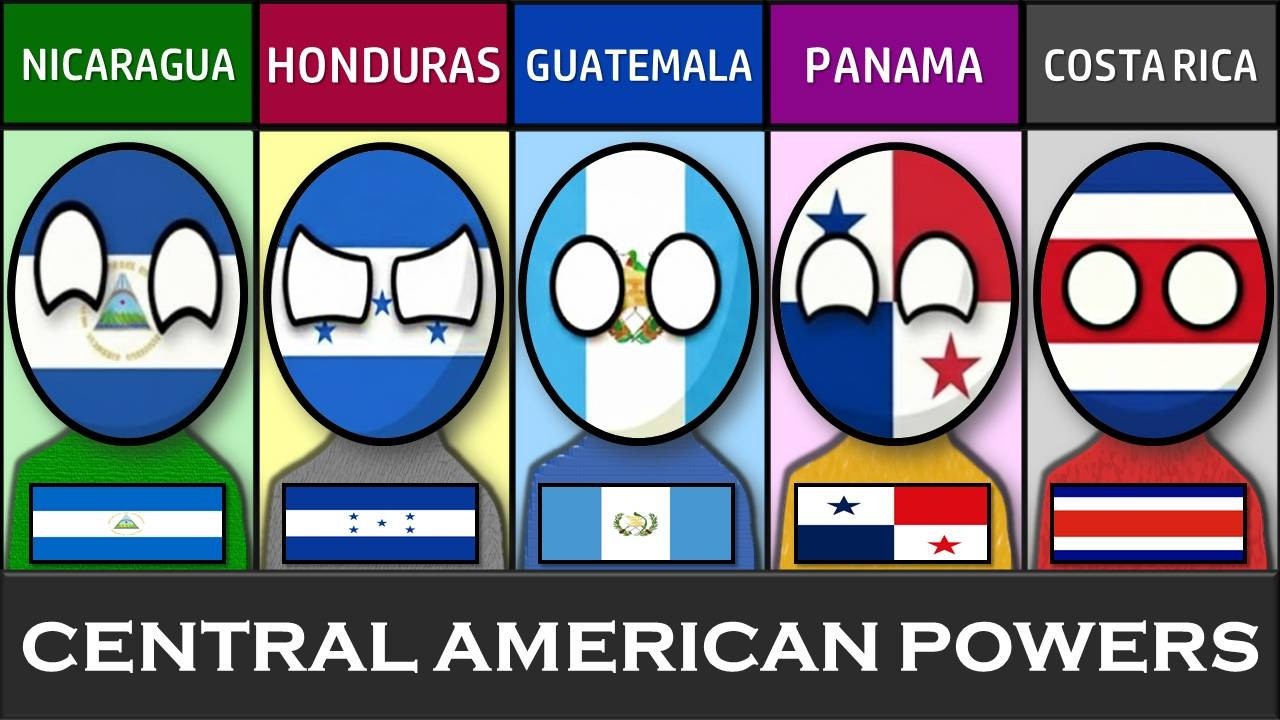
Nicaragua vs Honduras vs Guatemala vs Panama vs Costa Rica- Country Comparison: On the basis of Area, Economy, Military, Government, Culture, Population, Gender Ratio, Literacy Rate, Export, Import, Tourism, Olympics Medals, etc.
Central America:
Central America is the isthmian bridge connecting North and South America, comprising seven nations: Belize, Costa Rica, El Salvador, Guatemala, Honduras, Nicaragua, and Panama. Bordered by the Pacific Ocean and Caribbean Sea, it is characterized by tropical climates, mountainous terrain, and significant volcanic activity. With a population over 52 million, the region features rich biodiversity, Mayan ruins, and economies increasingly focused on tourism and agriculture.
Nicaragua:
Nicaragua, officially the Republic of Nicaragua, is the geographically largest country in Central America, comprising 130,370 km2. With a population of 7,142,529 as of 2024, it is the third-most populous country in Central America after Guatemala and Honduras, and the largest by area. Nicaragua is bordered by Honduras to the north, the Caribbean Sea to the east, Costa Rica to the south, and the Pacific Ocean and shares maritime borders with El Salvador to the west and Colombia to the east. Nicaragua's largest city and national capital is Managua, the fourth-largest city in Central America, with a population of 1,055,247 in 2020. Nicaragua is known as "the breadbasket of Central America" due to having the most fertile soil and arable land in all of Central America.
Honduras:
Honduras, officially the Republic of Honduras, is a country in Central America. It is bordered to the west by Guatemala, to the southwest by El Salvador, to the southeast by Nicaragua, to the south by the Pacific Ocean at the Gulf of Fonseca, and to the north by the Gulf of Honduras, a large inlet of the Caribbean Sea. Its capital and largest city is Tegucigalpa. Honduras was home to several important Mesoamerican cultures, most notably the Maya, before Spanish colonization in the sixteenth century. The Spanish introduced Catholicism and the now-predominant Spanish language, along with numerous customs that have blended with the indigenous culture. Honduras became independent in 1821 and has since been a republic. In 1960, the northern part of what was the Mosquito Coast was transferred from Nicaragua to Honduras by the International Court of Justice.
Gautemala:
Guatemala, officially the Republic of Guatemala, is a country in northern Central America. It is bordered to the north and west by Mexico, to the northeast by Belize, to the east by Honduras, and to the southeast by El Salvador. It is bounded by the Pacific Ocean to the south and the Gulf of Honduras to the northeast. Modern Guatemala was the heart of the Maya civilization before Spain conquered it in the 1500s under New Spain. It gained independence in 1821 and briefly joined the Federal Republic of Central America. After decades of instability and U.S.-backed dictatorships, a 1954 coup led to reforms.
Panama:
Panama, officially the Republic of Panama, is a country located at the southern end of Central America, bordering South America. It is bordered by Costa Rica to the west, Colombia to the southeast, the Caribbean Sea to the north, and the Pacific Ocean to the south. Its capital and largest city is Panama City, whose metropolitan area is home to nearly half of the country's over 4 million inhabitants. Before Spanish rule in the 1500s, Panama was home to diverse Indigenous tribes. It gained independence from Spain in 1821 and joined Gran Colombia. After its collapse, Panama became part of Colombia. Backed by the United States, it seceded in 1903, enabling construction of the Panama Canal, later transferred to Panama in 1999.
Costa Rica:
Costa Rica, officially the Republic of Costa Rica, is a country in Central America. It borders Nicaragua to the north, the Caribbean Sea to the northeast, Panama to the southeast, and the Pacific Ocean to the southwest, sharing a maritime border with Ecuador to the south of Cocos Island. It has a population of around five million in a land area of nearly 51,180 km2; the capital and largest city is San José, home to around 350,000 residents and two million people in the surrounding metropolitan area.
Humans have lived in Costa Rica since 7,000–10,000 BC. Colonized by Spain, it gained independence in 1821, briefly joining the First Mexican Empire and the Federal Republic of Central America before full independence in 1847. After a 1948 civil war, it adopted a 1949 constitution, abolished its army, and built a stable democracy with strong investment in education and a diversified economy.
Tags:
#guatemala
#panama
#honduras
#nicaragua
#costarica
#guatemalavsHonduras
#nicaraguavdHonduras
#panamavsCostarica
#guatemalavsNicaragua
#guatemalavsPanama
#facts_monk
#countrycomparison
#countriescomparison
#countrycomparison2026

Информация по комментариям в разработке