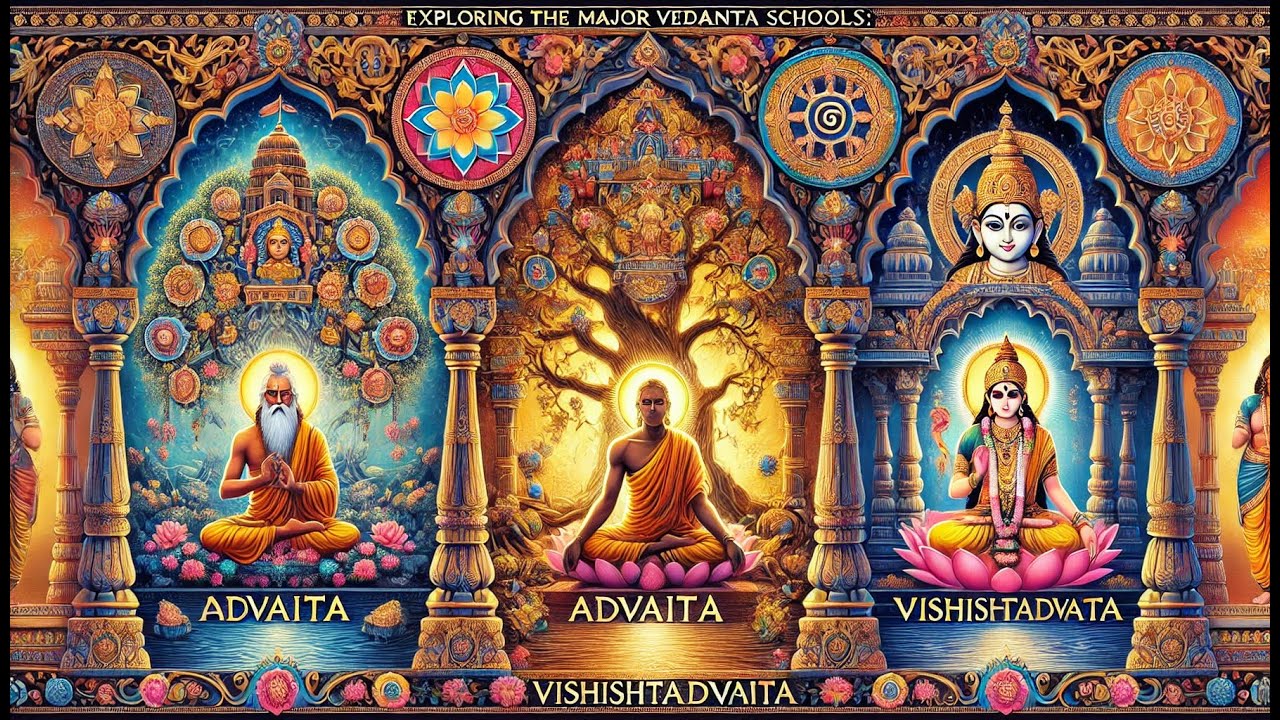
Indian philosophy is a rich and intricate tapestry of diverse schools of thought that explore the nature of reality, consciousness, and the ultimate truth. Among the most influential and enduring philosophical traditions in India are the Vedanta schools, primarily Dvaita (dualism), Advaita (non-dualism), and Vishishtadvaita (qualified non-dualism). These three schools offer distinct perspectives on the relationship between the individual soul (Jiva), the universe (Jagat), and the supreme reality (Brahman). This video explores the teachings of Dvaita, Advaita, and Vishishtadvaita, shedding light on their unique contributions to Indian philosophy.
Historical Development and Core Principles
Advaita Vedanta, one of the earliest and most influential Vedanta schools, was systematized by Adi Shankaracharya in the 8th century. Shankaracharya's teachings emphasize the oneness of the individual soul (Atman) and the supreme reality (Brahman). According to Advaita, the apparent multiplicity of the world is an illusion (Maya), and true liberation (Moksha) is attained by realizing the non-dual nature of reality.
In Advaita Vedanta, Brahman is the only reality, and everything else is merely a transient appearance. Liberation is achieved through self-knowledge (Atmajnana), involving the study of scriptures (Shravana), contemplation (Manana), and deep meditation (Nididhyasana). By overcoming the influence of Maya, one can perceive the underlying oneness of all existence.
Vishishtadvaita Vedanta, articulated by Ramanuja in the 11th and 12th centuries, presents a synthesis of monism and theism. Ramanuja's philosophy acknowledges the oneness of Brahman but also recognizes the distinctiveness of individual souls and the material world. This qualified non-dualism emphasizes that the universe is a manifestation of Brahman, and individual souls retain their distinct identities even in liberation.
In Vishishtadvaita, the path to liberation involves devotion (Bhakti) and surrender (Prapatti) to God. Ramanuja teaches that by cultivating a loving relationship with God and engaging in selfless service (Seva), one can attain liberation. The personal nature of God is significant in Vishishtadvaita, with Vishnu identified as the supreme deity whose grace (Kripa) is crucial for the soul's liberation.
Dvaita Vedanta, founded by Madhvacharya in the 13th century, posits a radical dualism between the individual soul and the supreme reality. Madhvacharya's philosophy asserts that the soul and God are eternally distinct entities, and the material world is real and distinct from both the soul and God.
In Dvaita Vedanta, the path to liberation is through unwavering devotion (Bhakti) and complete surrender to Vishnu (Narayana). Madhvacharya teaches that the individual soul must recognize its subservient position to God and engage in devoted service (Seva). A unique aspect of Dvaita Vedanta is the concept of eternal damnation (Nitya-Samsarin), where some souls are eternally destined to remain in ignorance and bondage.
Conclusion
The Vedanta schools of Dvaita, Advaita, and Vishishtadvaita represent distinct yet interconnected paths in Indian philosophy. Each school offers a unique perspective on the nature of reality, the self, and the ultimate goal of life. Through the teachings of Shankaracharya, Ramanuja, and Madhvacharya, these philosophies provide profound insights into the human quest for truth and liberation.
Advaita Vedanta's emphasis on non-dualism, Vishishtadvaita's synthesis of monism and theism, and Dvaita Vedanta's strict dualism each contribute to the rich diversity of Indian philosophical thought. By exploring these major Vedanta schools, we gain a deeper understanding of the multifaceted nature of Indian spirituality and the enduring quest for self-realization and unity with the divine.
In conclusion, the teachings of Dvaita, Advaita, and Vishishtadvaita offer timeless wisdom and guidance for seekers on the spiritual path. Whether through the realization of non-dualism, devotion and surrender to a personal God, or the recognition of eternal distinctions, these philosophies provide valuable insights into the nature of existence and the journey toward ultimate liberation.
#Vedanta #Dvaita #Advaita #Vishishtadvaita #IndianPhilosophy #Spirituality #Bhakti #Moksha #Brahman #Atman #Maya #AdiShankaracharya #Ramanuja #Madhvacharya

Информация по комментариям в разработке