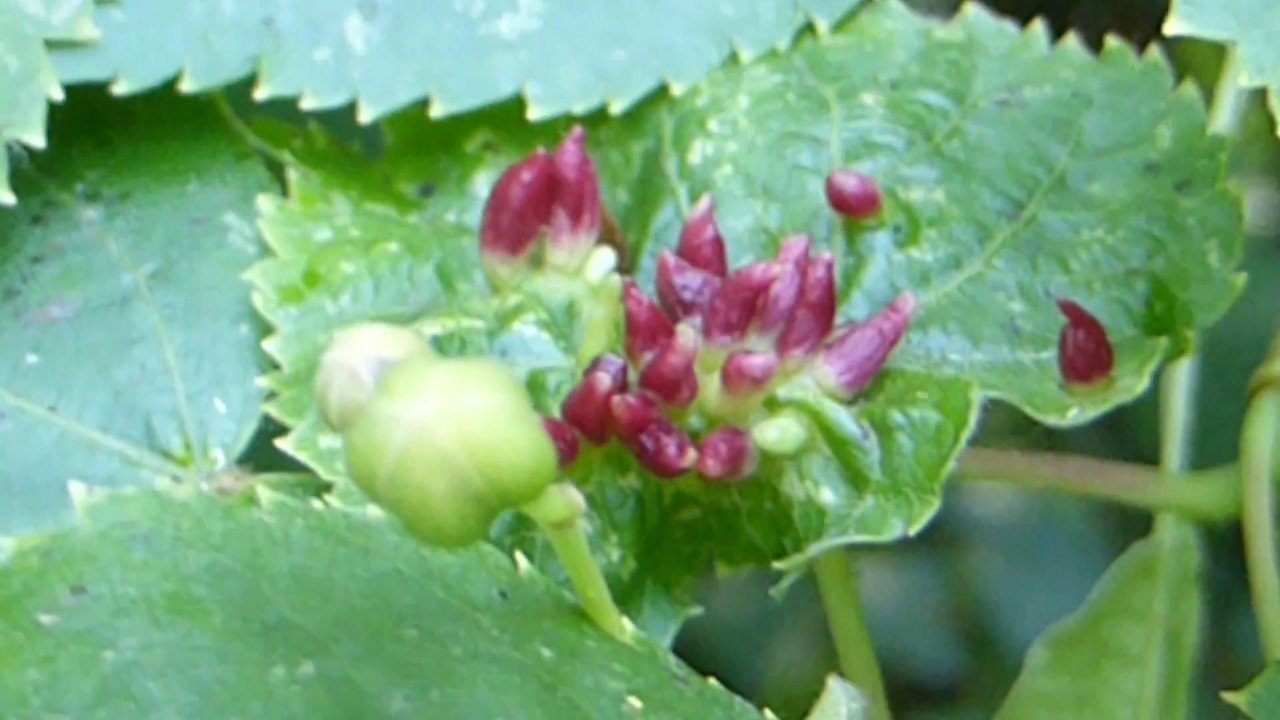
Lime Nail gall - from the mite - Eriophyes tiliae and Eriophyes lateannulatus - Eriophyes - Microscopic gall mites - Lime leaf galls - Bugle gall - on upper surface of the leaves of the common Linden - Tilia × europaea - Hjartalind - Linditré - Malvales - Skógartré - caused by the mite Eriophyes tiliae. Pale yellow or red pointed tubular structures up to 5-8mm long on the upper leaf surface - Very common on lime tree foliage, appearing in summer and persisting until leaf fall in autumn. The galls appear not to affect the health of the lime trees, and no way of controlling or preventing them exists. Plöntuæxli - geta vwerið mynduð af skordýrum eða bacterium.
Linditré einnig nefnd Lind (Fræðiheiti Tilia) er ættkvísl um 30 tegunda af trjám af stokkrósaætt sem útbreidd eru á tempraða hluta á norðurhelmingi jarðar. Lesa meira: https://is.wikipedia.org/wiki/Linditr...
The mites move onto the foliage in the spring, having overwintered in the bark crevices or around buds. These gall inducers are less than 0.2 mm long, however the chemicals they release while sucking the sap from the lower leaf epidermis have a dramatic, consistent and colourful effect, causing upward growing, hollow, yellow, red or pink, finger-like extensions. Before the autumn, the mites, which up to now have been actively feeding and growing inside the galls, depart from these shelters and seek protected sites elsewhere on the lime tree. The mites will pass the winter in such locations and then the cycle will be repeated. This species is one amongst a number of gall-formers which can be superficially similar in appearance; however E. tilae tilae is restricted to lime trees. See more: https://en.wikipedia.org/wiki/Eriophy...
The pointed nail galls are caused by microscopic mites, which overwinter in the bark of lime trees and crawl on to the underside of the foliage in spring to feed. The mites secrete chemicals into the leaves causing them to produce the unusual projections into which the mites move to continue feeding during the summer. Infestations of mites and the nail galls they induce don’t appear to affect the health of the trees and there’s no way of controlling or preventing them. See more: https://www.gardenersworld.com/how-to...
Lime nail gall mite - During the summer months, the foliage of lime trees (Tilia) can become disfigured with red tack-like galls on the upper side of leaves. This is due to the feeding activities of a gall mite. See more: https://www.rhs.org.uk/advice/profile...
What is a plant gall? See more: https://www.woodlands.co.uk/blog/flor...
Galls on trees are caused by insects laying eggs inside or feeding on the branches of leaves of trees and other plants. This usually occurs in the spring. The galls, or tumor-like growths, are produced by the tree in response to chemicals injected into it by an adult or larval gall-making insect. The shape of the gall is determined by the chemicals used by each species of gall-maker. Galls can be round and dense, woolly, fuzzy, veined, bullet-shaped or horned. See more: https://agrilifeextension.tamu.edu/fa...
Galls can be caused by fungus, bacteria, mite, fly, midge, moth, wasp or beetle larvae. The plant species can have several different gall species on different parts of the plant - leaves, twigs, buds, roots, flowers and catkins, often each caused by a different agent and occasionally a gall can appear on another gall! See more: http://www.ukwildlife.net/galls/galls...

Информация по комментариям в разработке