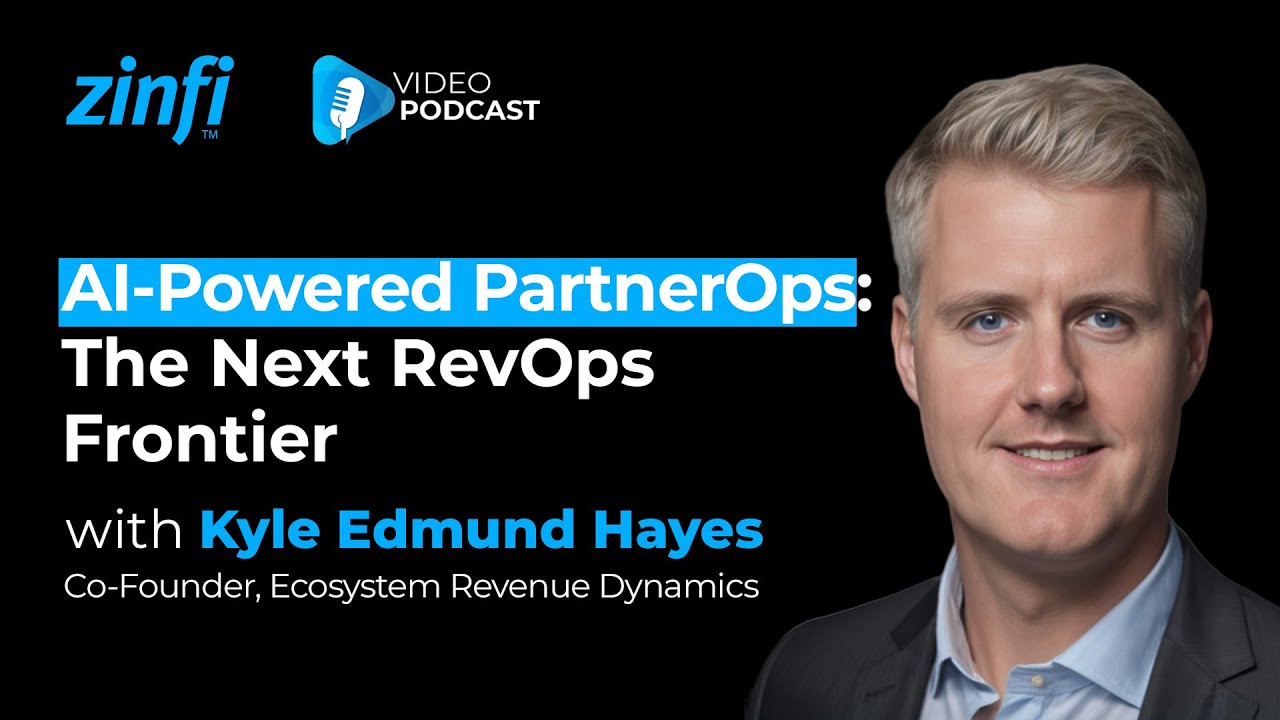
In this insightful episode of the ZINFI Partner Ecosystem Podcast, Sugata Sanyal, Founder & CEO of ZINFI, sits down with Kyle Edmund Hayes, Founding Partner at Ecosystem Revenue Dynamics. Together, they explore the fast-changing world of PartnerOps, fueled by AI and driven by the foundational principles of Revenue Operations (RevOps). With nearly two decades of experience spanning Microsoft, Infor, and Avanti, Kyle brings a powerful systems engineering lens to revenue alignment. He shares how today's mid-market and enterprise organizations are overwhelmed by tool sprawl, data debt, and operational silos—and how AI, ecosystem orchestration, and RevOps engineering are converging to solve this.
Listeners will gain deep insight into the rise of PartnerOps as the next evolution of RevOps, the challenges of modern tech stacks, and the frameworks needed to simplify go-to-market complexity. This is a must-listen if you're a CRO, partner leader, or RevOps strategist.
https://www.zinfi.com/video-podcast/a...
Chapter 1: From Engineering to Ecosystem Thinking
Kyle Edmund Hayes shares his evolution from engineering roles at IBM to strategic leadership in partner ecosystems. His early exposure to IT infrastructure and systems thinking provided a strong foundation in how technology supports business operations. Over time, Kyle moved into software engineering, program management, and client architecture roles at Microsoft, where he contributed to early Azure and SaaS migration efforts. These roles bridged technical depth with business alignment, setting the stage for his founding of Ecosystem Revenue Dynamics.
Sugata Sanyal notes that Kyle’s journey exemplifies the blend of engineering precision and strategic coordination needed in PartnerOps—a function that extends RevOps to manage the complexity of modern ecosystems.
Chapter 2: What RevOps Got Right—And What’s Next
Kyle outlines how RevOps emerged around 2016 as an evolution of sales ops, expanding to include customer success, marketing ops, and full revenue lifecycle management. This shift was driven by the rise of SaaS and the need to align go-to-market functions in subscription-based models.
Sugata adds that like the auto industry’s shift to post-sale revenue, RevOps is essential for managing long-term customer relationships. Kyle emphasizes that true alignment requires shared metrics, integrated systems, and cross-functional workflows. They agree RevOps is just the beginning—its next frontier is PartnerOps, which must mirror RevOps’ structure but accommodate the added complexity of multi-party collaboration.
Chapter 3: Tech Stack Overload & the ROI Challenge
Mid-market and enterprise organizations often juggle 50–130 tools, creating data silos, tech debt, and reduced ROI. Kyle notes most companies are under-resourced, with minimal ops staff supporting large, complex stacks. Sugata highlights the hidden cost of system maintenance when only 3–4 people manage ops at a $200M firm.
To address this, Kyle introduces RevOps performance benchmarks and stresses the need for clean data, standardized processes, and dedicated operations engineers. They discuss AI as a potential solution—but one that only works if foundational systems are in place. The emerging role of the “RevOps engineer”—a hybrid expert in automation, analytics, and systems—is key to unlocking value from AI in operations.
Chapter 4: Building PartnerOps: From Chaos to Coordination
Sugata shifts the conversation to PartnerOps, asking how RevOps principles apply to indirect channels. Kyle notes that partner-facing teams often rely on disconnected tools—PRMs, LMSs, and deal registration systems—lacking integration.
Simplifying the partner experience is key. Issues like multiple logins and disjointed data hurt engagement. Sugata shares ZINFI’s approach: a unified platform to streamline alignment. The goal isn’t just efficiency—it’s better partner relationships.
They introduce "ecosystem orchestration"—treating partners as contributors throughout the customer journey, not just lead sources. PartnerOps demands executive support, clear ownership, and dedicated resources. It's a strategic pillar with real operational impact.
Chapter 5: AI Agents, Ecosystem Engineering & the Future of GTM
AI surfaces as both an enabler and a complexity driver in go-to-market strategy. Kyle and Sugata agree that AI must be paired with structure and oversight. Kyle underscores the need for iteration and governance, especially as AI copilots and agents evolve in RevOps and PartnerOps use cases.
They introduce the “revenue engineer”—a future-proof role blending process, AI fluency, and system integration. Sugata highlights ZINFI’s vision for an integrated platform that supports both direct and indirect GTM motions. PartnerOps isn’t a rebrand—it’s a critical, emerging discipline that must be built with the same rigor as RevOps to support the evolving partner ecosystem.

Информация по комментариям в разработке