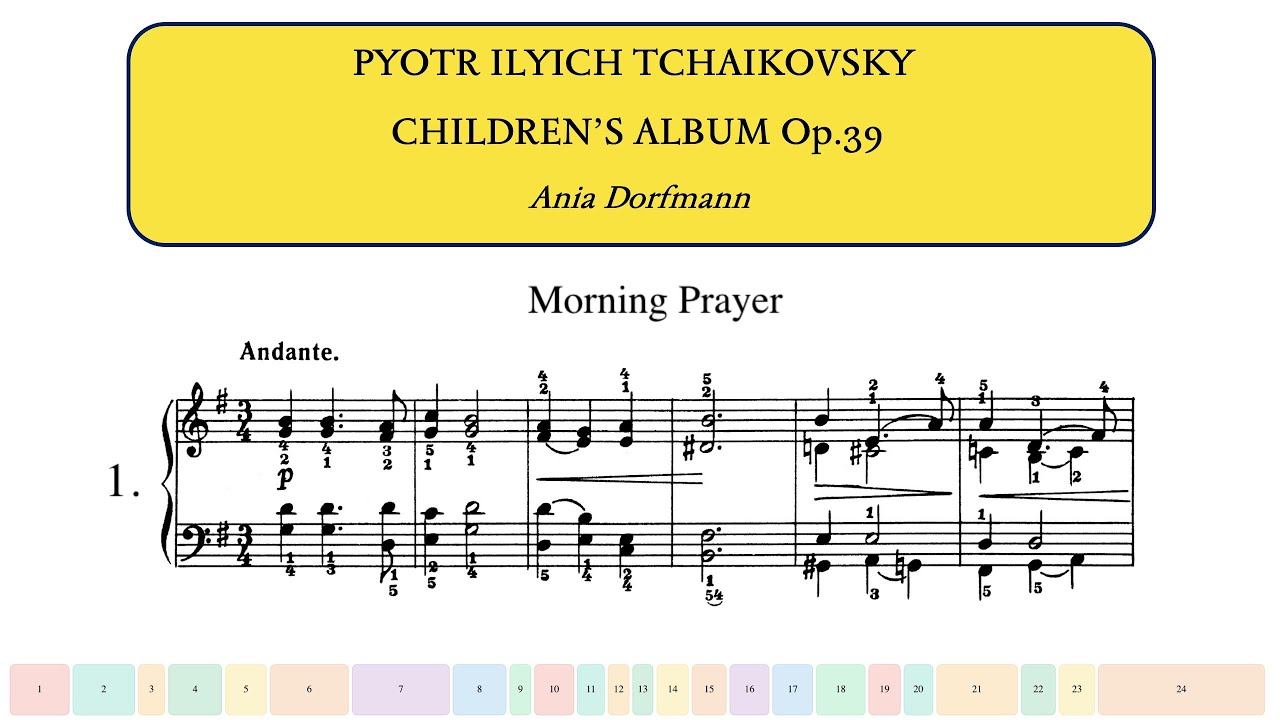
P.Tchaikovsky, Children's Album, Op.39, with with a theme-and-structure analysis and synchronized sheet music (score)
Performance: Ania Dorfmann (piano), 1954/04/12 Mono, Town Hall, New York City
Analysis, Score Editing, Synch: ScoreMan
00:00 1. Morning Prayer
01:13 2. Winter Morning
02:29 3. Playing Hobby-Horses
03:04 4. Mama
04:10 5. March of the Wooden Soldiers
05:02 6. The Sick Doll
06:37 7. The Doll's Funeral
08:34 8. Waltz
09:40 9. The New Doll
10:09 10. Mazurka
10:59 11. Russian Song
11:35 12. The Harmonica Player
12:04 13. Kamarinskaya
12:32 14. Polka
13:13 15. Italian Song
13:57 16. Old French Song
14:47 17. German Song
15:38 18. Neapolitan Song
16:39 19. Nanny's Story
17:20 20. The Old Witch
17:58 21. Sweet Dreams
19:36 22. Lark Song
20:20 23. The Organ-Grinder Sings
21:06 24. In Church
OVERVIEW
Children’s Album, Op.39 is a collection of 24 short piano pieces written by Pyotr Ilyich Tchaikovsky in 1878.
The pieces are written for children to play, but they are also expressive and beautiful enough to be enjoyed by adults.
Each miniature portrays a simple scene, mood, or character, such as "Morning Prayer," "The Sick Doll," "The Doll’s Burial," "The Hobby-Horse," and the famous "The Doll’s New Dress."
The album is meant to resemble a musical picture book, with each piece acting like a small story.
HISTORICAL CONTEXT
Tchaikovsky wrote this set partly for his young nephew, whom he loved very much.
He wanted to give him music that was charming, easy enough to learn, and artistically meaningful.
At the time, there was a tradition of children’s albums in Europe—especially after Schumann’s Album for the Young, Op.68—but Russia did not have many such collections yet.
Tchaikovsky composed the entire set during a stay at Kamenka (his sister’s estate), where he was relaxed and surrounded by family.
The pieces were published in 1878 and quickly became popular with young Russian pianists.
MUSICAL SIGNIFICANCE
This album became a cornerstone of Russian piano pedagogy, used by generations of children to learn musical expression and storytelling.
It shows Tchaikovsky’s gift for melody and emotional clarity, even in the simplest forms.
Several pieces have become iconic in their own right, especially "The Sick Doll" and "The Doll’s Burial", which form a touching pair showing Tchaikovsky’s sensitivity to childhood emotions.
The set helps young pianists learn different characters, rhythms, and techniques without overwhelming difficulty.
Although intended for children, the music reflects the warmth, lyricism, and emotional sincerity that characterize Tchaikovsky’s style.
🎹 Mozart Piano Sonatas • Mozart - 18 Piano Sonatas
✨ Beethoven's Masterpieces (sorted by Opus) • L. v. Beethoven's Masterpieces
🎶 Beethoven Symphonies • L. v. Beethoven - 9 Symphonies
🎹 Beethoven Piano Sonatas • L. v. Beethoven - Piano Sonatas
🎹 Schubert Piano Sonatas • F. Schubert - Piano Sonatas
✨ Chopin's Masterpieces (sorted by Opus) • F. Chopin's Masterpieces
🎶 Chopin Mazurkas • F. Chopin - 21 Mazurkas
🎶 Chopin Polonaises • F. Chopin - 19 Polonaises
🎶 Chopin Nocturnes • F. Chopin - 22 Nocturnes
🎶 Chopin Waltzes • F. Chopin - 19 Waltzes
✨ Prokofiev's Masterpieces (sorted by Opus) • S. Prokofiev's Masterpieces
🎹 Prokofiev Piano Sonatas • S. Prokofiev - Piano Sonatas
🎹 Piano Sonata Collections • Piano Sonata Collection
🎹 Piano Concerto (Piano & Orchestra) Collections • Piano Concerto Collection
🎻 Violin Concerto (Violin & Orchestra) Collections • Violin Concerto Collection

Информация по комментариям в разработке