説明
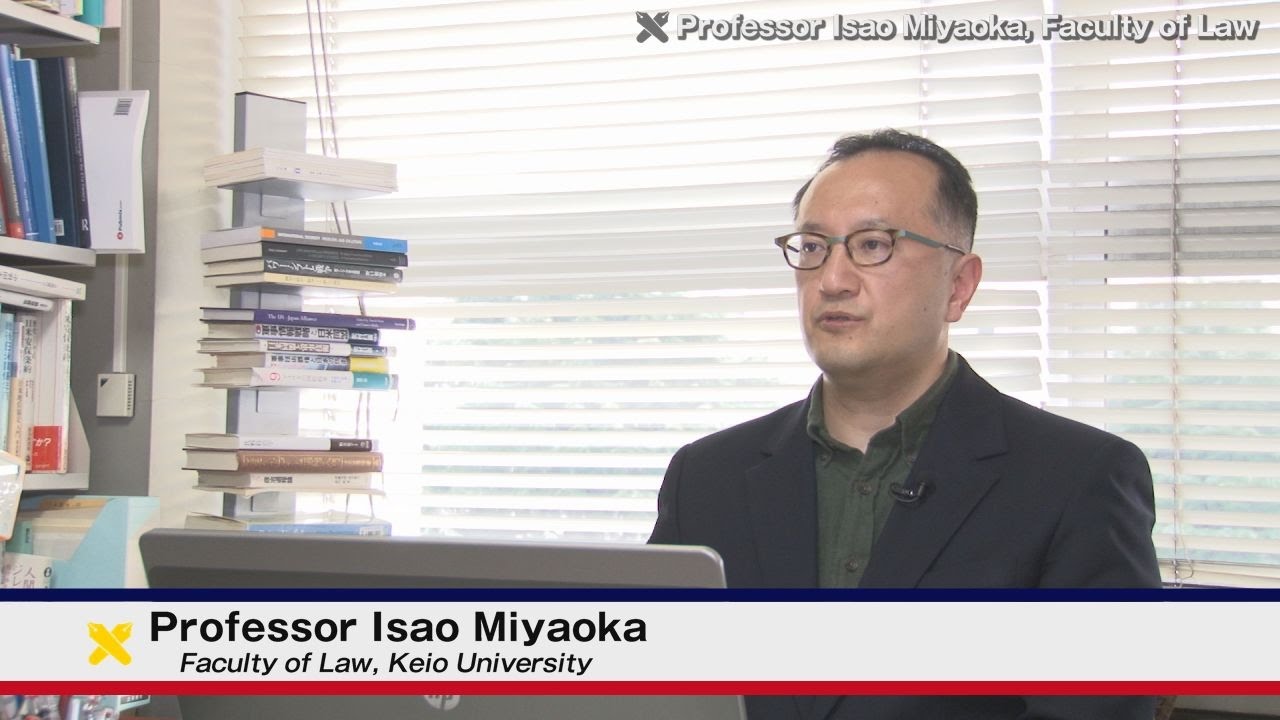
Isao Miyaoka, professor of political science in the Keio University Faculty of Law, is analyzing the alliance between Japan and the United States, and Japanese security policies, using international relations theories such as realism and constructivism.
Professor Miyaoka has summarized his recent research results in an article entitled "The Diffusion of Military Technology to Allies: British and Japanese Emulation of the Joint Information System of the U.S. Armed Forces."
The national power of the United States, particularly its military might, is far above that of other nations.
This is not just that the U.S. has more soldiers, or more tanks, or more airplanes,
but they are also far above other countries in the quality of their military.
We first note that the biggest reason for this is information technology.
After the Gulf War in 1991, the U.S. established an interoperable information system between the Army, Navy, Air Force, and Marines Corps. Professor Miyaoka emphasizes that this joint system is a significant factor in the overwhelming military capability the U.S. demonstrated in the subsequent Kosovo aerial bombardment, Afghanistan war, and the 2003 Iraq War.
This further strengthened the U.S. armed forces, but there is a problem when viewed from the perspective of international political theory.
That is the reality that, no matter how cutting edge the technology is, it will gradually be copied by other countries, emulated.
Regarding the emulation of military technology, there is important prior research by Resende-Santos, called the "neorealist theory of emulation."
The aspect being looked at by Professor Miyaoka is emulation of military technology by allied nations. After examining the relationship between the U.S. and its allies, the U.K. and Japan, Professor Miyaoka came to a different conclusion than Santos.
Both countries were diligently emulating the U.S. joint information system. What we must now consider is that the U.K. is in Europe, while Japan is in Asia. At the time, the international security environment in Europe was very different from that in Asia.
However, both the U.K. and Japan were emulating America's joint information system in the same way.
This seems to be a conclusion different from what Santos claimed. Another point is that Santos said that if a country had allies, it would feel safe, and wouldn't emulate, but the reality is strengthening alliances. We have an ally, and we want to strengthen the alliance, so we can't help but emulate the joint information system - that's the situation.
Professor Miyaoka sees the reasons why he obtained different results from his analysis as being that the examples he researched were in a different time, and that it was in the post-Cold War era.
I think a major difference is the globalization that exists in the relationship of allied countries in the beginning of the 21st century. So, when the U.S. forces cooperate with the U.K.'s, or when the U.S. forces cooperate with Japan's Self Defense Forces, America's army isn't just contributing to the neighborhood around the country itself, but making global military contributions. So, there are cooperative activities, cooperative collaborations in a variety of regions. The cooperative relationships of various alliances are determined from a global viewpoint.

Информация по комментариям в разработке