https://crosstowntraffic2018.wordpres...
This presentation took place as part of the conference Crosstown Traffic: Popular Music Theory and Practice, which was hosted by The University of Huddersfield from September 3 - 5 2018. This event combined the IASPM UK&Ireland Biennial Conference, the 13th Art of Record Production Conference (ARP), an ISMMS conference, and the additional participation of Dancecult.
A recurrent theme within popular music studies has been discussion of how the field can integrate different disciplines and professions, for example exploring both music and its context; involving both practitioners and researchers; and encouraging interdisciplinary and collaborative work. Many different issues make such approaches challenging, and various different popular music focused subject organisations have developed somewhat independently of one another. This conference brought four such groups together, to exchange knowledge, collaborate, and encourage crosstalk.
/// SUPPORT
Popular Music Studies Research Group (PMSRG), University of Huddersfield https://research.hud.ac.uk/pmsrg/#
Centre for Music, Culture and Identity (CMCI), University of Huddersfield
https://research.hud.ac.uk/institutes...
The International Association for the Study of Popular Music UK and Ireland Branch (IASPM UK & Ireland)
www.iaspm.org.uk
Association for the Study of the Art of Record Production (ASARP)
www.artofrecordproduction.com/
Dancecult Research Network (DRN) studies into electronic dance music culture
www.dancecult-research.net
International Society for Metal Music Studies (ISMMS)
www.metalstudies.org/
/// ORGANIZERS
IASPM UK&I: Rupert Till
ARP: Katia Isakoff, Shara Rambarran
ISMMS: Karl Spracklen
Dancecult: Graham St. John
University of Huddersfield: Jan Herbst, Austin Moore, Lisa Colton, Toby Martin, Catherine Haworth, Mark Mynett
/// CREDITS
This online project was edited, collated, and made available online by Chris McConnell, Jack Zissell, and Colin Frank.
/// PRESENTATION DETAILS
Sound Archaeology: Producing the Ancient Past
Dr. Rupert Till, University of Huddersfield
Email: R.Till@hud.ac.uk
/// ABSTRACT
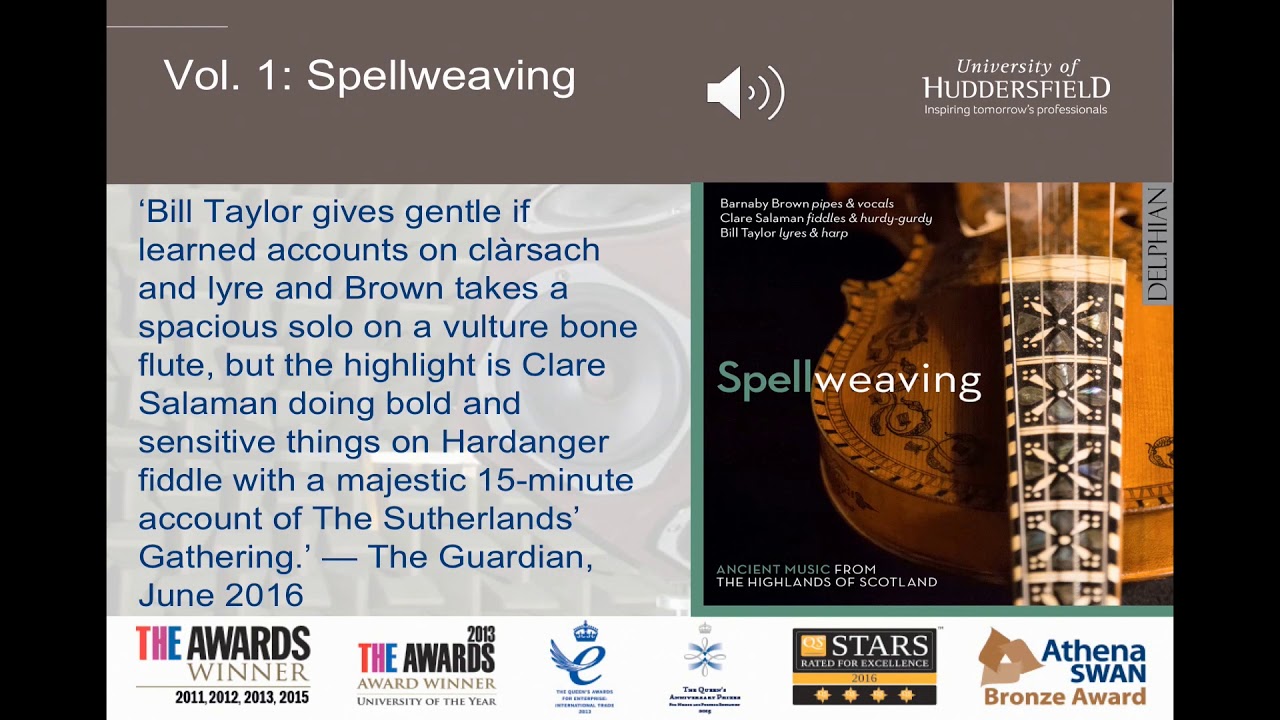
This presentation explores a recording project that produced 5 albums of music played on reconstructions of musical instruments found by archaeologists. It asks what one must consider when trying to reconstruct the soundworld of the past? This project focused on 5 projects, the music of ancient Scotland and Pibroch traditions; music of ancient Scandinavia from prehistory and early Christian cultures; the Carnyx and other giant Celtic war trumpets or northern Europe; Palaeolithic bone flutes, the oldest musical instruments found; and Greek and Roman musical instruments. A number of production approaches were taken, including live recordings in a concert hall, overdubbing in a studio, recording on location in country, use of ancient manuscripts and sources, improvisation and performance of new compositions. It also explored wider acoustic ecologies, including the use of captured impulse responses from archaeological sites and environmental sound. Drawing on periods when definitions of popular and art music are irregular, this project used methods from a range of traditions. Technologically the project covers a broad range from portable laptop equipment and digital microphones, to classical recording techniques and DAW pop remix approaches. Using a mixed methodology of phenomenology, ethnomusicology, and experimental sound archaeology, this project asks what can be learned by exploring the sounds of our ancient ancestors.







Информация по комментариям в разработке